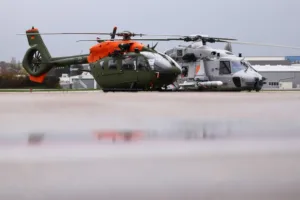






Germany’s newly procured combat helicopters can take to the skies, but they will not be capable of firing their weapons for the foreseeable future.
According to internal findings from the Federal Court of Auditors (Bundesrechnungshof) obtained by Der Spiegel, the €2.5 billion plan to adapt the civilian Airbus H145 into a frontline attack helicopter has run aground on failed trials, defective ammunition and uncertified armaments.
“The Bundeswehr underestimated the effort required to convert a commercially available civilian basic helicopter type into a military combat helicopter,” the report says according to Der Spiegel. The auditors described the programme as being “on a critical path”.
As a result, the Bundeswehr would receive models in a “preliminary configuration” with which it can “not fight, but only train”. This would significantly delay operational readiness “compared to the original planning”.
The technical breakdown strikes at the heart of Defence Minister Boris Pistorius’ flagship procurement strategy.
To bypass Germany’s military bureaucracy and rearm the Bundeswehr rapidly following Russia’s full-scale invasion of Ukraine in February 2022, Pistorius, of the Social Democratic Party (SPD), championed purchasing proven, off-the-shelf civilian systems rather than commissioning lengthy, custom-built defence programmes.
Ordered in December 2023 to replace Germany’s ageing and maintenance-plagued Tiger attack fleet, the acquisition of up to 82 Airbus H145M helicopters was designed to be a showcase for rapid rearmament. The first 62 were ordered firmly at the time, with a further 20 following in December 2025 at a cost of €931 million.
Pistorius has already declared the helicopter project a success. At the handover of the first H145M in November 2024, he said he had significantly increased the speed of procurement, according to Die Welt.
The model is already widely used across civil rescue operations, policing and utility roles, including by the air rescue service of German motoring club ADAC.
The concept appeared straightforward: Equip an established, reliable civilian frame with modern military optics, ballistic pods and anti-tank missiles, delivering a combat-ready force on an accelerated timetable by 2028.
This procurement of 82 attack helicopters was presented by the defence ministry as living proof of the Zeitenwende (turning point), the rapid modernisation of the armed forces and surge in defence spending announced by then chancellor Olaf Scholz following the invasion of Ukraine.
Instead, federal auditors concluded that defence planners fundamentally underestimated the technical complexity of turning a light utility craft into a survivable battlefield weapon.
While the aircraft themselves are airworthy, integration of the weapon systems has fallen significantly behind schedule, effectively leaving the fleet unable to carry out its primary combat mission.
The primary obstacle preventing the H145M from firing is its ballistic weaponry.
German military authorities have refused to clear the onboard 20mm cannon for operational service after discovering that the primer caps on the ammunition are sensitive to electrostatic discharge.
Ground crews face a risk of accidental ignition simply during routine handling and loading operations.
Until the supplier develops and certifies a safer ignition system, live firing remains blocked. It is unclear when the manufacturer will be able to offer a solution, according to the report.
Guided weapons have fared little better.
The first firing trials for the anti-tank missiles, in May 2025, had to be aborted following control problems.
The missiles, which come from Israel according to Der Spiegel, are due to be delivered from the end of 2027 at the earliest. The defence ministry itself described the goal of completing tests by 2029 as “very ambitious”.
Despite the failure to validate the missile system in operational tests, the defence ministry nevertheless resolved to proceed with ordering €384 million worth of the unproven missiles.
This shortcut drew censure from state auditors for committing taxpayers to expenditure before the weapon can actually hit a target. The auditors warned that the missile could fail its operational testing and prove unusable for the Bundeswehr.
The disclosures have triggered sharp criticism across the Bundestag, where opposition MPs accuse the defence ministry of cutting corners on core safety and functionality to generate quick political headlines.
According to Euronews, Airbus did not raise the problems when Pistorius visited its defence site in Manching, near Ingolstadt in Bavaria, in late October.
The delays also carry consequences for Berlin’s standing within the Atlantic alliance.
Under NATO capability pledges made after 2022, Germany committed to providing 12 operational light combat helicopters by 2029, expanding to a full fleet of 72 by 2032.
With weapons certification stalled, federal auditors warned lawmakers that Berlin is now at acute risk of missing its alliance readiness deadlines.