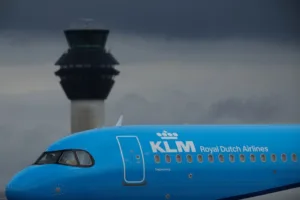
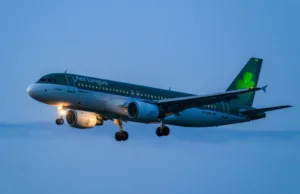


Dutch flag carrier KLM has announced a major restructuring that will eliminate or reassign roughly 5,000 roles, cutting its workforce by nearly 15 per cent as management warns that the historic airline’s long-term survival is under acute threat.
The overhaul, unveiled on November 5 alongside parent group Air France-KLM’s third-quarter results, aims to deliver an annual financial improvement of €1 billion by 2028, freeing up capital to modernise its fleet and service debts amid volatile fuel prices, high airport charges and tightening environmental restrictions at Amsterdam Airport Schiphol.
The new target comes on top of the more than €750 million in structural savings KLM says it has already secured under its previous “Back on Track” programme, taking the total targeted improvement to €1.4 billion a year.
In an unusually stark message accompanying the announcement, KLM president and chief executive Marjan Rintel said that decades of stability can no longer be taken for granted.
“KLM’s future is not guaranteed,” Rintel said.
“The environment we operate in is becoming increasingly complex, with global instability, high fuel prices, and growing pressure on aviation. That is why, at this pivotal moment for KLM, we are taking far-reaching, sometimes painful measures. Continuing on the current path is not sustainable.”
“Every department and every division will be asked to contribute,” she added, warning that “further changes to the organisation, working conditions, productivity and staffing levels may still be needed”.
The 5,000 affected roles reflect a combination of direct post eliminations, outsourcing and group-level consolidations. According to Rintel, KLM’s headcount will fall from around 36,000 to 31,000 full-time equivalents.
Approximately 1,000 jobs will disappear directly through targeted productivity gains, while 800 ground handling roles, including baggage handling in Schiphol’s East Hall and below-the-wing work for KLM Cityhopper, are slated to be transferred to third-party contractors.
Another 2,000 positions, including 1,500 staff at customer contact subsidiary Cygnific, will be transferred into the broader Air France-KLM group structure.
A further 1,250 catering positions have already been shifted into an external partnership with Switzerland-based gategroup since the spring.
KLM said it expects to avoid compulsory redundancies through natural attrition, voluntary departure schemes and internal redeployment.
Alongside staff reductions, the carrier plans an operational pivot across its European network.
KLM will shift away from larger Airbus A320neos it had on order in favour of smaller Embraer E195-E2 aircraft, expanding the footprint of its regional subsidiary KLM Cityhopper to better calibrate capacity to fluctuating continental demand. The A321neo will remain in the fleet, while the Boeing 737 and Embraer E190 will be phased out over the coming years, leaving a simplified fleet of 185 aircraft.
Rintel said the larger jets were proving hard to fill on European routes without price cuts that generated heavy losses.
The company is also demanding a minimum 8 per cent structural productivity boost from remaining employees by 2028, alongside “very moderate” pay increases, setting up difficult negotiations with Dutch aviation trade unions over incoming collective labour agreements.
Bas Brouns, KLM’s chief financial officer, defended the package as necessary to preserve the carrier’s core international hub operations, which connect Schiphol non-stop to some 160 destinations.
“We need to strengthen our financial foundation to make KLM more resilient in the face of uncertainty and better prepared for the future,” Brouns said.
“Decisions that were previously postponed can no longer be avoided.”
The announcement came despite an improvement in KLM’s quarterly figures: the KLM Group posted an operating result of €458 million for the third quarter, up from €352 million a year earlier. Air France-KLM chief executive Ben Smith nonetheless said the Dutch carrier’s margin remained below 5 per cent, blaming the Dutch air passenger tax and Schiphol’s airport charges, which he described as the highest in Europe.
“If we don’t get KLM to 8 per cent, we will have to look at another way of doing it,” Smith said.
Trade union CNV negotiator Souleiman Amallah said the scale of the overhaul has sparked deep uncertainty across the workforce.
“We share the ambition to make KLM stronger and more robust, but with the choices KLM is now making, the employees pay the price,” Amallah said, noting that ground staff were already dealing with the consequences of an ongoing reorganisation.
Fellow union FNV said that the workers had to foot the bill. “The people who keep KLM running every day are now being handed the bill,” said FNV representative Egon Groen, who warned that outsourcing ground handling risked reviving “unhealthy competition” between handlers at Schiphol.