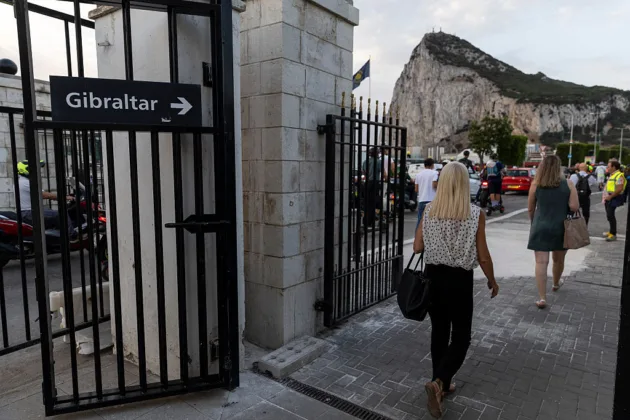






Gibraltar’s Chief Minister Fabian Picardo has said the imminent dismantling of the territory’s border fence with Spain marks the end of an uncertainty that has been “very damaging” for the local economy and its cross-border workforce.
In an interview with Spanish newspaper El País published on May 25, Picardo welcomed the looming entry into provisional application of the EU-UK Agreement in respect of Gibraltar, signed in December 2025 after four years of post-Brexit negotiations. The Gibraltarian leader said the final settlement would allow citizens and businesses to plan for the long term.
The agreement is due to enter provisional application on July 15. It will remove all physical barriers, checks and controls on people and goods circulating between Spain and Gibraltar, according to the Council of the European Union.
Schengen entry-exit checks will instead be carried out at Gibraltar’s airport and port by officers from Spain’s Policía Nacional, working alongside Gibraltar border agents. The arrangement is similar to that in place at Eurostar terminals in London and Paris.
Gibraltar is not joining the Schengen area. Immigration, policing and justice will remain the responsibility of the Gibraltar authorities, while the territory is set to form a customs union with the EU.
The deal completes the legal framework of EU-UK relations established by the Trade and Cooperation Agreement of 2020, which excluded Gibraltar from its scope. The Committee of Permanent Representatives (Coreper) endorsed the texts on April 1, with all 27 member states backing the agreement without objections.
The original target date of April 10 was pushed back by three months to allow legal-linguistic reviews and translation into all official EU languages. Picardo has described the revised timetable as “a very positive development” that provides “certainty and additional time to prepare”.
Around half of Gibraltar’s population crosses the border each day, and some 15,000 frontier workers depend on the crossing. The Campo de Gibraltar area, in southwest Spain, is home to about 300,000 Spanish citizens, many of whom rely economically on the British Overseas Territory.
Picardo, who has led Gibraltar since 2011, met Spanish Foreign Minister José Manuel Albares in Madrid on April 22, in the first bilateral meeting between the two on Spanish soil. Madrid had previously avoided such encounters because of its long-standing sovereignty claim, which dates back to the 1713 Treaty of Utrecht.
Gibraltar’s government has since confirmed that the process of dismantling all physical barriers, including the Verja, will begin before July 15 to ensure compliance with the new treaty. Picardo has stressed that the rollout will be gradual, given the complexity of the operation.
The Spanish Government has also moved to lift Gibraltar from its tax haven blacklist after 35 years, with a draft ministerial order out for public consultation until June 1. The British Overseas Territory had been included on the list since 1991.
Picardo, who has announced that 2026 will be his final year as Chief Minister ahead of the next Gibraltar general election in 2027, told El País that a European Gibraltar without a border fence would open “a new chapter” for the territory and the wider region.