
The European Union’s decision to open accession talks with Ukraine and Moldova was greeted with cheers by the Eurocrats who govern in Brussels. They had best conduct those talks with great care if they don’t want to add fuel to the populist fire that threatens their hold on power.
Populists are gaining strength for many reasons, but mass migration is the biggest. The millions of migrants that have swarmed into the richer nations of the EU have created cultural and economic pressures that drive working-class voters to the populist Right.
Allowing Ukraine and Moldova into the Union without limiting their citizens’ right to live and work anywhere would almost certainly create yet another massive influx of cheap labour. The two nations would easily be the poorest in the Union, with only about $22,000 per capita GDP (€19,000) as measured by purchasing power parity.
That is less than half the figure for the Union’s current poorest nation, Bulgaria, and less than one-third of the EU average.
Similar disparities resulted in massive movements of workers from the former Communist states in Eastern Europe to the more prosperous West when those countries were admitted. Polish migration reached about two million soon after that nation entered the Schengen Area, and about 1.5 million Poles still live in other countries despite the nation’s rapid economic growth. Nearly one-quarter of Romanians – about 4.6 million people – live outside their country, most of whom reside in the EU.
The relative poverty of Ukraine and Moldova would result in similarly large outflows. Over four million Ukrainian refugees already live in the EU. Why would any of them return if they had the permanent right to live and work in their far richer adopted countries?
The Union should also expect some of the roughly one million additional refugees living outside the EU to move there to obtain the rights to secure work and living arrangements. They will likely be joined by many of the roughly 28 million Ukrainians still residing in regions controlled by Kiev rather than stay in a war-ravaged land.
Western European nations could absorb that level of migration in the early 2000s because they were still growing. But the economies of Germany, France, and Italy are now stagnant, with projected growth rates well under one percent. More workers competing for a shrinking employment pie will likely mean more unemployment and slower wage growth for the native-born.
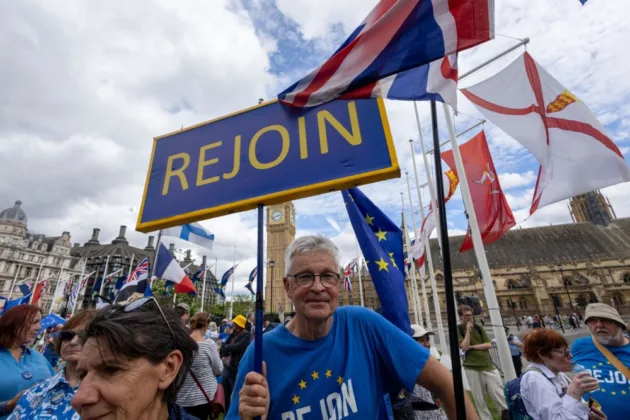
That toxic brew was a major factor in Great Britain’s decision to leave the Union in 2016. The 2008 financial crash threw the British economy into recession and then slow growth, yet migration from Eastern Europe continued because wages and jobs were still higher and more available than in their home countries.
Another serious economic reverse, coupled with continuing high migration from the poorer East, could easily increase separatist sentiments in already combustible countries like France.
There is a way to ameliorate this occurrence, thereby easing the way for Ukraine and Moldova to enter the Union: Remigration. If the Union made serious efforts to return the refugees from Africa, Central Asia, and the Middle East who arrived in the last decade, that would offset some or even most of the pressures stemming from increased migration from Ukraine.
Indeed, savvy populist leaders of nations could make adoption of remigration a condition for their acceptance of Ukrainian and Moldovan accession. One out, one in, could their requirement for allowing free movement and settlement. A Eurocracy eager to bring Kiev into its orbit might find that a tempting offer.
Ukrainian leaders might find that arrangement enticing too. They will need people to rebuild their country, and outmigration would exacerbate their already frightening demographic crisis.
Barring that, it would be wise to withhold full free movement even if the remigration gambit fails. Perhaps the EU and Ukraine can settle on a funds plus conditions strategy: Ukraine gets EU funds to rebuild provided it agrees to accept the return of most refugees and limits outmigration until certain economic conditions are met.
Both sides would benefit from such an arrangement. The Union’s leaders get the political benefit from adding Ukraine’s military and land space to its borders while Ukraine gets the influx of funds and people it desperately needs. By the time Ukraine fully recovers from the war, perhaps other Eastern European migrants will have returned to their now richer countries, providing space for new economic migrants to occupy.
The problem of mass migration is one that European leaders have underestimated for decades. Whatever course they take on Ukrainian and Moldovan accession to the Union should take heed of the painful lessons that ignorance has taught.