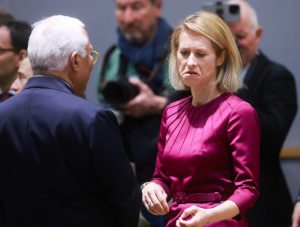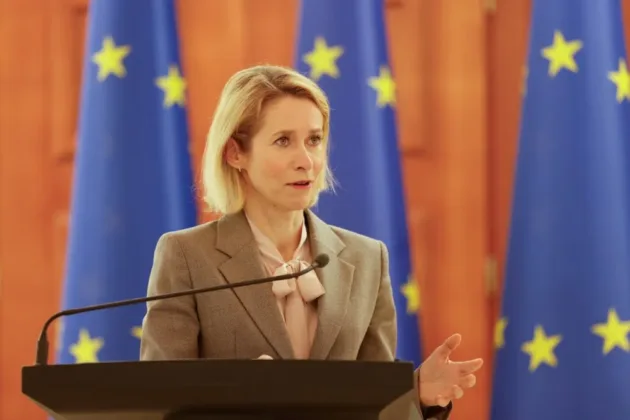




A fresh diplomatic crisis has erupted between the European Union and Israel after Israeli Foreign Minister Gideon Saar announced that he has suspended all contacts with EU foreign policy chief Kaja Kallas, accusing her of spreading what he described as a “calumny” against the Jewish state.
The controversy emerged following reports published by Euractiv on June 12, which cited diplomats familiar with remarks allegedly made by Kallas during a private discussion in Mexico in late May. According to the report, the EU High Representative compared Israel’s treatment of Palestinians in Gaza and the West Bank to South Africa’s apartheid regime.
The dispute marks one of the most serious confrontations between Brussels and Israel in recent years. The language allegedly used by Kallas in private appears to go significantly beyond the terminology the European Union has publicly adopted towards Israel, since senior EU officials have generally avoided comparisons with South Africa’s apartheid regime. The leak therefore exposed a potential gap between the EU’s public diplomatic posture and views allegedly expressed behind closed doors.
The comments immediately provoked outrage. On June 18, Foreign Minister Gideon Saar announced that he was severing all ties with Kallas, accusing her of spreading what he called a “blood libel” against the Jewish state. “I have instructed the Foreign Ministry not to maintain any contact with Kaja Kallas,” Saar declared, describing the apartheid comparison attributed to the EU foreign policy chief as “a modern blood libel against Israel” and accusing her of pursuing an “obsessive and hostile line” towards Israel.
Israeli leaders demanded a clear retraction, arguing that the remarks undermined trust at a particularly sensitive moment in the region, while several EU officials sought to downplay the incident.
Kallas subsequently attempted to contain the fallout in a post on X on June 18, directly addressing Saar and stressing the need to lower the temperature. “I value our dialogue and cooperation and remain open to continuing it in a respectful and constructive spirit,” she wrote, adding that “dialogue is the basis of diplomacy, especially when disagreements arise” and that “the EU remains committed to a constructive relationship with Israel,” while reiterating that a two-state solution is “the only viable path” to lasting peace in the Middle East.
The conciliatory message, however, failed to convince Israeli officials, with Saar maintaining that Kallas had shown a persistent bias against Israel and confirming that diplomatic contacts would remain frozen, in what amounted to one of the sharpest public ruptures in EU-Israel relations in recent years.
The controversy also highlights a broader ambiguity in the EU’s Middle East policy. Over the past two years, Brussels has developed an increasingly assertive and pressuring strategy towards Russia following the invasion of Ukraine, built around unprecedented sanctions packages, diplomatic isolation and long-term geopolitical containment.
By contrast, he European Union has never adopted against Israel anything comparable to the extensive sanctions regime imposed on Russia, nor has pursued a strategy of diplomatic isolation. Instead, EU policy has largely oscillated between a late criticism of specific Israeli actions, calls for humanitarian access and support for a two-state solution, while preserving political, economic and institutional cooperation with Israel.
Against this backdrop, the apartheid comparison reportedly made by Kallas stood out as particularly significant. If accurately reported, it would represent language considerably stronger than that normally employed in official EU statements and would reinforce Israeli concerns that private views within parts of the European establishment may be harsher than Brussels’ public diplomatic posture suggests.
The significance of the affair lies not only in the diplomatic rupture itself but also in what it revealed. The episode has exposed the absence of a coherent European strategy towards the Middle East and highlighted the tension between the EU’s official diplomatic language and views allegedly expressed in private.
At a time when Brussels has shown remarkable unity and strategic clarity towards Russia, the Kallas-Israel row suggests that Europe still lacks a comparable framework for dealing with one of its most sensitive neighbouring regions.