Poland is backing proposals in the EU to exclude Ukrainians of military age from being granted protection status in the EU.
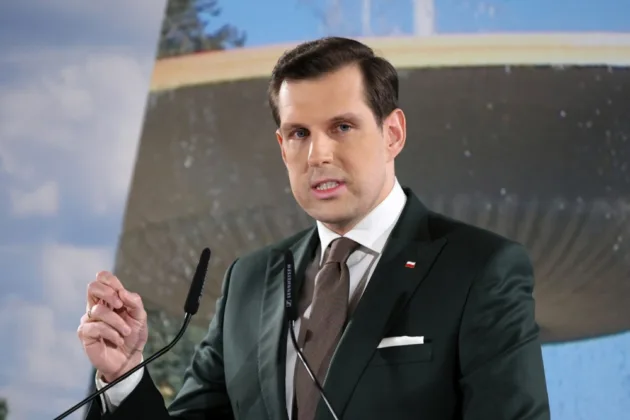
The country’s deputy interior minister Maciej Duszczyk, who serves in the centre-left government led by Prime Minister Donald Tusk, signalled Poland’s support for such restrictions ahead of a meeting of interior and justice ministers from member states which took place in Luxembourg on June 4 and at which the extension of legal protection for Ukrainian refugees sheltering from the war with Russia was discussed.
According to the current EU regulations, Ukrainian war refugees have the right to live, work and go to school across the community.
However, these protection measures are temporary and have to be periodically reviewed. The current EU provisions expire in March 2027.
The European Commission is in favour of extending the current regulations for another year, but some member states support making restrictions such as the removal of Ukrainians of military age and those who left Ukraine without permission from their authorities.
“Poland generally agrees with such a solution,” Duszczyk told reporters ahead of the EU’s Luxembourg meeting.
Following Russia’s invasion of Ukraine in February 2022, Kyiv barred most men aged 18-60 from leaving the country, with those aged 25 or older subject to military conscription.
However, some of these Ukrainian restrictions were relaxed in August of last year, causing a significant rise in the number of young men crossing the Polish border.
The Polish media has for some time featured stories about how Ukrainian young men have been avoiding the draft in their home country. The reports actually led the Polish government to offer Ukraine help in identifying and sending back the draft dodgers.
Poland has hosted over a million Ukrainian refugees since the start of Russia’s invasion, granting refugees access to the country’s labour market and its education, health and welfare systems.
The country hosts 960,000 Ukrainians with temporary protection status in Europe, the second highest number in the EU. Only Germany with 1.2 million has more such registrations out of the 4.3 million Ukrainian refugees currently residing in the EU.
Last September Poland passed legislation which limited financial support for Ukrainians by making certain benefits dependent on recipients being in work in order to avoid Ukrainians claiming child benefit for kids who were actually still living in Ukraine.
That legislation and further restrictions on health care introduced in March of this year have come in response to declining public support for providing assistance to the Ukrainian population in Poland which has consistently been tracked in opinion polls.
This change of heart has come despite the fact that it is widely recognized that Ukrainian workers are making a major contribution to the Polish economy.
Tensions have grown because of the large numbers involved, reports of the operations of Ukrainian organised crime and accusations that refugee status was enabling Ukrainians to have easier access to hard-pushed health services than the Polish population. This proved toxic at a time when waiting lists and closures of hospital wards have been commonplace in the Polish media.
Moreover, public opinion has been affected by disputes which have taken place between the two countries’ governments over the past 3 years.
Poland initially backed Ukraine to the hilt after the beginning of the war with Russia in February offering huge military support including nearly 300 Soviet era T-72 tanks and MIG fighter planes which were used immediately by the Ukrainian military trained on that equipment.
The country became a hub for military and humanitarian support of Ukraine as well as hosting millions of its refugees in the immediate aftermath of war.
This led to expressions of gratitude from the Ukrainians such as the award of the highest order of the Ukrainian state for Polish President Andrzej Duda, reciprocated with the award of the highest Polish honour for Ukrainian President Volodymyr Zelensky.
There was even feverish talk in some circles of the two countries in future forming a union but that was quickly quashed as it triggered negative response in Ukrainian nationalist circles and led Moscow to claim Poland was attempting to take over Ukraine.
The first sign of trouble in relations came in late 2022 when a stray Ukrainian air defence missile hit a Polish farm killing two workers. Instead of simply admitting a mistake the Ukrainians maintained that it had been a Russian strike.
President Duda on leaving office in 2025 said that he realized that Ukraine by claiming that this missile had been from Russia was trying “to drag Poland into the war against Russia”.
Relations soon soured when Ukrainian grain and food produce flooded the Polish market causing protests on the Polish side and forcing the Polish government to declare a unilateral embargo on much of those products in defiance of the EU’s policy of opening up the community’s markets to Ukrainian agricultural goods.
These restrictions on Ukrainian food products led to Zelensky accusing Poland in 2023 of unwittingly aiding and abetting Moscow during a UN General Assembly speech, remarks that were bitterly resented in Warsaw.
There were also protests from the road haulage industry when Polish companies complained that Ukrainian road haulage firms were enjoying an advantage on EU markets as they did not have to meet EU standards of operation.
But worse was to follow on past history between the countries. Poland has for decades been restrained in raising the issue of the mass murder, the Poles view it as genocide, of over 100,000 Poles in Volhynia during the Second World War.
That massacre was committed on the inspiration of Ukraine’s liberation army (UPA) which opposed the Soviets and wanted to drive the Poles out of Ukraine.
Volhynia had before the war been a part of Poland whereas after the Soviet liberation of the territory from the Germans after the war it became a part of the USSR.
Poland hoped that Ukraine would recognize Volhynia as genocide and allow for all the victims to be exhumed.
However, Ukraine has refused to accept Volhynia as a genocide, arguing that during the Second World War Polish partisans also committed atrocities against Ukrainians and that after the war the Polish communist government ethnically cleansed an area in the South-East of Poland. It has also restricted Polish access to sites at which Poland wanted to conduct exhumations of the victims, despite the fact that it has allowed unrestricted access to Germany over exhuming the remains of its soldiers from the time of the Second World War.
Moreover, since the Maidan revolution in Ukraine of 2013-2014 the Ukrainian state and its local authorities have increasingly been honouring the leaders of UPA and the nationalist movement such as Stepan Bandera, building monuments and naming streets in their name.
This was always frowned upon by Warsaw and when Zelensky last month decided to name a crack unit of his military in honour of UPA fighters the outrage led the current opposition Conservatives (PiS) aligned President Karol Nawrocki to say he would move for stripping Zelensky of the highest honour of the Polish state bestowed on the Ukrainian head of state by ex-President Andrzej Duda.
The cooling of relations has been reflected in the scale of aid given to Ukraine by Poland. In the year of the Russian invasion (2022) according to figures from the Kiel Institute Poland’s then PiS government provided military and humanitarian aid worth €3.2 billion.
In 2023 that figure was halved and amounted to €1.6 billion, but the figures declined even more rapidly under the present Tusk government, falling to €500 million in 2024 and €300 million in 2025.
Nevertheless, Poland still pays for Ukraine’s Starlink connection, is proposing to use the EU’s Security Action for Europe (SAFE) loans partly for joint ventures between Ukrainian and Polish defence industries and continues to host the hub for military and humanitarian aid in the south-east of Poland.
The Tusk government has supported Ukraine beginning negotiations for accession to the EU, but even before the current spat over the honouring of the UPA, President Nawrocki and also parts of the present ruling coalition have signalled that Poland could not support Ukrainian membership of the EU if it continued to honour Bandera and the UPA as that nation’s heroes.