







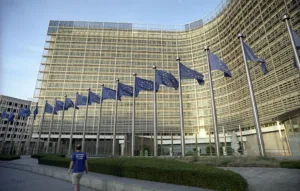

The European Union has agreed to extend temporary protection for Ukrainians fleeing the war until March 4, 2028, while withholding it from new arrivals who have not met their military obligations at home.
Member states struck the deal on July 15, prolonging by one year the scheme that allows displaced Ukrainians to live and work anywhere in the bloc. It follows a proposal put forward by the European Commission on June 26.
The Council of the European Union said the extension would give clarity and predictability to those fleeing the Russian invasion, and that the bloc would stand behind Kyiv for as long as needed.
The novelty lies in the conscription clause. Governments agreed that protection should go only to those complying with their military obligations in Ukraine, citing the country’s evolving defence needs.
The restriction applies to new applicants alone. Those already holding the status in the EU would keep it whatever their age.
In practice, applicants would have to prove they had left Ukraine legally. That could be done with a passport carrying an exit stamp issued by the Ukrainian authorities, or with a paper or electronic document confirming exemption from or compliance with military service.
Jim O’Callaghan, Ireland’s Minister for Justice, Home Affairs and Migration, chaired the talks under the Irish presidency of the Council, which began on July 1. He said the decision “provides stability for those who found safety in the EU”.
Kyiv itself pressed for the carve-out. Presenting the proposal in June, European Commissioner for Home Affairs and Migration Magnus Brunner said: “This is what Ukraine has asked us to do.”
Ukraine has struggled to fill its ranks as the fighting grinds into a fifth year. Its government has argued that generous European welfare systems draw away men it needs at the front.
More than four million displaced Ukrainians have benefited from the scheme since March 2022, with some 4.33 million holding the status in March 2026. Germany hosts the largest contingent, ahead of Poland and Czechia.
Adult men account for 26.6 per cent of Ukrainian refugees in Europe, though there are no figures for how many are of fighting age.
The measure was created as an emergency response to Russia’s full-scale invasion and has been rolled over year by year. The Commission has already urged member states to prepare for its end.
Ministers would formally adopt the decision in the coming weeks, after which it would be published in the Official Journal of the European Union.
Denmark, which sits outside the scheme because of its migration opt-out, has gone further. It grants residence permits to Ukrainian men aged 23 to 60 only if they can show they are exempt from military service.