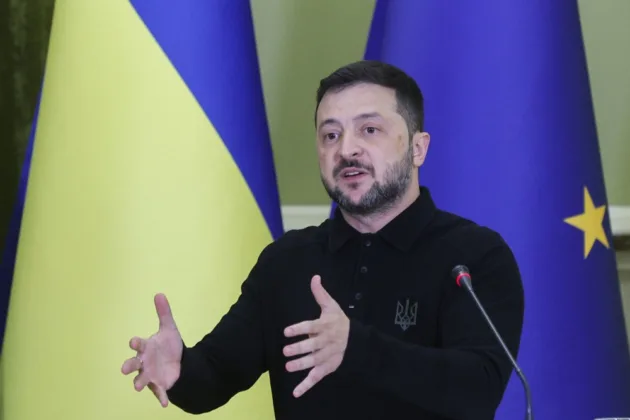

The diplomatic deadlock has been broken and Brussels bigwigs are throwing a party. With Budapest now disciplined, the opening of the first accession chapters for Ukraine is being hailed as a historic milestone. Still, behind the handshakes lie fundamental questions that the European elite avoids: Is the European Union still a club of achieved equals, or is it about to become an asylum for corrupt states threatened by authoritarian neighbours? What can Brussels gain by letting Kiev in?
For decades, EU membership has been the reward for stability, a seal of approval for nations that have successfully navigated the route from challenges to success. With Ukraine, that logic has been reversed. We are being asked to accept a nation that is not only in the midst of a brutal war, but is also facing a legacy of deep-seated corruption and institutional fragility. The “Copenhagen Criteria”, which were once the strict golden standard, are now being treated as mere guidelines, bent by political priorities.
So, under what conditions would Kiev’s accession indeed serve Europe’s interest? Well, to begin with, it certainly cannot be as a charity project. Ukraine’s entry only makes sense if it acts as a catalyst for a radical restructuring of the Union itself through a reassessment of its core policies. To absorb a country of that size, with its massive agricultural sector and decimated infrastructure, without bankrupting the Common Agricultural Policy (CAP) or the Cohesion Funds, would require a level of reform that Brussels may have not yet sufficiently grasped.
On the one hand, economically, the project is a gamble of staggering proportions. The reconstruction costs alone are estimated in the hundreds of billions. Yes, Ukraine offers a massive market, untapped potential in critical minerals and energy opportunities. But the immediate burden on the European taxpayer would be unprecedented, and gains for European companies eying reconstruction contracts are not guaranteed, as competition with other Western players is expected to be relentless. The whole thing only makes sense under strict preconditions that will ensure that the investment is a safe one.
On the other hand, the geopolitical implications are nothing short of daunting. Ukraine’s EU entry is sure to entail a transition that would permanently shift the EU’s centre of gravity to the East, likely at the expense of the South. However, there is a bold perspective here – one that is rarely being discussed: Could Ukraine’s accession also become the key to a holistic settlement with Russia? Importantly, this may be the main – if not the only – framework in which the matter is really worth discussing.
Realism suggests that a total military victory for either side remains a non-viable prospect. So, if Kiev were to accept its territorial losses as a historical reality, and Moscow were to accept that a non-NATO Ukraine could become a full member of the EU, we might find the basis for a lasting normalisation. Such a deal would require Moscow to recognise that the EU is a massive economic and institutional player that must be respected. At the same time, it would require Europe to recognise that Russia is a permanent neighbour and a superpower with whom a modus vivendi needs to be established.
Such a normalisation could lead to a renewed energy partnership, however limited it may be. While the REPowerEU strategy, adopted in 2022, mandates a shift away from Russian fossil fuels, a stabilised Eastern Europe could allow the Union to enhance pluralism in its energy providers. Instead of a total, permanent blockade, a working relationship with Moscow might allow for a diversified energy mix where Russia is one of many competing suppliers, rather than a monopolistic hegemon. This can prove beneficial, if not life-saving, for the European economy.
The path to 2027 – the target set for the Accession Treaty – is not one that we should tread lightly. If Ukraine is admitted as a “symbolic” member while its institutions are broken and its borders remain in flux, it will only accelerate the dilution of the European project. But if we use this crisis to forge a new security and economic architecture – one that settles the Ukraine question once and for all through a combination of EU integration and pragmatic territorial realism – then we might finally see the end of a long post-Cold War winter.
The time for empty slogans about standing with Ukraine is over. In fact, the time for slogans may be over overall. Res, non Verba. Enough with invoking principles, only to end up taking the cost and looking like hypocrites, too. We must decide if we are building a stronger Europe, or if we are simply expanding an institution that started out as a private club and is now close to resembling an asylum. If Kiev’s membership goes ahead, it must become an asset that bridges, not a liability which divides.