


Polish prosecutors have opened an inquiry into whether President Karol Nawrocki’s life or health was put at risk during last year’s election campaign, after he described a sudden collapse in a forthcoming memoir.
The probe, launched by prosecutors in the south-western city of Świdnica, will determine whether there are grounds for a full criminal investigation.
It follows the publication, by the website wPolityce.pl, of an extract from “Where Did Karol Nawrocki Come From?” a book-length interview with Nawrocki conducted by historian Andrzej Nowak, ahead of the memoir’s official release in July of this year.
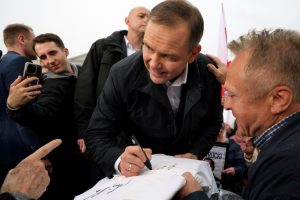
In the extract, Nawrocki, then a candidate backed by the opposition Conservatives (PiS) party, recalls a “moment of terror” after a campaign rally in the town of Ząbkowice in Silesia on 15 May 2025.
He says that it was something he will never forget.
“I was in a truly critical situation then. There was a moment of terror that I still remember very clearly,” the President said.
Nawrocki says he lost consciousness on the campaign bus and woke to find aides standing over him, with his suit and the vehicle covered in vomit after several minutes of violent convulsions.
After a five-minute speech outside the town hall on his way to the bus Nawrocki felt, as he describes it, as though someone had suddenly “switched off his body.”
“I finished speaking and suddenly felt that something very bad was happening to me. A sudden weakness, as if I had taken a solid blow to the jaw,” recalls Nawrocki, who is a former amateur boxing champion from the region of Gdańsk.
Despite this, he tried to function normally, waving to people and speaking to them. He asked an aide for water, told them to lead him to the coach so that he could lie down.
What happened moments later was later described by his security guards as scenes straight out of a horror film.
“ I was kicking my legs, my body was jerking, I was vomiting compulsively,” the President recalled.
Nawrocki also reminded that from the very beginning of the campaign, his security detail had warned him against risky gestures, including kissing female voters’ hands, suggesting that this could be a way of administering poison to him. He confirmed that, despite the warnings, he did not change his behaviour.
In the published excerpts, Nawrocki himself does not state unequivocally that he was poisoned. He describes the symptoms, the circumstances and his own impressions, calling the entire situation “something he still treats very seriously.”
However, Professor Nowak, the book’s co-author, has suggested someone tried to poison Nawrocki to knock him out of the race, even raising the possibility of an assassination attempt.
“They tried to poison Karol Nawrocki. Simply poison him, eliminate him from that campaign at a moment when it was already clear that he was heading for victory”, claimed Nowak during an appearance on Polish media.
Nawrocki said he had earlier been warned by security staff that greeting supporters by kissing women’s hands could be a way of poisoning him, but continued the practice regardless because he saw shaking hands in direct contact as key to his campaigning.
Prosecutors in Świdnica said they were checking media reports that Nawrocki’s health had suddenly deteriorated and that he had briefly lost consciousness, and that this “may have resulted from the administration of substances endangering his life or health.”
According to the chiefs of Nawrock’s security the President refused to be taken to hospital or for an ambulance to be called and the security team reluctantly agreed since he was conscious and seemed to be recovering.
Zbigniew Bogucki, Nawrocki’s chief of staff, told reporters last week that the situation had been “secured in keeping with the rhythm of the campaign” and that Nawrocki had “focused on the campaign” rather than seeking medical attention.
He refused however to speculate whether a poisoning attempt had taken place, merely saying that it was now up to prosecutors to investigate.
Former PiS Prime Minister Mateusz Morawiecki suggested the “ruling camp” could “go to extremes” against opponents, while cautioning he had yet to read the book himself and did not know all the details relating to the incident.
The ruling centre-left government led by Prime Minister Donald Tusk has reacted with skepticism about claims that Nawrocki may have been poisoned.
Deputy Interior Minister Czesław Mroczek said the incident sounded serious but added that it was surprising no protective measures appear to have followed it.
“It was serious, sudden, posed a threat to the health and life of the president, and it turns out that no actions were taken related to ensuring any form of protection, ” said Mroczek and emphasized that it was important what rescue measures were taken at the time.
“It is not known what mechanisms were activated, or why they were not activated. Therefore, let the prosecutor’s office clarify this. Those who were with the president at the time, who may know something about the matter, will be questioned, and I am certain that within a few weeks we will have more knowledge,” added the deputy minister.
Tusk’s Civic Coalition (KO) political allies have called for Nawrocki to undergo a medical examination but have not made clear what such an examination might uncover since a year has passed since the incident in question.
However the controversy surrounding the alleged incident was ratcheted up by Krzysztof Radziwon, the chief of Nawrocki’s security team during the presidential election campaign last year.
Radziwon told Polish daily Rzeczpospolita that he and his security team had detected surveillance of their and the candidate’s movements.
“ We noticed the appearance of drones, not just at mass meetings where that is the standard, but also during unscheduled stops. We also detected that the same cars were parked for hours close to where the candidate was present and we detected that wer were being recorded as a security formation to see how we work”.
According to Radziwon the candidate and his security team were followed on the campaign trail.
“We noticed that the candidate’s column of vehicles was followed by cars observing us. We noticed how the cars took it in turns to watch us. This is why I took no chances and made sure that if there was a drink or food needed by the candidate we would deliver it to the vehicle without him needlessly stepping out”, recalled Radziwon.
However Radziwon would not be drawn to speculate who might have been invigilating Nawrocki and his security team but did say he felt that Nawrocki’s symptoms during the incident were indicative of poisoning with a substance rather than ordinary food poisoning.
Nawrocki was a surprise winner of the Polish presidential election in 2025. He was a relative unknown, not a member of any party though he was backed by PiS.
His opponent, Warsaw Mayor Rafał Trzaskowski, was, according to the polls, the clear favour to win.
As Nawrocki’s poll ratings crept ever upwards during the election campaign he came under attack for his past alleged association with the Gdańsk underworld during his time as a security guard in a Gdańsk hotel; the fact that as a young man he had participated in fights between football fans and his purchase of a former municipal apartments from a man he had helped to buy it.
The attacks however did not check the rise in the polls for Nawrocki and two other right wing candidates; Sławomir Mentzen from the Confederation Party and Grzegorz Braun who leads the break-away (from Confederation) Polish Crown party.
Nawrocki with his conservative messaging and firm opposition to the Tusk government managed to garner most of the votes of Mentzen and Braun from the first round and, despite polling less votes than Trzaskowski in the first round of polling won the run-off 51-49 percent.
Tusk and his party alleged there had been irregularities in the counting of the votes but the state electoral regulator (PKW) nor the public prosecutor’s investigations found no significant cases that could have overturned the result.
However Tusk’s allies claimed that the Supreme Court chamber charged with reviewing protests was illegitimately constituted, despite the fact that this is the same body that had validated the parliamentary election in 2023 in which Tusk’s majority came to power as well as the 2024 local and European Parliamentary elections.
This led to a campaign by Tusk’s attorney Roman Giertych MP which tried to pressure Szymon Hołownia, the Speaker of Parliament to refuse to take the oath of office from Nawrocki in August last year. That campaign led to a massive row within the governing coalition as the Speaker refused and accused Tusk of trying to stage a coup.
Since coming to power Nawrocki’s popularity has risen and his approval ratings now stand at 55 percent, well ahead of PM Donald Tusk and the government.