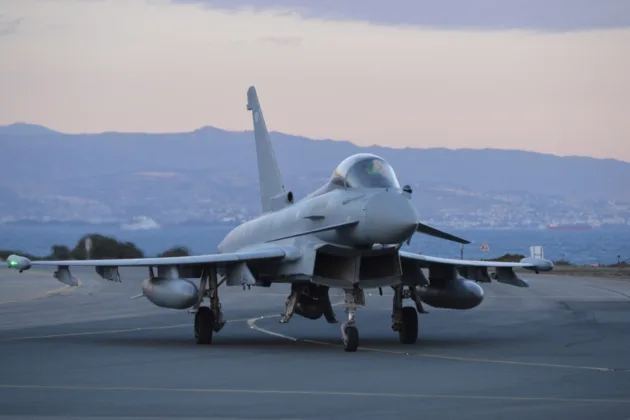






Commercial aviation across Europe has faced continued disruption as a wave of false bomb threats escalated on the morning of November 5, triggering fighter-jet scrambles, military base diversions and emergency runway sweeps across multiple EU member states.
The rolling wave of alerts, which began on November 2 and accelerated through November 5, has affected around 20 commercial flights operated by Aer Lingus, Finnair, Ryanair, LOT Polish Airlines, Scandinavian Airlines (SAS) and Wizz Air.
In one of the most serious incidents on November 5, an Aer Lingus flight (EI402) travelling from Dublin to Rome was intercepted by French Air Force fighters and diverted directly to the Évreux-Fauville Air Base in Normandy. The office of French Prime Minister Sébastien Lecornu confirmed that all 151 passengers and six crew members were evacuated safely to allow military ordnance teams to sweep the Airbus A320. The air force said it had scrambled its aircraft “as soon as the threat was reported”, while Aer Lingus said the diversion was taken “as a safety measure” and that it was working to rebook passengers.
The same morning, Italian fighter jets escorted a Finnair flight from Helsinki to Rome Fiumicino, where bomb disposal experts checked the aircraft, and a Wizz Air flight from Milan to Warsaw was rerouted to Vienna. Czech police said four aircraft bound for Prague had received threats; pyrotechnic inspections were negative and the National Centre against Terrorism, Extremism and Cybercrime (NCTEKK) has taken over the investigation.
In Belgium, security alerts were triggered at Brussels Airport on November 5 after a LOT Polish Airlines flight (LO235) inbound from Warsaw received a threat en route. The aircraft landed safely at Zaventem, where federal police conducted a risk analysis before determining that additional measures were not required. Police are examining whether the threat is linked to the earlier incidents.
In Bulgaria, three Ryanair flights bound for Sofia were targeted on November 5. Aircraft arriving from Copenhagen and Madrid landed in the capital, where the transport minister said inspections found nothing, while a flight from London Stansted was diverted to Plovdiv. The country has now logged six threatened flights in four days, starting on November 2 when a Wizz Air service from London Luton to Sofia was diverted to Budapest under escort from Hungarian Gripen fighters.
The November 5 disruptions follow a day of extensive security scares across Central and Southern Europe on November 3, when at least seven flights were targeted.
That day, a LOT Polish Airlines Boeing 737 MAX from London Heathrow bound for Warsaw Chopin Airport, with 181 people on board, was diverted to Warsaw-Modlin, prompting authorities to temporarily close parts of the regional hub while passengers were evacuated. At Chopin Airport itself, an arriving SAS flight from Copenhagen triggered standard counter-terrorism protocols and was isolated on a taxiway for checks.
In Bulgaria, counter-terror police swept two incoming flights arriving in Sofia from Bergamo and Dublin, disembarking around 360 passengers in total.
Parallel emergency measures were activated in southeastern Spain, where parts of Murcia Airport were cordoned off to screen a Ryanair flight arriving from Manchester, while Italian Eurofighters were scrambled to escort a Ryanair flight from Dublin into Rome Fiumicino.
“The pilot received information through his own channels, from the airline, that such a threat existed,” Bulgarian Transport Minister Georgi Peev said on November 3, adding that “all protocols have been activated” and that the public could “stay calm”.
While every search to date has confirmed the threats to be hoaxes with no explosive devices discovered, the repeated alerts have imposed significant operational costs, with airports partially closed, runways and taxiways blocked and dozens of connecting flights delayed.
Matthew Borie, chief intelligence officer at aviation security consultancy Osprey Flight Solutions, told the Associated Press that explanations ranged from copycat threats to a single individual or group behind multiple alerts, and that state actors or their supporters could not be ruled out. The pattern has drawn comparisons with the digital interference and drone incidents recently directed against European transport hubs — Germany has blamed Russia for a failed drone attack on Leipzig airport in August — though investigators have so far found no evidence linking the bomb threats to a hostile state.
No one has claimed responsibility. National police and transport authorities are investigating the communication channels used to submit the threats to airlines and air traffic control, and whether the incidents across jurisdictions are connected.