

Italy’s governing centre-right is facing an increasingly strategic question ahead of the 2027 general election: can it afford to leave Roberto Vannacci outside the coalition?
The latest SWG poll for La7, published on June 30, shows Vannacci’s newly founded movement, Futuro Nazionale, climbing to 5.6 percent, overtaking Matteo Salvini’s League, which has slipped to 5.4 percent. The result is particularly notable given that Futuro Nazionale was officially launched only in mid-June, after Vannacci formally left the League following months of tensions over the party’s direction.
The same survey confirms that Prime Minister Giorgia Meloni’s Brothers of Italy (FdI) remains Italy’s largest party on 29.8 percent, despite a slight decline. Forza Italia, led by Deputy Prime Minister Antonio Tajani, stands at 9.1 percent.
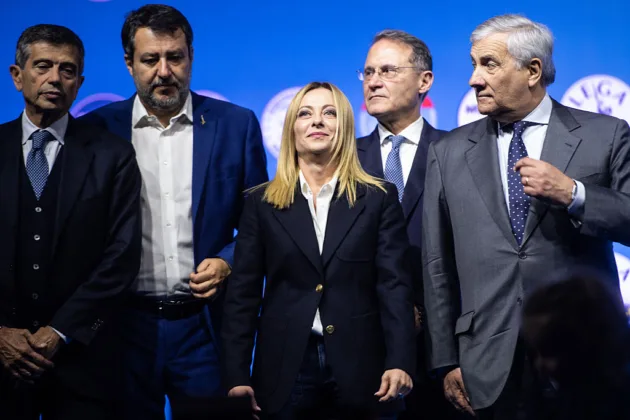
Together, Brothers of Italy, the League and Forza Italia form Italy’s governing centre-right coalition, which aims to seek a second consecutive mandate in 2027. On current figures, the three parties command 44.3 percent of voting intentions.
On the opposition side, the Democratic Party polls at 22.7 percent, the Five Star Movement at 12.4 percent, and the Green-Left Alliance at 6.9 percent, for a combined 42 percent.
Under current polling conditions, the centre-right would remain the favourite if Vannacci were incorporated into the governing alliance. If instead Futuro Nazionale ran independently, the electoral contest could become significantly tighter, particularly in Italy’s single-member constituencies where coalition unity is decisive.
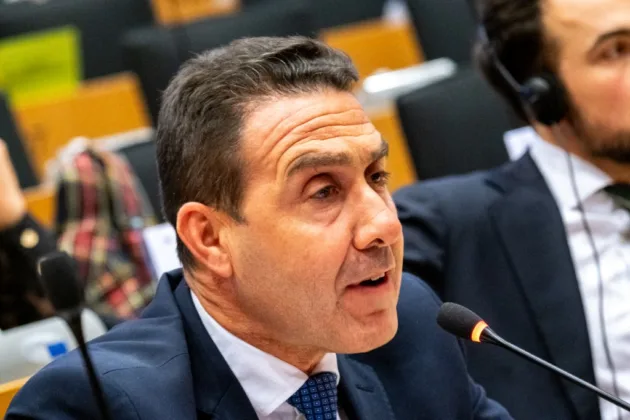
Vannacci, elected to the European Parliament in 2024, has built his political profile around stricter immigration policies, national sovereignty and criticism of what he calls the “dictatorship of political correctness.” His rhetoric has resonated with voters disillusioned with Matteo Salvini while positioning him firmly on the right of Meloni’s political space.
Yet the most significant resistance to his potential integration does not come from Brothers of Italy. It is instead concentrated within Forza Italia, the centre-right’s liberal, pro-European party belonging to the European People’s Party (EPP).
Several senior Forza Italia figures have ruled out cooperation with Vannacci, arguing that his positions on immigration, civil rights and the European Union are incompatible with the political identity shaped under Silvio Berlusconi.
Although she holds no formal political office, Marina Berlusconi, the eldest daughter of the former prime minister, is widely regarded as the most influential figure opposing any cooperation with Vannacci.
Through the Berlusconi family’s long-standing control of Fininvest, which anchors Forza Italia’s financial and organisational ecosystem, she is seen as shaping the party’s strategic direction, while day-to-day leadership remains with Antonio Tajani.
In recent months, Marina Berlusconi has repeatedly signalled a preference for a more liberal and pro-European positioning, distancing the party from more hardline conservative currents.
Figures close to the Berlusconi family have also dismissed concerns about defections towards Vannacci’s movement, framing them as the result of earlier recruitment mistakes rather than a structural realignment.
Tensions have occasionally become personal. On 25 May 2026, responding to reports that Marina Berlusconi opposed any future alliance between Forza Italia and his movement, Vannacci dismissed her political relevance, asking: “Who is Marina Berlusconi? As far as I know, she doesn’t lead a political party,” and suggesting that such influence would imply Forza Italia was driven by “the power of money and publishing.”
Beyond internal disputes, the broader strategic issue for Meloni is that Vannacci’s inclusion could reshape coalition dynamics. Some observers argue that bringing Futuro Nazionale into the alliance might accelerate centrifugal pressures inside Forza Italia, increasing internal debate over its long-term alignment.
This has fuelled speculation in political commentary about Forza Italia’s post-2027 trajectory. Given its EPP membership and increasingly centrist positioning under Tajani, some analysts suggest the party could, in a fragmented parliament, become open to supporting a broad pro-European governing arrangement with centre-left forces.
Such a configuration is often described as resembling the “Ursula majority” at EU level, referring to cooperation between the European People’s Party and the Socialists and Democrats in backing European Commission President Ursula von der Leyen.
For Meloni, the trade-off is therefore double-edged: excluding Vannacci risks fragmenting the conservative vote and weakening electoral cohesion, while including him could strain relations within the governing alliance and intensify internal tensions.