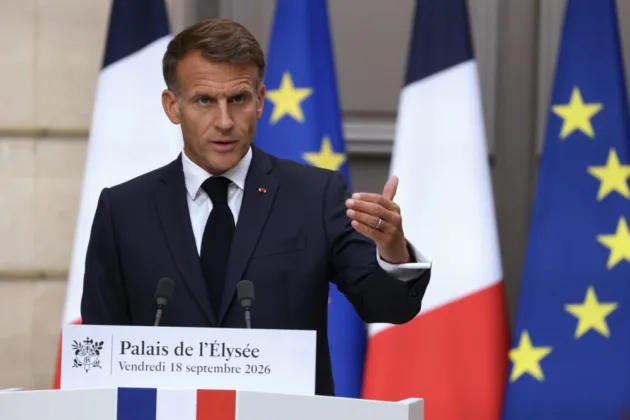









France has marked its national day with a Bastille Day military parade led by pro-Ukraine troops, in a display of European resolve staged as President Emmanuel Macron presided over the ceremony for the last time.
Some 500 soldiers from the Coalition of the Willing, the grouping of nations backing Kyiv against Moscow, opened the march down the Champs-Élysées on July 14. They were followed by 25 Ukrainian soldiers, whose appearance drew the loudest cheers from the crowd.
Macron said the parade would “illustrate its strategic reawakening and our unity”, casting the event as proof of a Europe stirring in the face of Russia’s invasion, now in its fifth year.
Around 30 leaders watched from the Champs-Élysées, among them Ukrainian President Volodymyr Zelensky, British Prime Minister Keir Starmer and German Chancellor Friedrich Merz.
In a break with tradition, foreign contingents marched with their own national flags rather than a single invited nation taking part. It was the first time in some 20 years that British troops had joined the parade.
The Paris military governor said 7,600 troops took part, a record compared with 5,810 in 2025, alongside a flypast of aircraft from 11 European countries. French Mirage jets flew with Ukrainian co-pilots trained in France.
The parade followed a summit of the Coalition of the Willing held at Les Invalides on July 13, where Ukraine and nine European states announced a new anti-ballistic missile pact.
“Our goal is to build a shared ballistic missile defence capability for Europe,” the 10 nations said in a joint statement. Denmark, France, Germany, Italy, the Netherlands, Norway, Spain, Sweden and the United Kingdom signed alongside Kyiv.
Zelensky pressed allies for stronger air defences and said a low-cost, mass-produced interceptor system could be developed jointly within 12 months.
The Kremlin was dismissive. Spokesman Dmitry Peskov branded the grouping a “coalition of warmongers” and said its members did not want peace.
This year’s ceremony also paid tribute to the French Navy, which is marking 400 years since its founding under Cardinal Richelieu. A red-alert heatwave and forest fires forced the cancellation of the traditional evening fireworks.
It was Macron’s final Bastille Day as president before he leaves office in 2027, closing a two-term drive for a Europe less dependent on the United States for its own defence.