


Italy has been gripped by growing political tensions after the death of a Moroccan-born man during a police intervention in Bologna, in a case that opponents of Prime Minister Giorgia Meloni’s government are already comparing to the 2020 killing of George Floyd in the United States.
The victim was Abderrahim Fakir, a 42-year-old Moroccan-born man who had lived in Italy since the age of seven and built his life in the Bologna area. He died on July 19 during a police intervention in Bologna’s Pilastro district after officers restrained him while attempting to handcuff him.
His death has quickly moved beyond the circumstances of the arrest itself, becoming a major political flashpoint. The case has triggered demonstrations in Bologna, clashes with police and calls for further protests in other Italian cities, while political parties on both sides have presented sharply different interpretations of what happened.
According to investigators, police were called after reports that Fakir was allegedly behaving aggressively in the streets, damaging property and alarming residents. Officers intervened to stop the situation and attempted to immobilise him after he reportedly resisted. Pepper spray was used before he was restrained on the ground and his wrists and ankles were bound.
Videos recorded by witnesses and widely shared on social media show Fakir being held face down on the pavement while shouting for help and saying he could not breathe. The footage has become the centre of a growing political controversy, with critics accusing police of using excessive force and questioning whether the restraint contributed to his death.
Four ambulance staff were present at the scene. Prosecutors are examining the actions of the officers involved as well as the medical response, and the Bologna prosecutor’s office has opened a manslaughter file.
The two officers and the four ambulance workers have been entered in the “Model 45-bis” register created by the Meloni government’s security decree, which covers cases where a legal justification may apply and which does not in itself make them formal suspects. Interior minister Matteo Piantedosi told Il Messaggero the mechanism was not a criminal shield and that nobody in Italy was above the law.
Prosecutors have ordered a post-mortem examination to be carried out by a panel including a forensic pathologist, a toxicologist and a cardiologist. The official cause of death has not yet been established.
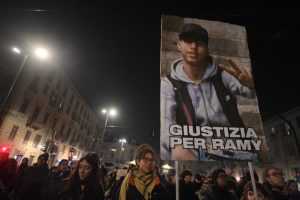
Migrant rights organisations, anti-racist groups and left-wing activists organised demonstrations in Bologna on July 20, accusing police of excessive violence and drawing direct comparisons with the death of George Floyd, whose killing while being restrained by police in Minneapolis triggered worldwide protests in 2020.
Thousands gathered in piazza Nettuno, at a rally called by Bologna mayor Matteo Lepore, to demand “truth and justice” for Fakir. The demonstration, which began peacefully, later escalated into clashes between some protesters and police forces around the prefecture in piazza Roosevelt.
Objects were thrown at officers, property was damaged and riot police used tear gas and water cannon to disperse parts of the demonstration. Bologna police headquarters said 64 officers were injured, with prognoses of between three and 35 days, while emergency services treated 11 people at the scene and two municipal vehicles were set alight.
The mobilisation has since expanded politically beyond Bologna, with activist groups and migrant rights organisations calling for further demonstrations in other Italian cities. The Fakir case has therefore moved from a local incident into a wider national debate over police powers, immigration and the treatment of migrants in Italy.
In the hours following the death, the case was compared to that of George Floyd by protesters, activists and members of Italy’s political opposition. Democratic Party leader in the Senate Francesco Boccia condemned what he portrayed as the adoption of US-style policing, telling Repubblica: “If the right wants to import the ICE model, this is the wrong country. We have democratic antibodies.”
Boccia said the priority was to defend the rule of law, which he said applied to everyone without categorisations.
Green and Left Alliance senator Ilaria Cucchi, whose brother Stefano died in 2009 after being detained by police, echoed the comparison at a Senate press conference, saying: “Hearing the victim’s niece speak was like reliving a pain [ … ] They are already starting to say he died through his own fault. Does that remind you of anything?”
With images circulating online, protests spreading and political divisions deepening, the death of Abderrahim Fakir has become one of Italy’s most sensitive debates over policing, migration and public order.