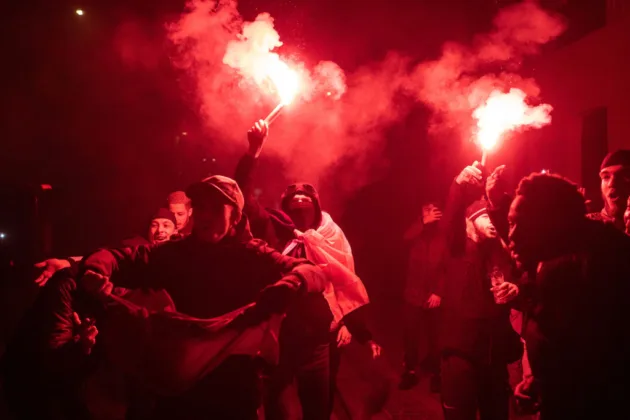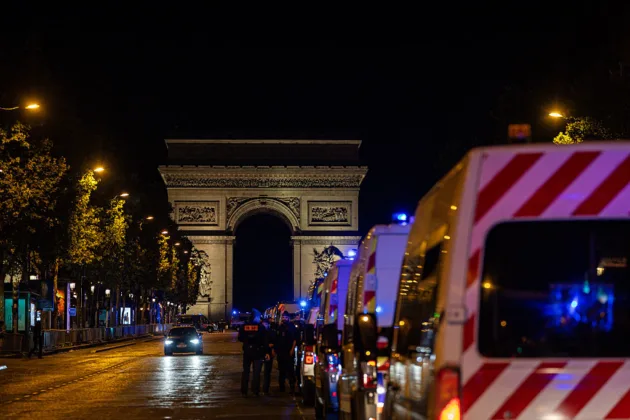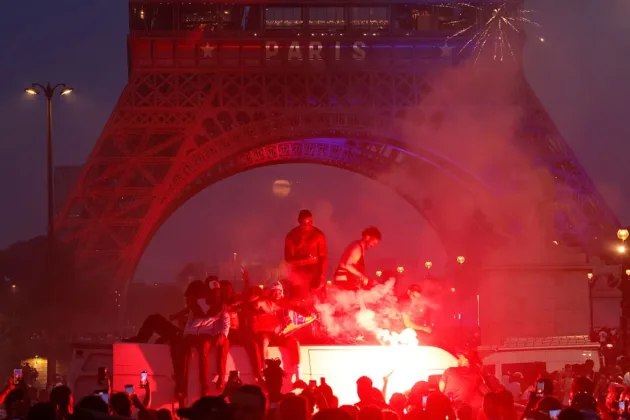


Towards the end of the Second World War, Paris was famously saved from destruction as Hitler’s order to destroy the French capital was not executed. Today, as the morning commute began in Paris, a similar feeling of relief was in the air: The city did not burn and is still in one piece. Only that this time, the threat did not come from a retreating Wehrmacht, but from within. Last night’s World Cup quarter-final between France and Morocco ended in a 2–0 victory for Les Bleus. Yet, the defining story of the night was not written by Mbappé or Dembélé in Boston, but by the total, pre-emptive paralysis of the French capital.
It certainly appears to be a paradox: For the progressive metropolitan elite, international football, same as most high-profile international sports, is championed as the ultimate tool for multicultural integration. They view it as a glamorous field of display where parallel communities are expected to harmoniously share a common identity. The reality on the ground, though, consistently exposes this narrative as an imaginary and dangerous sentimentality.
Last night, the French state effectively declared a state of siege against its own population. To prevent a football match from triggering widespread civil unrest, the Paris Police Prefecture chose to paralyse the capital. Major metro lines were shut down, entire stations on Line 6 were closed for the night, the Champs-Élysées was sealed behind steel, riot police in their thousands (some 8,000 in the capital and 20,000 nationwide, according to the interior ministry), and surveillance drones hovered over the city. This was not a security mechanism managing a sporting celebration. It was a G7 capital in a state of war.
This is the great illusion of the modern European melting pot. For decades, post-modern French Marxists and liberals have argued that sports, amongst other social and cultural activities, will cure societal division. They pointed to the multi-ethnic triumph of the 1998 World Cup as proof that a football pitch could build a modern, unified national identity. Yet, three decades later, the rupture has grown so deep that a simple game played 5,000 kilometres away forces a nuclear power to freeze its daily life. Apparently, the football field has not integrated the banlieues. It has merely turned the calendar into a series of high-risk dates.
What makes this situation particularly tragic is that this paralysis is now treated as some kind of normal and expected meteorological event. The Ministry of the Interior deploys thousands of police officers to pre-emptively shut down the heart of Paris, while ordinary shopkeepers board up windows as a routine cost of doing business. It is a sad demonstration of a state that has given up its obligation to achieve and sustain domestic peace. When a nation must systematically isolate its central districts to survive 90 minutes of a sporting event, the integration model has not just stumbled. It has completely failed.
Ultimately, last night was a microcosm of a much larger European crisis. The heavy police cordons may have kept the peace, but the underlying hostility remains almost entirely unaddressed. This morning, sports pages will debate tactics, substitutions and semi-final projections. But the real lesson is written in the silence of a capital city that has to paralyse itself to stay safe. Until European leaders face the reality of failed integration with cold realism rather than sentimental rhetoric, public order will remain hostage to celebrations that have become threats.