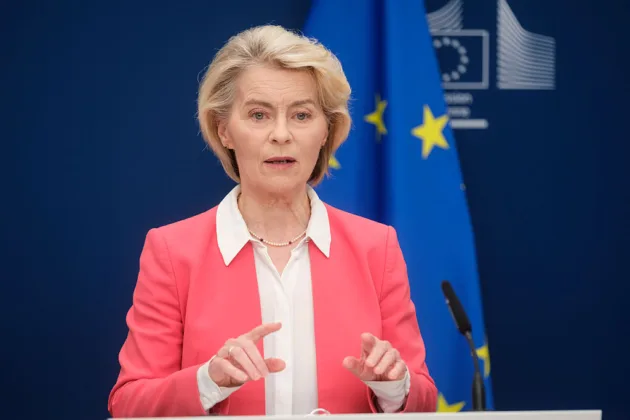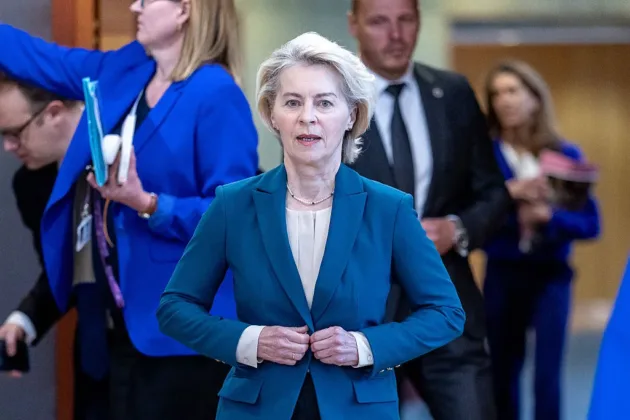











On July 13, an advisory group established by European Commission President Ursula von der Leyen will report back on how children should be protected online, part of a potential EU-wide social media ban being considered by Brussels. The justification, as ever, is children’s mental health. “Social media can connect and inspire,” von der Leyen said in June, “but when one in three young people say it leaves them feeling stressed, sad or excluded, we cannot ignore the impact on their mental health and wellbeing.” The solution, European children have been taught to believe, is more talk: “Learn more about mental health, even if you don’t struggle yourself,” runs the Commission’s guidance for schools. “It helps build understanding and care.”
The EU’s 2023 Communication on a Comprehensive Approach to mental health, adopted on June 7, identifies at least €1.23 billion for mental health in the Union. It intended to mark a “turning point in the way mental health is addressed in the EU,” going “beyond health policy” to involve schools, workplaces, digital platforms and other institutions. Although the document also refers to treatment and care, its guiding assumption is that prevention is better than cure: “The promotion of good mental health, prevention of mental health problems and early interventions,” the document states, “are more effective and cost-effective than treatment.”
While this sounds hard to oppose, before Brussels spends another €1 billion to build this assumption into everyday life, it is worth asking whether it is true. My new report for MCC Brussels, Mental Health, Governance and the EU, finds that the EU’s mental-health agenda may be causing many of the very problems it claims to solve. It’s time to realise that more awareness, more protection and more promotion may actually lead to more mental ill-health.
The case for this vast expansion of mental health policy rests on some apparently alarming figures. The Commission claims that 46 per cent of EU citizens had “an emotional or psychosocial problem in the last 12 months.” In April 2026, the Organisation for Economic Co-operation and Development (OECD) claimed that one in five people across OECD and EU countries experience a mental disorder, declaring mental ill-health “one of the most significant public health and economic challenges” of our time. The prescriptions are the same: more prevention, more promotion, more institutional intervention across nearly every area of life.
But look more closely at the figures and this picture begins to dissolve. That 46 per cent number, for instance, comes from Flash Eurobarometer 530, a 2023 survey in which respondents were asked, “In the last 12 months, have you had any emotional or psychosocial problems (such as feeling depressed or feeling anxious),” with a follow-up question asking which “symptoms” respondents had, including “feeling sad/down.” In this way, any “negative” feeling, no matter how warranted, becomes a “symptom” of an implied illness. The OECD’s estimate is drawn from modelled Global Burden of Disease estimates whose methodology has been widely criticised for relying on self-report screening instruments rather than clinical interviews, which are known to inflate prevalence. Beyond these, the Commission’s most emotive data point, that suicide is a leading cause of death among young Europeans, omits the necessary context that young Europeans rarely die of anything and that their suicide rate has in fact fallen by 20 per cent since 2011.
This does not mean suffering is unreal or that serious mental illness should be ignored. It does mean, though, that the evidence does not support the simple story of an ever-worsening epidemic involving a near majority of Europeans. What we are seeing instead is an expansionary definition of illness, what psychologists call “concept creep,” and a policy programme that depends on it.
The MCC Brussels report documents what this programme looks like in practice and why it is likely to go terribly wrong. Mental health promotion means more than funding for counselling or the odd anti-bullying campaign. Under the banner of a “whole-society approach” to promoting mental health, EU-funded programmes are training teachers, librarians, social workers, justice professionals, and employers to function as mental health monitors. In an Erasmus+ funded programme called PROMEHS, promoted on the Commission’s School Education Platform, children from early years to secondary school are taught to scrutinise their feelings, friendships, family life and self-understanding through the language of mental health. The programme extends beyond pupils: materials for parents ask them to reflect on their own mental health, identify recent emotional states and track them using an “emotio-meter.” This is what “mental-health promotion” means in practice: not better treatment for the seriously ill, but the spread of therapeutic self-monitoring into ordinary family and school life.
While the intrusion into the mental and emotional lives of citizens is worrying enough, what makes it all the more troubling is that research is increasingly showing that the assumptions behind mental health promotion are fundamentally flawed.
It is not simply that these programmes may be ineffective. It is that teaching people to monitor their feelings, interpret ordinary distress as potential “symptoms” of illness, and to seek professional help for an ever-expanding array of once ordinary problems, may itself generate the level of disorder and incapacity that such programmes claim to prevent. This is not a recent discovery. Critics of medicalisation have been making versions of this argument for decades, from Thomas Szasz and Christopher Lasch in the last century to Frank Furedi’s work on therapy culture in this one. But a growing body of experimental evidence is now confirming the extent of the problem. Consider mindfulness, which the Commission also actively promotes on the School Education Platform. One of the largest and most rigorous attempts to test school-based mindfulness at scale, the MYRIAD trial, found no overall benefit compared with teaching as usual. Worse, several secondary outcomes moved in the wrong direction, leading the authors themselves to warn that for some students mindfulness training may “exacerbate difficulties.”
It’s not just mindfulness. A double-blind randomised controlled trial found that exposure to ADHD awareness materials made healthy young people significantly more likely to believe they had the disorder. A large Australian study found the same pattern with depression, with nearly half of respondents labelling subthreshold symptoms as clinical illness. A 2026 review synthesising a number of similar studies found that awareness materials consistently lower the threshold for what people consider illness, increase symptom-scanning, and in some cases worsen symptoms, with adolescents the most affected group.
This growing body of evidence has caused even psychologists to ask whether mental-health awareness is backfiring. As Nick Haslam, a professor of psychology at the University of Melbourne who coined the term “concept creep,” puts it, by teaching people to interpret more of ordinary life through the language of pathology, these cultural changes “may be contributing to making us ill.”
The therapeutic chickens are already coming home to roost. The OECD’s own data shows mental disorders are now the leading cause of disability among young people in high-income countries. In England and Wales, where mental health promotion has been a policy priority for decades, working-age claimants of incapacity and disability benefits rose from 2.9 million in 2019 to 4.5 million by August 2025, with mental health conditions driving the increase. The Netherlands has one of Europe’s most developed mental health systems, a long tradition of destigmatisation campaigns, and a system that increasingly favours formal diagnosis. In 2016 the Dutch government initiated a nationwide mental health awareness campaign to increase resilience and reduce depression. The NEMESIS longitudinal studies show what followed: diagnosable disorder rose from 17.4 per cent to 26.1 per cent of the population between the 2007-2009 and 2019-2022 survey periods, with self-reported mental ill-health and demand for services trending upward. The Netherlands has more campaigns, more “awareness”, and more measured disorder. As the MCC Brussels report concludes, “It is a preview of where the EU wants to take the entire continent.”
There may be a reason, beyond a simple failure properly to review the literature, that this agenda has been so resistant to mounting contrary evidence. The language of mental health transforms potentially contentious political questions and debates into the apparently neutral language of health and illness. The EU’s own Comprehensive Approach gives us a particularly telling example. Noting that suicide rates among farmers are 20 per cent higher than the national average in some member states, it promises “support will be offered to strengthen their resilience.” A single line dissolves years of farmers bitterly protesting policies made by distant EU technocrats that deeply affected their livelihoods. Suddenly, it is simply a problem of individual “coping skills” for policies that have already been decided and an economic world that it is taken out of their hands.
And yet the Eurobarometer survey that produced the EU’s 46 per cent prevalence figure also gave us something even more illustrative: when asked what most affected their “mental health,” Europeans placed financial security, living standards, and housing on top. Mental health promotion campaigns came last. Most, it turns out, already understand where the real problems lie.
No one should be fooled: The scattergun approach to promoting mental health among entire populations may do more harm than good and have deeper political drives. In light of this, the MCC Brussels report calls for the EU to abandon these programmes and refocus resources on those who need it most: those experiencing serious psychiatric illness who find themselves on waiting lists behind swathes of the vaguely unwell. This doesn’t mean that we should dismiss the reality of suffering. But we should recognise that some upset is warranted and that we need to take seriously whether, and who, large-scale interventions are actually helping.
On the evidence available, the EU’s billion-euro mental-health agenda is unlikely to do what it promises. The question Brussels should be asking is not how to do and spend more, but why doing and spending more keeps making things worse.