


The European Union must reduce regulation, lower non-tariff trade barriers and embrace economic growth if it wants to remain globally competitive, US ambassador to the EU Andrew Puzder has said, arguing that Europe’s current economic model is holding back both European and American companies.
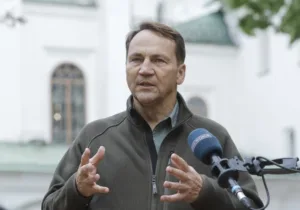
Speaking at a Brussels Report event near the European Parliament on July 14, Puzder defended the recently negotiated US-EU trade agreement while warning that Europe’s biggest economic challenges are largely self-inflicted.
Puzder described the transatlantic relationship as the world’s most important economic partnership but argued it had become increasingly unbalanced. The two sides account for almost 30 per cent of global trade in goods and services and 43 per cent of global gross domestic product (GDP), according to the Council of the European Union.
“The European Union is our biggest trading partner,” he said, while noting that the United States continues to run a trade deficit with the bloc.
According to Puzder, the foundations of the post-Cold War economic relationship had fundamentally changed.
“When the Berlin Wall fell, the United States continued to provide Europe’s defence while maintaining favourable trade arrangements. But the world has changed.”
He argued that tariff disparities between the two sides had become unsustainable and said both European Commission President Ursula von der Leyen and US President Donald Trump had recognised the need for a new approach.
“This relationship needed to be rebalanced.”
While acknowledging disagreements over issues such as Greenland, US court rulings and Iran, Puzder dismissed them as “bumps in the road”, stressing the bigger picture.
Giving credit to the European Commission for reaching an agreement, he described the negotiations as “a ten-month journey”. The deal was struck by von der Leyen and Trump in July 2025 and set out in a joint statement on August 21, 2025.
‘NON-TARIFF BARRIERS ARE MUCH TOUGHER’
The ambassador argued that tariffs are no longer the principal obstacle to transatlantic trade.
“The non-tariff trade barriers are much tougher.”
He singled out a range of EU regulations, including methane emission rules, the EU Deforestation Regulation (EUDR) and the Digital Markets Act, as examples of measures that impose substantial costs on businesses. The EUDR, adopted in 2023, has been postponed twice and will apply to large and medium-sized operators from December 30, 2026.
According to Puzder, these regulations ultimately hurt Europe’s own economy.
“They are devastating European economies.”
Puzder argued that Europe could no longer rely on the economic assumptions that had underpinned its prosperity for decades.
“The assumptions were cheap Russian energy, an endless Chinese export market and American security guarantees.”
“All three have collapsed.”
Combined with Europe’s extensive welfare systems and complex regulatory environment, he said, this had undermined competitiveness.
“The welfare state isn’t going away,” he said. “The solution is economic growth.”
Excessive regulation, he argued, was preventing that growth.
Quoting Mistral AI chief executive Arthur Mensch, Puzder said innovative companies in Europe eventually “hit a wall” before relocating investment elsewhere.
“Companies move to the United States or China because it’s easier to manufacture and grow there.”
To illustrate Europe’s relative decline, Puzder pointed to output per head.
“Germany’s GDP per capita is now below that of West Virginia. Germany would be one of the poorer states if it were part of the United States.”
AI ‘IS THE ECONOMY’
Puzder described artificial intelligence (AI) as the defining economic challenge of the coming decades.
“The AI economy is the economy.”
He praised Europe’s universities and scientific talent but argued that success in AI requires five essential ingredients: Abundant energy, critical minerals, data centres, access to data and advanced hardware.
Because of a lack of opportunities in Europe, he said, many tech entrepreneurs, scientists and thinkers move to the US to do bigger business.
He called for greater investment in nuclear power, fossil fuels and liquefied natural gas to provide reliable baseload electricity.
He also criticised EU regulatory action against major technology companies.
“Companies constantly complain to me about fines and regulation.”
“It’s important that these fines stop.”
“If you want European companies to grow, you need to remove what stops them from growing, not prevent American companies from growing.”
Puzder said the United States wanted to cooperate closely with Europe on emerging technologies such as quantum computing and AI but argued that the current regulatory climate was undermining that partnership.
MIGRATION IMPROVING, FREE SPEECH REMAINS CONCERN
Turning to broader political issues, Puzder said Europe had made noticeable progress in reducing illegal migration.
“Europe is doing a lot.”
“Illegal migration is falling, asylum claims are dropping and returns are increasing.”
“You can do more, but compared to where you were, you’ve made progress.”
On freedom of speech, though, he expressed concern about developments in several European countries.
He stressed that these were primarily issues for individual member states rather than EU institutions but singled out Germany as an example.
“In Germany, you can get into trouble for criticising politicians.”
According to Puzder, restrictions on political expression risk fuelling support for anti-establishment parties.
“That is feeding what they call the far right.”
Despite his criticism of EU regulation, Puzder also cautioned against assuming all right-wing parties were aligned with the Trump administration’s trade agenda, noting that both Hungary’s Fidesz and France’s National Rally had opposed or criticised elements of the US-EU trade agreement.