






Armenian law enforcement officers have detained former president Robert Kocharyan on corruption charges, a day after Prime Minister Nikol Pashinyan told parliament that the country could lodge a European Union membership application in the near future.
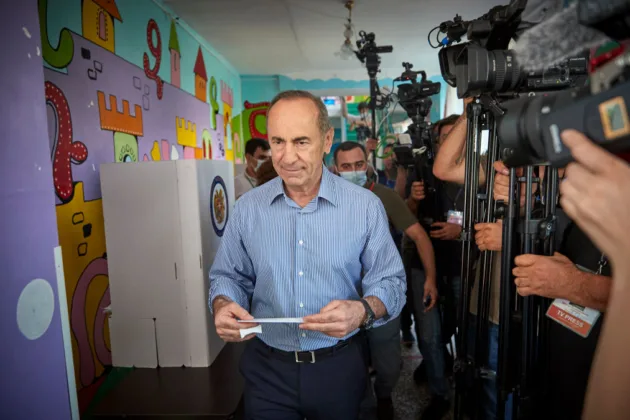
Kocharyan, 71, was taken to the Anti-Corruption Committee in the capital Yerevan on the morning of August 25. His eldest son Sedrak and four other people were detained in the same operation, the committee said.
The Prosecutor General’s Office opened the case on August 24. It charged Kocharyan with three counts of abuse of official powers, two of taking bribes on a particularly large scale and four of large-scale money laundering.
Prosecutors said he had used his position as president between 1998 and 2008 to move state property to himself and to people close to him at prices well below market value. They said the assets were registered to affiliated companies to disguise who controlled them.
The assets cited include land around the Cascade complex in Yerevan and the Kaputak Sevan sanatorium. Investigators also allege that a 30 per cent stake in the dealership Toyota Yerevan was signed over to Sedrak Kocharyan as a bribe.
The Anti-Corruption Committee said it was examining transfers made in the son’s name between 2001 and 2019 worth about 144 billion Armenian drams, $309 million (€265 million), €77 million and 18 million roubles.
Nine other people face prosecution in the same proceedings. They include former president Serzh Sargsyan, former Yerevan mayor Gagik Beglaryan, businessman Samvel Mayrapetyan and the late prime minister Andranik Margaryan, who died in 2007.
Kocharyan’s lawyer Aram Orbelyan said the allegations related to government decisions approved while his client was in office. A spokesman for the former president described the case as “politically motivated”.
Kocharyan leads the Armenia Alliance, the second-largest opposition bloc in parliament and the main pro-Moscow force in the country’s politics. He was prosecuted in 2018 over the deadly suppression of protests after the 2008 election, though the case collapsed in 2021.
The detentions followed a parliamentary exchange on August 24 in which Pashinyan challenged the family over its wealth. Levon Kocharyan, an opposition MP whose home was among the addresses searched, had called the Prime Minister a traitor.
Pashinyan’s Civil Contract party won 64 of the 105 seats in the June 7 election and the European Commission opened the bloc’s market to most Armenian exports on July 2. The Parliamentary Assembly of the Council of Europe flagged Armenia in January for political polarisation and institutional fragility after the arrest of several senior clerics.