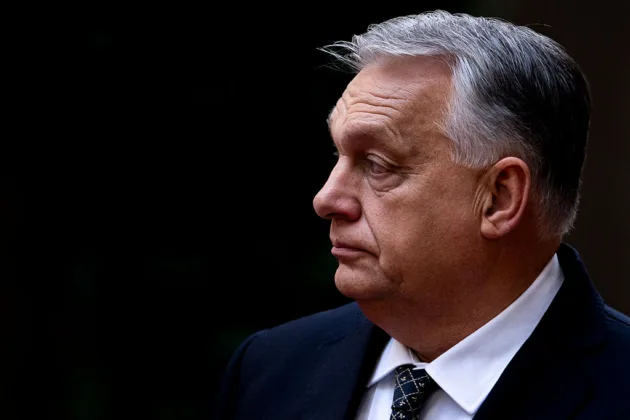







Hungary’s ruling Tisza party has nominated András Baka, a former president of the Supreme Court, as its candidate for the largely ceremonial post of President of the Republic.
The parliamentary group of Tisza, led by Prime Minister Péter Magyar, announced the decision on August 8 following a secret ballot. Baka was picked from a shortlist of three, alongside the lawyer Botond Fülöp and the historian Ignác Romsics.
Baka is expected to be elected by the National Assembly on August 11, when the party’s two-thirds majority makes the outcome a formality. Tisza holds 141 of the 199 seats, above the threshold needed in the first round of the secret ballot.
Tisza lawmakers praised Baka’s longstanding commitment to the separation of powers, the rule of law and judicial independence. They described his experience as a significant asset at a time when the party is preparing the foundations for a new constitutional order.
Baka, 73, previously served two terms as a judge at the European Court of Human Rights in Strasbourg, sitting for 17 years from 1991 to 2008 and spending a decade as a section vice-president. He was elected president of Hungary’s Supreme Court in 2009 for a six-year term.
The Fidesz government under Viktor Orbán removed him early in 2011 by reorganising the court as the Kúria and introducing new rules for its leadership. His mandate ended on December 31, 2011 under the transitional provisions of the Fundamental Law, and a requirement of five years’ judicial service in Hungary ruled him out of the new post because his Strasbourg years did not count.
The European Court of Human Rights later ruled that the premature removal violated his rights. Its Grand Chamber found in June 2016 that Hungary had breached his right of access to a court and his freedom of expression after he publicly criticised the judicial changes, and the Council of Europe’s Committee of Ministers has since pressed Budapest over its failure to implement the judgment.
“His life’s path serves as an example of commitment to a democratic rule of law and constitutional principles,” Magyar said.
“We are convinced that Dr András Baka’s experience and the professional independence he has demonstrated throughout his life represent particular value in this period, during which we are preparing to jointly lay the foundations of Hungary’s new constitutional order.”
The nomination follows the early termination of the previous president, Tamás Sulyok, an Orbán-era appointee.
In July, Tisza used its supermajority to pass the 17th amendment to the Fundamental Law, which ended Sulyok’s term the day after it entered into force. The July 13 vote was carried by 139 to six, and his mandate lapsed on July 20.
Sulyok had refused repeated calls to resign. He sought a review by the Constitutional Court and an opinion from the Council of Europe’s Venice Commission.
Seven of the court’s 15 judges declared a personal interest in the case, leaving the bench short of the 10 required for a quorum. The Venice Commission declined to use its urgent procedure and will examine the amendment in October.
Fidesz boycotted the parliamentary vote, denounced the move as autocratic and a “constitutional coup” and argued it violated the rule of law.
Sulyok ultimately signed the amendment under threat of impeachment proceedings, while describing it as trampling on democratic values.
Amnesty International Hungary criticised the method of the new Hungarian Government. The organisation argued that removing him via a rapid constitutional amendment disregarded his right to due process and that the proper route was the existing impeachment procedure with full constitutional safeguards.
It also objected to the short five-day public consultation period, below the eight days it said were the usual minimum, while accepting that Sulyok’s departure was warranted.
An earlier preferred candidate, chess grandmaster Judit Polgár, declined the role after Magyar named her without the public consultation he had promised.
Fidesz and its ally the Christian Democratic People’s Party (KDNP) are taking part in neither the nomination nor the vote, arguing that the post is not vacant. Fidesz parliamentary group leader János Bóka has called Baka a puppet of the Tisza majority.
A TISZA-frakció az imént titkos szavazással meghozta az eddigi egyik legfontosabb döntését: Dr. Baka Andrást, a Legfelsőbb Bíróság korábbi elnökét jelöljük Magyarország köztársasági elnökének.
Dr. Baka András több évtizedes hazai és nemzetközi jogászi, bírói tapasztalattal… pic.twitter.com/xnLkdaXmUV— Magyar Péter (Ne féljetek) (@magyarpeterMP) August 8, 2026