

August casts a long shadow over Iran. Thirty-eight years ago, facing one of the gravest crises in its history, the clerical regime turned its fury against political prisoners.
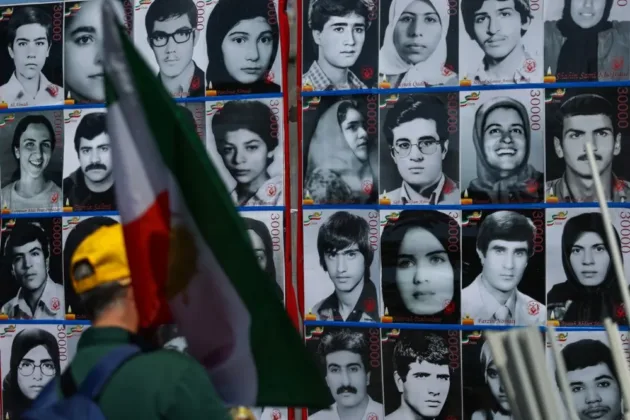
The result was the 1988 prison massacre, in which some 30,000 prisoners, most of them members and supporters of the principal Iranian opposition movement, the People’s Mojahedin Organisation of Iran (PMOI/MEK), were summarily executed and buried in secret mass graves, according to the PMOI’s own count. Independent human rights organisations, among them Amnesty International and Human Rights Watch, put the toll at between 2,800 and 5,000. The regime believed that by exterminating its most steadfast opponents, it could secure its own survival.
Today, the Tehran regime is again reaching for the same bloody playbook.
The parallels are striking. In 1988, Ruhollah Khomeini had just accepted a ceasefire in the Iran-Iraq war after years of insisting that the conflict continue until the conquest of Jerusalem. Weakened, humiliated, fearful of internal dissent and confronted by an organised opposition it could not politically defeat, the regime turned its repression against defenceless political prisoners.
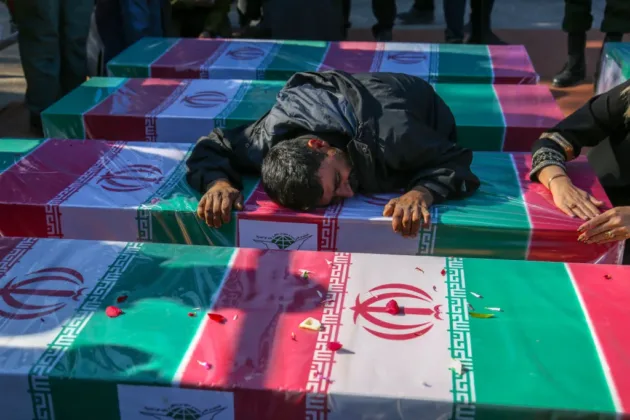
Fast forward to 2026, the regime faces another existential crisis. War has exposed its vulnerabilities. The elimination of its supreme leader, Ali Khamenei, killed in a US-Israeli strike on Tehran on February 28, 2026, and of top commanders of the Islamic Revolutionary Guard Corps (IRGC) has shaken the ruling apparatus. His son, Mojtaba Khamenei, was named Supreme Leader on March 8. Economic hardship, inflation, unemployment and corruption have intensified public anger. At the same time, an increasingly organised opposition inside the country has challenged the regime’s monopoly on fear.
Once again, Tehran’s answer is not reform or accountability; it is execution.
Since July 2025, 10 PMOI members have been executed, according to the National Council of Resistance of Iran (NCRI). 13 more are now on death row, among them two women, one only 25 years old, the other 68, illustrating the indiscriminate cruelty of a system that treats political conviction as a capital offence. These are not ordinary judicial cases. They are political messages written in blood.
One recent example is Isa Chari, a 37-year-old Baluch labourer and father of two, sentenced to death by Branch 23 of Tehran’s Revolutionary Court on charges of PMOI membership and “anti-security measures”. He was arrested in Varamin, southeast of Tehran, on December 7, 2025. Other political prisoners face similar pressure and death threats on charges of PMOI membership.
The opposition has documented the final messages and testaments of executed members of the Resistance Units. Their writings, composed under the shadow of the gallows, reflected not regret but resolve. Among them was Mehdi Khanaki, 26, executed on July 22, 2026, whose final testament, “I will remain a Mojahed and die a Mojahed”, has become a symbol of defiance against a regime that seeks not merely to kill its opponents, but to break their will.
The crackdown extends far beyond those already named. Roughly 2,000 members of the Resistance Units have been forcibly disappeared, detained, killed or executed, the NCRI says. Those arrested during the January 2026 uprising have faced torture, lengthy prison terms and execution. At least 30 have already been hanged, including an 18-year-old on April 2, 2026 and two in public in Isfahan on July 28. Amnesty International has documented at least 26 executions linked to the January protests in the first half of 2026, and at least 26 more on other politically motivated charges. The objective is clear: To intimidate the public and prevent a new wave of nationwide unrest.
This is precisely how 1988 began: Not with a single massacre announced to the world, but with demonisation, secret proceedings, isolated prisoners and a systematic effort to strip political opponents of their humanity before eliminating them. By the time the world grasped the scale of the crime, thousands had already perished.
The most disturbing parallel today is not only the regime’s brutality. It is international silence.
In 1988, the world did more than fail the victims. Governments looked away. International institutions failed to investigate. Many Western capitals, eager to preserve relations with Tehran, effectively buried one of the late twentieth century’s worst atrocities, which Javaid Rehman, then the United Nations Special Rapporteur on human rights in Iran, concluded in a July 2024 report amounted to crimes against humanity and could meet the threshold of genocide. The perpetrators learned a dangerous lesson: Political mass murder carried no meaningful cost.
That lesson must not be reinforced today.
The UN, the EU, the US and others must publicly condemn the death sentences against political prisoners, demand access to Iran’s prisons for international investigators and hold accountable the judges, prosecutors, prison officials and security commanders responsible for these abuses. Above all, they must make clear that any repeat of 1988 will carry serious consequences.
History is offering the world a second chance. The warning signs are no longer subtle. Iran’s political prisoners do not need sympathy decades from now. They need action today. If the world remains silent again, it will not be able to say it did not know.