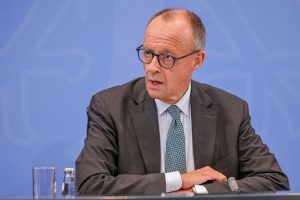












Only 10 per cent of German voters are satisfied or very satisfied with Chancellor Friedrich Merz, the lowest figure for any chancellor since the ARD-Deutschlandtrend began in 1997, according to the Deutschland Wählt, an independent, data-driven political tracking project.
Eighty-eight per cent say they are less satisfied or not satisfied at all.
The rating is down three points from the start of September, when 13 per cent were satisfied.
Dissatisfaction rose five points.
Infratest dimap interviewed 1,303 eligible voters aged 18 and over by telephone and online between September 28 and 30.
The margin of error is typically two to three points.
Satisfaction with the Union–SPD government is equally low.
Ten per cent are satisfied or very satisfied with its work, and 89 per cent are not, according to the ARD-DeutschlandTrend matrix integrated into the tracking archive, this is a historic low for the series.
This immense personal drag means that 90 per cent of the electorate is actively dissatisfied with his leadership style, poor communication, and handling of the economy, indicating that the chancellor himself has become a major liability rather than a driving force for his party.
Other ministers score better.
Defence minister Boris Pistorius of the SPD is on 50 per cent. Foreign minister Johann Wadephul of the CDU is on 34 per cent, and interior minister Alexander Dobrindt of the CSU on 27 per cent.
On voting intention, the Alternative für Deutschland is unchanged on 27 per cent, ahead for a sixth consecutive month.
The CDU/CSU is down one point to 20 per cent, its lowest in the Deutschlandtrend since September 2021, and seven points behind the AfD.
The Greens are up one point to 16 per cent, the SPD unchanged on 13 per cent, and the Left down one point to 11 per cent.
The FDP remains on 4 per cent, below the 5 per cent threshold for seats in the Bundestag.
The poll follows a poor result for the CDU in Mecklenburg-Vorpommern, where the party took 4.9 per cent in the state election on 20 September and failed to enter a Land parliament for the first time in its history.
The continuous Sonntagsfrage (Sunday Poll) exposes a severe problems for Merz’s governing coalition, with the CDU/CSU dropping 3 per cent compared to the elections, below the symbolic 20 per cent threshold and far behind the Alternative for Germany Party, which is firm in the lead.
BUNDESTAGSWAHL | Sonntagsfrage Infratest dimap/ARD
AfD: 27%
Union: 20% (-1)
GRÜNE: 16% (+1)
SPD: 13%
LINKE: 11% (-1)
FDP: 4%
Sonstige: 9% (+1)Änderungen zur letzten Umfrage vom 03. September 2026
Verlauf: https://t.co/yezJbEnw88#btw29 pic.twitter.com/95KmVjqpcH
— Deutschland Wählt (@Wahlen_DE) October 1, 2026