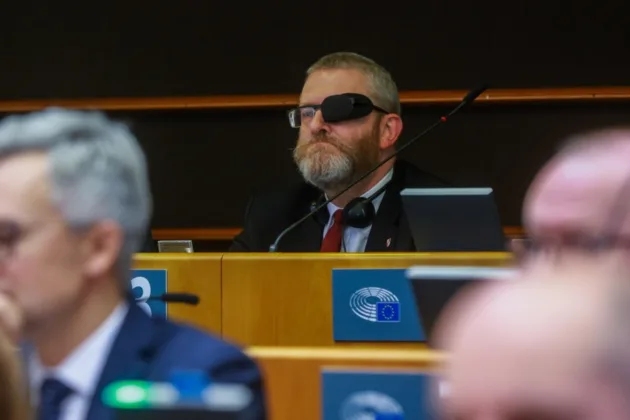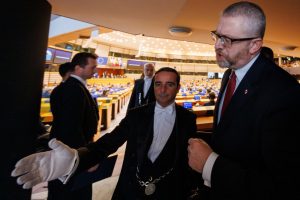









The leader of Poland’s Confederation of the Polish Crown (KKP) party and MEP Grzegorz Braun has been charged by Poland’s Institute of National Remembrance (IPN) with denying German Nazi crimes.
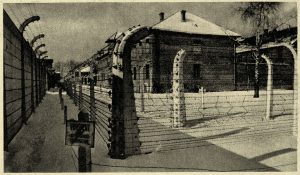
Prosecutors allege that in July 2025, in the towns of Jedwabne, northeast Poland, and the capital city Warsaw, Braun publicly questioned the existence of gas chambers at the former German Nazi concentration and extermination camp of Auschwitz-Birkenau, and their use for the mass killing of prisoners.
Denying German Nazi crimes is a criminal offence in Poland under Article 55 of the IPN Act, punishable by a fine or up to three years in prison.
The charge follows the European Parliament’s decision on March 26, 2026, to lift Braun’s parliamentary immunity, after prosecutors opened an investigation on July 14, 2025, based on complaints from, among others, the Auschwitz-Birkenau State Museum, the Left party MP Anna Maria Żukowska and the Basta Foundation.
The remarks were made on July 10, 2025, in an interview on internet broadcaster Radio Wnet and on July 14 on the YouTube programme Jan Pospieszalski rozmawia (Jan Pospieszalski in conversation), in which Braun said: “Ritual murder is a fact and, let us say, Auschwitz with gas chambers is unfortunately fake.” On hearing these remarks the interviewer promptly terminated the conversation with Braun.
“Ritual murder” is a claim that has been used for centuries by anti-Semites to inflame anti-Jewish sentiments.
Braun was summoned to IPN’s branch office in the southern city of Kraków on August 25, 2026, where he was informed about the charges made against him.
The prosecutors have focused specifically on the gas chamber remarks made by Braun.
The IPN, the body in Poland which is responsible for investigating Second World War and post-war communist crimes, has stated that the claims contradict well-established historical knowledge based on documents, witness testimony, perpetrators’ own admissions and criminal investigations, both past and ongoing.
It added that traces of hydrogen cyanide in the remains of the camp’s mass-killing apparatus were confirmed by scientific studies carried out in the 1990s by the Kraków-based Institute of Forensic Research.
Braun refused to retract the comments for which he was charged and did not admit guilt, declining to give testimony until he receives the written grounds for the charges.
Speaking to his supporters gathered outside the IPN’s Kraków office, Braun said: “They try to blackmail the public by saying these are universally known and unquestionable facts. I do question them, at that one sensitive point: those mythical gas chambers at Auschwitz.”
Auschwitz-Birkenau was the largest German Nazi concentration and extermination camp in occupied Poland. At least 1.1 million people were murdered there during the Second World War, about one million of them Jews.
Meanwhile, Braun is already being tried in Poland for seven other alleged offences including attacking a Hanukkah celebration and supposed assault on a gynaecologist at a hospital in Oleśnica, southwest Poland.
The district prosecutor’s office in Warsaw has separately charged Braun with other alleged crimes, including the theft of Ukrainian and EU flags he tore down and vandalising an LGBT+ exhibition.
No Polish politician of note before Braun has ever questioned the Holocaust. The existence of the gas chambers in Auschwitz-Birkenau has been verified, among others by the Polish underground officer Witold Pilecki.
Pilecki volunteered to infiltrate the death camp during the war before escaping in April 1943. His testimony formed a key part of evidence submitted to the Western allies by the Polish underground forces of the Home Army (AK).
Pilecki, who later fought in the Warsaw Uprising, was arrested, tried and executed in 1948 by Poland’s communist authorities installed after the war by the Soviet Union. The whereabouts of his remains are unknown and are still being investigated by the IPN.
Braun though has expressed scepticism about Pilecki’s testimony about the existence of the gas chambers in Auschwitz-Birkenau. He claims that there is no evidence that Pilecki actually saw the gas chambers with his own eyes.
The MEP has protested against Israel’s actions in Gaza, which he has called genocide. He was removed from the chamber of the European Parliament for interrupting a commemoration of the Holocaust.
In Poland Braun came to prominence when still as an MP for the Confederation Liberty and Independence (Confederation) party he doused a Hanukkah menorah in the Polish parliament with a fire extinguisher in December 2023, an action for which he is being prosecuted.
The highly visual act ensured that Braun stood out from the crowd and became a cause célèbre. At public meetings young people lined up with fire extinguishers for Braun to sign.
In 2024 Braun stood for Confederation in the European Parliament election and won a seat but as a result of his controversial views, considered to be anti-Semitic, he has not been admitted into any of the right-wing groups in the European Parliament.
Meanwhile, Braun pursued a strategy of staging visual stunts such as the taking down of Ukrainian flags from public buildings, burning an EU flag and knocking down the exhibits of a pro-LGBT exhibition in the Polish parliament. He has also been involved in disrupting an academic conference on the Holocaust which he considered to be anti-Polish.
In January 2025 Braun was expelled from Confederation after announcing he would stand in the presidential election, in which his former party supported the libertarian Sławomir Mentzen.
During the election campaign he was involved in an attempted citizen’s arrest on April 16, 2025 of a gynaecologist at a hospital in Oleśnica who had terminated a pregnancy at 36 weeks. Prosecutors discontinued their investigation into the doctor in December 2025, finding no criminal offence. The action gained him considerable sympathy among devout Catholics and he also gained considerable support for his strongly anti-Ukrainian stance.
Despite his campaign being ignored by the mainstream state and commercial media he polled 6.34 per cent of the vote and came fourth. In the second round he supported the eventual winner, the opposition Law and Justice (PiS)-backed Karol Nawrocki.
Since the presidential election Braun’s Confederation of the Polish Crown has steadily grown its support from below 5 to around 10 per cent, with an IBRiS poll for Rzeczpospolita on July 24-25, 2026 putting it at 10.9 per cent.
This means that Braun’s party is projected as being required for the formation of a right-wing government after the 2027 parliamentary election. Most polls point to a scenario in which without his support the other parties of the right, PiS, Confederation and the new Rozwój Plus (Development Plus) grouping led by former PiS prime minister Mateusz Morawiecki, would not have a majority in parliament.
The problem is that PiS, Morawiecki and also Confederation are at the moment ruling out any coalition with Braun because of his alleged anti-Semitism and sympathy for Russia which he has expressed in his criticism of Ukraine. PiS leader Jarosław Kaczyński told Wirtualna Polska in June 2026 that he considered Braun “very dangerous” and would rather not govern than govern with him.
US ambassador in Warsaw Tom Rose has on several occasions criticised Braun and has hinted that President Donald Trump’s Republican administration would find the maverick MEP’s participation in a future Polish government hard to accept.
Braun has tended to take votes from PiS rather than the libertarian nationalist Confederation party.
In response PiS has tilted rightwards on issues such as the EU and Ukraine. But the problem is that PiS’ track record when in government (2015-2023) was of staunch support for Ukraine and the Ukrainians and that the party swallowed the EU’s Green Deal and did not block the conditionality mechanism later used to block EU funds for Poland.
PiS will not support Poland leaving the EU nor the stopping of all support for Ukraine. Braun has no hesitation in campaigning for both and is therefore hard to trump on the right.
According to Polish political scientist Rafał Chwedoruk the emergence of Braun led indirectly to PiS splitting because it was the Braun surge in the polls which led Kaczyński to choose the former education minister Przemysław Czarnek, who favours the pursuit of identity issues and is sceptical about Poland supporting Ukraine, as the party’s candidate for prime minister in March 2026, over former PiS prime minister Mateusz Morawiecki.
Morawiecki took the March decision badly and spent the following months building his own faction inside the party which split off in July 2026 following an ultimatum from the PiS leadership over its legal status being disbanded. Around 40 PiS parliamentarians left with him.
As a result there are now four parties of the right which together are polling just under 50 per cent, at 47.9 per cent in the late-July IBRiS survey, but with no party polling in excess of 20 per cent.
This means that, despite being hit with several scandals including gross malpractice and cronyism in the health service and the way flood relief was handed over to party allies, Donald Tusk’s ruling Civic Coalition (KO) still has a poll lead, even though that lead is insufficient to be able to form a majority government because of the poor poll performance of its coalition partner.
Though one survey has shown that should Tusk’s party and his coalition partners from the Left Party and the centre-right Polish People’s Party (PSL) stand on a joint slate they could poll just over 45 per cent, a level of support which given that Poland’s electoral system in the parliamentary election system favours large parties, should be enough to achieve a majority.
There is no certainty yet that there will be a joint list nor that the right will actually enter the election as fragmented as it is today. It is more than likely that President Nawrocki will want to help achieve a right-wing majority and he has become Poland’s most popular politician.
But it is unlikely that he could, or would want to, see Braun as part of any electoral alliance in the election to the ruling chamber, the Sejm, whereas it is possible that such a tactical alliance might form for the revising second chamber, the Senate, which is elected in 100 one-member constituencies on a first-past-the-post basis.
Nawrocki, before becoming President, headed the IPN, the body now prosecuting Braun for his alleged Holocaust denial, from 2021 to 2025. He is known for his staunch anti-Russia stance and in his time as head of state has been President Trump’s closest ally in Europe.