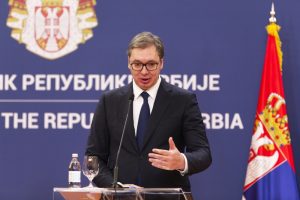
Serbian President Aleksandar Vučić has warned that the world stands “at the beginning of a bigger war” in an interview with Axel Springer CEO Mathias Döpfner conducted shortly after hosting Ukrainian President Volodymyr Zelensky in Belgrade.
In the latest episode of Döpfner’s podcast MD MEETS, published on August 9, Vučić said: “I think we are at the beginning of a bigger war. And that is why I had hoped that by now someone else would have done something to create peace. That has not happened, and it will not happen soon, which means that we are on the brink of a much, much bigger war.”
He added that he hated having to say it.
The conversation took place one day after Zelensky’s first visit to the Serbian capital on August 7-8, a move that surprised many given Serbia’s traditionally close ties to Russia.
Vučić defended the meeting and Serbia’s independent stance, stating he was “not here to please the Russians, the Ukrainians or anyone else — only the Serbs”.
He said he had not informed Russian President Vladimir Putin in advance, noting that Serbia “is not a puppet of any other country”.
He also observed that his contacts with Putin had become less frequent.
On the war in Ukraine, Vučić was pessimistic about a near-term resolution.
He said he saw no end this year or before the spring of 2027, arguing that one side must become stronger and, in some form, victorious for the conflict to conclude.
In the current stalemate, he saw little prospect of compromise because “nobody wants to see peace. Everyone wants to see the defeat of the other side.”
Both leaderships, he noted, were under intense pressure from daily losses.
Vučić cautioned against waiting for the exhaustion of Russian forces, describing Russia as a nuclear power that could not easily be defeated and calling instead for compromise solutions rather than the defeat of either side.
On hybrid warfare, when asked about Russian actions in European countries, he compared them to European support for Ukraine through arms, sanctions and finance, describing the latter as “essentially the same” as hybrid war against Russia.
He acknowledged, though, that Ukraine had not started the war and that aggressor and victim should not be confused.
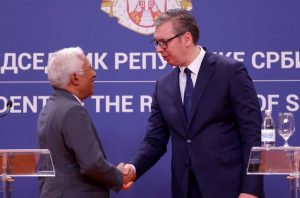
At the joint press conference on August 8, Vučić said Serbia respected Ukraine’s territorial integrity and would back its bid to join the European Union, while repeating that Belgrade would not sanction Moscow.
The discussion also covered Serbia’s balancing act between Russia, Ukraine, China and the European Union, the shifting global power balance (with the US and China as the main poles and the EU as a potential third), Europe’s economic competitiveness, and other regional issues including NATO and Kosovo.
Vučić expressed concern about Europe’s economic decline and the need for the continent to work harder to remain competitive in a more dangerous era.