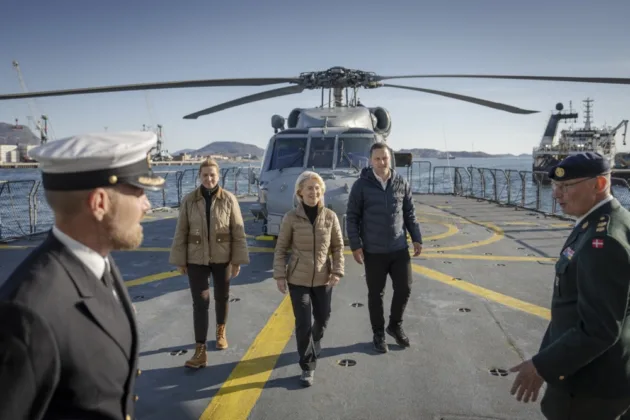



The European Commission has said its President, Ursula von der Leyen, would travel to Greenland on August 30-31 to sign a joint declaration between the European Union and the Arctic island.
Chief spokesperson Paula Pinho announced the trip at the Commission’s midday briefing in Brussels on August 27, describing Arctic security and cooperation as a key priority for the EU.
Von der Leyen is due to meet Greenlandic Prime Minister Jens-Frederik Nielsen, Danish Prime Minister Mette Frederiksen and Faroese Prime Minister Beinir Johannesen during the two days.
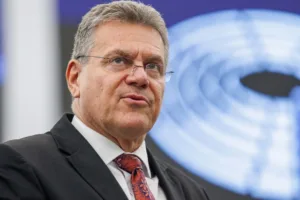
She will be accompanied by International Partnerships Commissioner Jozef Síkela and by Jyrki Katainen, the former Finnish prime minister designated in April as special adviser for EU-Arctic relations.
The visit had originally been planned for March. It was put off after Frederiksen called an early Danish general election for March 24, which left neither bloc with a majority and opened more than two months of coalition talks.
Frederiksen returned to office on June 3 at the head of a four-party minority government.
Von der Leyen last went to Greenland in March 2024, when she and Frederiksen opened the EU office in Nuuk. She became the first Commission President to visit the Faroe Islands on the same trip.
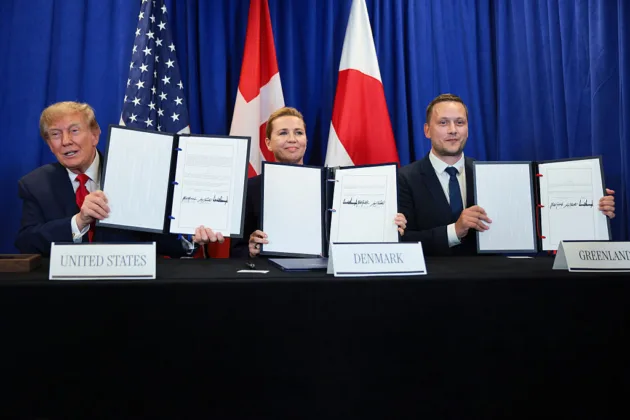
Relations with Washington have dominated Arctic diplomacy since. US President Donald Trump spent much of late 2025 and early 2026 pressing for American control of the territory of 57,000 people, citing national security.
In January he said he would impose a 10 per cent tariff on goods from Denmark, Norway, Sweden, France, Germany, the United Kingdom, the Netherlands and Finland, rising to 25 per cent in June, over their part in Arctic Endurance, a Danish-led NATO exercise.
Von der Leyen and European Council President António Costa said in a joint statement on January 17 that the EU stood “in full solidarity with Denmark and the people of Greenland”.
Trump later dropped the tariff threat and Copenhagen, Nuuk and Washington opened talks on Arctic security.
Denmark has since expanded its own military presence on the island, sending conscripts to Greenland for the first time in early August.
Síkela travelled to Nuuk in May, where he set out €50 million in EU investment and said a revised Arctic strategy would be published by the end of the year.
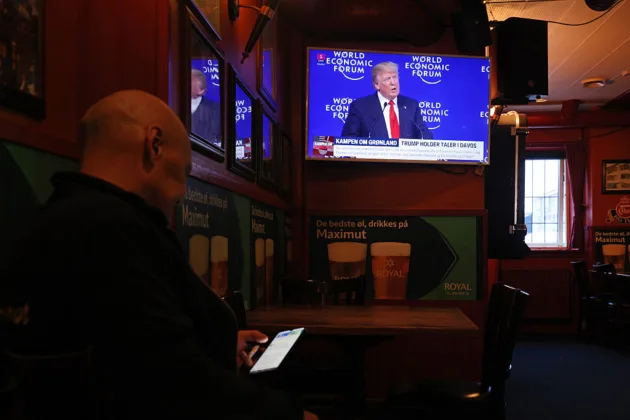
Von der Leyen announced that review at the World Economic Forum in Davos in January, arguing the region had moved to the centre of geopolitics.
Greenland left the European Communities in 1985 and is now an overseas country and territory associated with the bloc, with an EU office in Nuuk since 2024.