





The United States has bought Japanese yen using euros rather than dollars, in a coordinated operation with Tokyo that has left the European Central Bank watching from the sidelines while its own currency served as the instrument.
Japan confirmed on August 3, 2026 that it had intervened in currency markets on July 31 alongside the US Treasury, the first joint yen-buying operation by the two countries since 1998.
US President Donald Trump had already disclosed Washington’s role the previous day, casting it as a favour to an ally. “They wanted a little bit of help, and we’re always there for Japan,” he told reporters.
Rather than selling dollars to buy yen, the Treasury sold euros, the Financial Times reported, citing people familiar with the matter. Two market sources later confirmed the account to Reuters.
The Federal Reserve Bank of New York, which executes intervention on the Treasury’s behalf, placed the trade through Goldman Sachs and Morgan Stanley, the FT said. HSBC called the choice “a highly unusual — maybe unprecedented — step”.
The yen had slid to 163.73 to the dollar on July 30, its weakest in close to four decades. It reached 155.20 on August 3, its strongest in almost three months, before easing back to about 157.5 by August 5.
The euro fell from a high of 187.4 yen on July 30 to briefly below 180 on August 3, a move of more than 4 per cent. It has since settled between 181 and 183.
Bank of Japan data indicated Tokyo may have sold as much as $58.97 billion (€51.1 billion) on July 30, before the joint operation the following day. Estimates of the combined effort have run to around $87 billion (€75.4 billion).
A photograph taken at a US cabinet meeting at Camp David, Maryland on July 31 showed a notepad in front of US Treasury Secretary Scott Bessent reading “Buy Japanese Yen (JPY) $5-10 bil”.
Bessent said Washington would not hesitate to take part in further joint intervention. Japanese finance minister Satsuki Katayama said Tokyo stood ready to act again.
Currency strategists read the choice of euros as an attempt to help Japan without signalling that Washington wants a softer dollar.
The United States is running inflation above target, and analysts at MUFG said a weaker dollar would complicate efforts to bring it down. Barclays said the decision kept the operation “a yen-only affair”.
Jason Wong, a currency strategist at Bank of New Zealand, said it was “not a good look for the US Treasury to be selling US dollars”.
Robin Brooks, of the Brookings Institution in Washington, argued the approach was self-defeating. “This kind of twist in my opinion undercuts the efficacy of US participation,” he wrote.
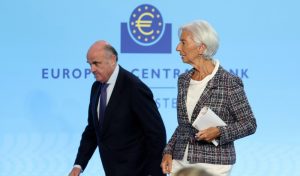
An ECB spokesperson declined to comment on reports that US authorities had sold euros. A source familiar with events said the bank had been in contact with the Fed.
Bessent addressed the matter himself on August 4, saying he had been in close touch with European partners including central banks. “I assured them that it was just a reallocation of our reserves,” he told CNBC.
He went on to observe that the euro looked close to an equilibrium price, while declining to say where it ought to trade.
Being informed after the event, and then told by a foreign treasury roughly what your currency is worth, is a thin role for an institution that has argued since 2025 that the euro should become a genuine rival to the dollar.
European Central Bank President Christine Lagarde has said repeatedly that erratic American policy has opened a “global euro moment” for the single currency. An ECB report published on June 2, 2026 found the euro’s international standing had barely shifted, sitting at roughly 20 per cent across a broad set of indicators.
Brussels has meanwhile pressed ahead with the digital euro, presented as a way of loosening the bloc’s dependence on American payment networks. MEPs approved a negotiating mandate on July 9, 2026 by 416 votes to 169, with 22 abstentions.
Washington holds around €26 billion in readily deployable foreign currency, split evenly between the Fed’s System Open Market Account and the Treasury’s Exchange Stabilization Fund. MUFG judged the sums too small to shift the euro to any great degree.
The more awkward question is whether repeated American sales of euros would survive scrutiny at the G7 and G20, where members have long committed to letting exchange rates be set by markets.
Few analysts expect the intervention to hold. ING said it could create an inflection point though not overturn the divergence in interest rates. HSBC said only a structural shift in Bank of Japan policy would deliver a lasting recovery.
Bessent’s use of the fund follows its deployment to steady the Argentine peso. ING said the two episodes pointed to a Treasury increasingly willing to deploy it for wider geopolitical ends.
For the eurozone, the immediate market effect is modest. The precedent is not. The euro was neither defended nor negotiated over. It was spent, by someone else.