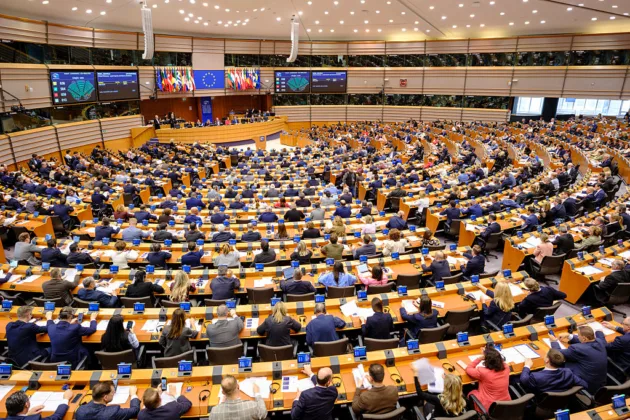





The European Parliament’s Committee on Economic and Monetary Affairs has approved the draft regulation on a digital euro, clearing a major procedural hurdle and moving the project closer to formal trilogue negotiations with the Council and Commission.
The move follows a February 2026 plenary resolution supporting both online and offline versions and aligns with the Council’s December 2025 negotiating mandate.
The European Central Bank has indicated it could be ready to issue the digital euro by 2029 if legislation is finalised this year or next.
The project, first formally proposed by the Commission in June 2023, is presented as a public digital complement to physical cash in a world where private payment systems and foreign stablecoins are gaining ground.
Proponents argue that Europe risks losing control over its monetary infrastructure.
As cash use declines, especially among younger generations and in contactless transactions, citizens and businesses increasingly rely on private intermediaries, many of them non-European.
A central bank digital currency (CBDC) would ensure continued access to public money in digital form, strengthen the euro’s role in payments, and provide a resilient, pan-European alternative to fragmented national schemes or foreign-dominated card networks.
The ECB and Commission also cite strategic autonomy.
European payments are dominated by US companies, ranging from Visa and Mastercard to PayPal and Google Pay or Apple Pay.
Only recently there has been a new European initiative with Wero.
With the rise of dollar-pegged stablecoins and China’s digital yuan experiments, a digital euro is framed as a tool to protect monetary sovereignty and reduce dependence on external payment rails.
Offline functionality is emphasised as a resilience feature, allowing payments even when networks fail.
The digital euro would be a direct claim on the Eurosystem, issued by the ECB but distributed through supervised intermediaries (primarily banks).
Users would hold it in digital wallets or accounts, with proposed holding limits (discussions have centred on €500 to €3,000 per person) designed to prevent large-scale shifts from bank deposits.
It would support both online instant payments and offline functionality similar to cash, with the latter offering higher privacy. Transaction details would remain known only to payer and payee.
Basic use is intended to be free for individuals, while merchants would face acceptance obligations in many scenarios.
The architecture is two-tier to preserve the banking sector’s role in credit provision and customer relationships.
Legal tender status and mandatory acceptance rules are under discussion, which would give the digital euro a competitive advantage over purely private solutions.
For consumers, it promises seamless, low- or no-cost payments across the euro area; peer-to-peer transfers, in-store purchases, and online transactions without needing multiple apps or foreign cards.
For the public sector and policymakers, it offers a programmable or programmable-adjacent tool for targeted disbursements in future crises, though current designs avoid full programmability to maintain public trust.
Businesses could benefit from faster settlement and potentially lower fees in a more competitive payments market.
First step: done.
Europe is restoring its sovereignty in payment methods from the oligopoly of US giants like Visa and Mastercard by adopting the digital euro.
— Aurore Lalucq 🇪🇺 (@AuroreLalucq) June 23, 2026
Critics, however, view the project as unnecessary at best and dangerous at worst.
Several economists and (former) policymakers argue that Europe already possesses efficient payment systems and that the digital euro risks solving non-existent problems while introducing new ones.
A major worry is financial stability.
In times of banking stress, a digital euro perceived as safer than commercial bank deposits could trigger rapid outflows, even with holding limits. This could raise funding costs for banks and ultimately increase borrowing rates for households and businesses.
The European Banking Federation (EBF) and several national banking associations have warned that the digital euro could trigger large-scale deposit outflows, particularly during periods of financial uncertainty, even with the proposed holding limits.
Banks argue that the project threatens their core retail deposit base, which forms the foundation of their lending activities, and would increase their funding costs.
Many institutions also fear losing direct customer relationships if citizens shift balances into ECB-backed digital wallets.
Rather than introducing a public competitor, the industry maintains that policymakers should focus on removing regulatory barriers to allow private innovation in payments to flourish across the single market.
Privacy remains one of the most contentious issues.
While offline payments are designed to mimic cash anonymity, online transactions would generate data for compliance purposes.
Many fear “function creep”, where the digital euro evolves into a surveillance tool.
Austrian MP and former OeNB Vice-President Barbara Kolm has warned that the digital euro represents “a threat to the very foundations of a free society”, potentially enabling control over monetary flows, compulsory use for state payments, and reduced freedom of choice.
Others, including Belgian MEP Johan Van Overtveldt, question the conceptual foundation.
They argue the project confuses payments infrastructure with money itself and may represent an admission of failure: Europe has struggled to foster truly competitive, continent-wide private payment solutions due to regulatory fragmentation and overregulation.
Instead of fixing those underlying problems, the EU appears ready to launch a public competitor.
There are also broader governance concerns.
The digital euro would give the ECB a much more direct relationship with citizens, expanding its role beyond traditional monetary policy.
Future decisions on remuneration, holding limits, or acceptance rules could become powerful tools with significant behavioural and economic effects.
Critics ask whether central banks should have such influence over everyday transactions.
Finally, the opportunity cost is significant. Resources poured into building and maintaining a complex CBDC infrastructure might be better spent improving existing instant payment schemes (such as SEPA Instant) or removing barriers to genuine private innovation across the single market.
With public trust in institutions already strained, the project risks reinforcing perceptions that Brussels prioritises control and sovereignty rhetoric over practical freedoms and proven market solutions.
European Union finance ministers have endorsed a plan by the European Investment Bank (EIB) to take on more risk and ramp up lending for military projects, energy security and technology. https://t.co/vGPlcPWJmA
— Brussels Signal (@brusselssignal) June 12, 2026