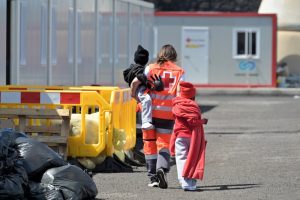











More than two-thirds of the children who illegally reached Europe in 2025 on the Mediterranean and Balkan routes arrived without a parent or guardian, United Nations agencies have said, even as the total number of child arrivals fell.
A joint report published on October 7 by the International Organization for Migration (IOM), the UN High Commissioner for Refugees (UNHCR) and the UN children’s fund UNICEF recorded 31,100 children arriving in 2025 in Bulgaria, Cyprus, Greece, Italy, Malta and Spain.
Some 20,800 were unaccompanied or separated from a parent or guardian.
Overall child arrivals by land and sea were down 25 per cent on 2024.
The share travelling alone rose from 51 per cent to 67 per cent.
Of those counted, 78 per cent were boys and 22 per cent girls.
The concentration is sharpest in Italy and Spain, where 86 per cent of the children arrived alone.
Italy was the exception to the fall: child arrivals there rose 12 per cent, to 14,083 by sea, of whom 12,177 were unaccompanied, many from Egypt, Eritrea, Bangladesh and Somalia.
Spain recorded more than 4,700 unaccompanied minors, chiefly from Algeria, Morocco, Mali and Senegal.
The Spanish Government has been moving them off the arrival points. Some 1,143 children had been transferred from the Canary Islands, Ceuta and Melilla to other regions by March 19, 2026 under a reform of article 35 of the immigration law, with about 3,800 still in the three territories.
Greece took in nearly 10,000 children, a little over 3,000 of them alone.
The agencies say poverty, conflict and environmental hazards are among the reasons people attempt the crossings, and that fewer legal routes “appeared to be pushing more children into dangerous journeys and the hands of smugglers”.
IOM director-general Amy Pope said the report showed “how exposed they are to violence and exploitation when safe pathways are limited and they have to rely on smugglers”.
Critics have long argued the opposite of the agencies’ “safe pathways” line.
The Italian Government says the certainty of rescue and disembarkation, including by NGO ships that patrol off Libya and then seek an Italian port, is itself a pull, and that smugglers price the crossing on that expectation.
Specific legislation was written to break the pattern. Decree-Law 1/2023, known as the Piantedosi decree after interior minister Matteo Piantedosi and converted into Law 15/2023, requires rescue vessels to sail for an assigned port immediately after a single rescue, on pain of fines and administrative detention.
Courts have since suspended several of those detentions. The Constitutional Court let the decree stand on July 8, 2025 but held that national rules cannot override the duty to save life at sea, and tribunals in Agrigento, Brindisi and Crotone have lifted individual impoundments.
Interviews with more than 4,600 people aged 15 to 24 on the Mediterranean, West African Atlantic and Western Balkan routes found that nearly half had suffered physical violence.
Most accounts described more than one form, including torture and kidnapping in transit and at borders. Some reported forced labour.
On the central Mediterranean route, 28 per cent said they had been held against their will and 17 per cent forced to work.
Libya was the place named most often.
The findings land four months into the bloc’s new asylum rulebook. The Pact on Migration and Asylum began to apply on June 12, 2026 and keeps children arriving alone out of the accelerated border procedure unless they are treated as a security risk.
The report is a count of those who arrived, not of those who did not. It does not estimate how many were turned back, how many died, or how old the unaccompanied claimants were found to be after assessment.
A 29-year-old asylum seeker living in Alkmaar is facing prosecution for the alleged rape of a 13-year-old Dutch girl. During court proceedings the man reportedly suggested marrying his victim as a way to resolve the matter. https://t.co/NxKIgzQBMZ
— Brussels Signal (@brusselssignal) June 29, 2026