Tens of thousands of people have gathered outside town halls across Spain in support of Ceuta, turning what was billed as an institutional act of solidarity into a public verdict on the Spanish Government’s handling of the border crisis.
Gatherings were held in more than 260 municipalities on September 2, the official day of the North African city, at the call of the Spanish Federation of Municipalities and Provinces (FEMP). Its president is María José García-Pelayo, the Partido Popular (PP) mayor of Jerez de la Frontera in southern Spain.
Crowds formed in Barcelona’s Plaça de Sant Jaume and in Zaragoza, Valencia, Seville, Palma, Santander, Murcia, Cáceres, Badajoz and Cartagena, as well as in towns across Asturias, Castilla-La Mancha and Andalusia.
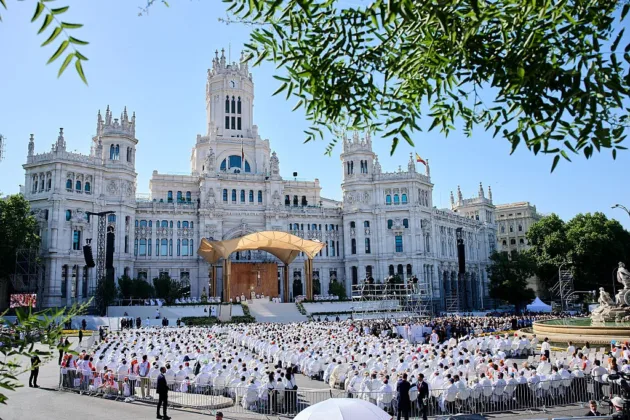
The largest was in Madrid’s Plaza de Cibeles. The Government Delegation put the crowd there at 50,000 and the city council at 150,000. Demonstrators carrying Spanish and Ceuta flags filled the roundabout, the start of the Gran Vía and stretches of the Paseo del Prado.
The main chant was “Ceuta no se vende, Ceuta se defiende” — Ceuta is not for sale, Ceuta is defended. Others demanded that Prime Minister Pedro Sánchez resign or be jailed.
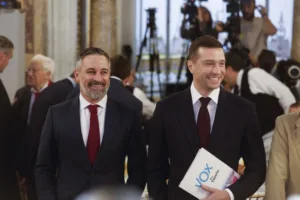
PP leader Alberto Núñez Feijóo and Vox leader Santiago Abascal both attended in Madrid, a rare joint appearance for two parties long at odds. Madrid regional President Isabel Díaz Ayuso also took part.
The capital’s mayor, José Luis Martínez-Almeida, was the only politician to speak from the stage, reading the FEMP manifesto and defending the Spanish character of the city.
Ayuso called for the Government to go. “They have abandoned not only Ceutans but all of Spain,” she told reporters, attributing the crisis to inaction and untruths on Sánchez’s part.
Feijóo said the Government stood “closer to Morocco than to Spain as a whole”. Abascal described the executive as a “traitor” and accused several ministers of knowing in advance that a mass crossing was coming.
Spain’s interior ministry has put at about 72,000 the number who crossed from Morocco on July 30 and 31. Rabat has given a lower figure of around 40,000. Most were returned within four days and at least 72 died, most by drowning. Ceuta has about 84,000 residents.
The rally followed the disclosure of a report by the Centro Nacional de Inmigración y Fronteras (CENIF), the intelligence unit of the National Police immigration directorate, sent to National Court judge María Tardón and revealed by El Español.
The 55-page document concludes that the crossing cannot be explained without “prior planning” and describes strategic direction and monitoring on the ground. It includes 32 photographs of Moroccan officers, uniformed and in plain clothes, guiding people towards the Tarajal breakwater.
Plain-clothes facilitators gave instructions to uniformed Moroccan police, the report says, adding that the migratory purpose served as formal cover.
It also records that 90.8 per cent of the telephone lines promoting the calls to gather carried a Moroccan prefix. Sánchez had said on Cadena SER that Russia, Israel and an international right-wing network were behind a disinformation campaign.
Spain’s interior ministry, in three statements in a single day, said it could not establish the involvement of any government, though it did not dispute the images analysed by CENIF.
The Guardia Civil is preparing a second report for the same judge which identifies members of Morocco’s intelligence services among those who crossed, ABC reported on September 3.
Sánchez released a video that morning to mark the day of Ceuta. He thanked residents for their serenity and acknowledged that “the state response is insufficient” until normality returns. He did not mention Morocco, referring instead to what happened on July 30 and 31.
He pointed to €309 million approved by the cabinet the previous day for humanitarian aid, security and local businesses.
The day was preceded by a dispute over the legal status of the events. Government delegate Francisco Martín wrote to Madrid council and other municipalities in the region to say mayors “do not hold the right of assembly” as institutions, so their notifications could not be processed as demonstrations.
The delegation said it had neither banned nor prevented the events, and that councils were free to hold institutional acts. Madrid council accused the Government of trying to sabotage public support for Ceuta.
Almeida said the delegate had helped bring people out by attempting to obstruct the event, and that an earlier police report had warned of a serious risk of a mass arrival.
Two other gatherings took place in Madrid that evening. A citizens’ initiative, Por Ceuta, assembled outside the Congress of Deputies, while a smaller protest at Plaza de Callao against racism drew figures from Podemos and Izquierda Unida.
Left-wing groups on several Madrid councils criticised the FEMP for putting an institutional initiative to partisan use. The manifesto read in Cibeles lacked the consensus the federation normally seeks.
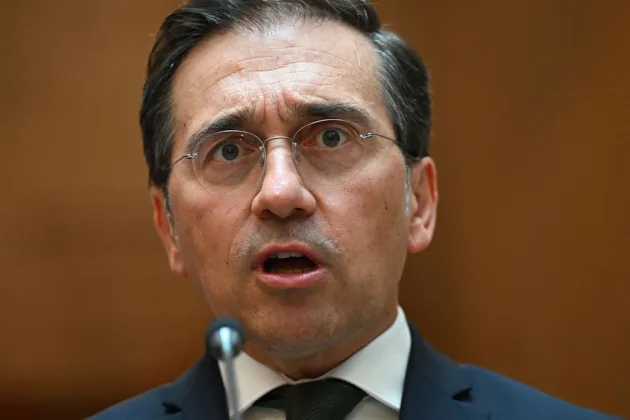
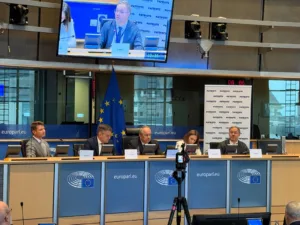
In Brussels, MEPs held their own gathering outside the European Parliament on the same day, while Spanish Foreign Minister José Manuel Albares accused other EU governments of amplifying disinformation about the crossing.
Sánchez had called the July entry an attack on Spain’s territorial integrity while thanking Morocco for co-operating on returns. He was due to address the Congress of Deputies on September 3, his first appearance on the crisis since it began.