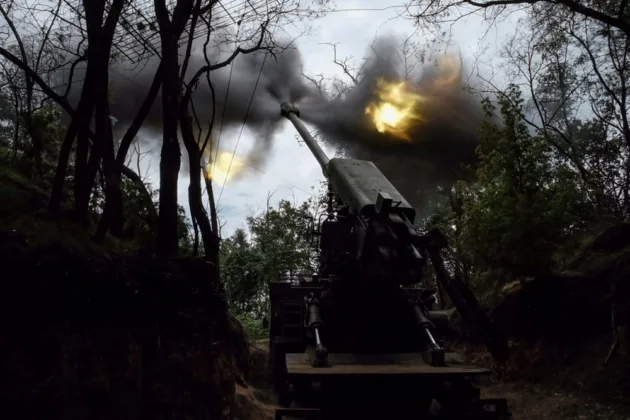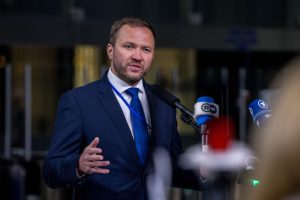




Estonia’s defence minister Hanno Pevkur has resigned after a failed attempt to buy artillery shells for Ukraine left about €70 million in advance payments stranded with an Indian-owned Italian firm that had never previously sold a shell.
Pevkur, an Estonian Reform Party minister in office since July 2022, told public broadcaster ERR’s flagship bulletin Aktuaalne kaamera on September 2 that the National Audit Office’s findings on the Defence Forces and the Estonian Centre for Defence Investments (RKIK) were serious enough for him to take political responsibility.
“The minister does not count socks and ammunition or conduct contract negotiations,” he said, but the criticisms still required him to stand down.
“As defence minister, I of course have to recognise that I am responsible for the entire area under my ministry and if you are now waiting for that big answer, then, of course, a leader must have both the courage and the stature to take responsibility as a matter of political responsibility, even when there is no personal responsibility. I will take that responsibility and the prime minister will have to find a new defence minister,” Pevkur said.
The shell contracts were first detailed by Eesti Ekspress.
In 2024 RKIK signed four deals with Datasel S.R.L., an Italian-registered company acquired on March 6 that year by Neco Defence Munitions, an Indian firm controlled by cousins Anand and Avneesh Jayaswal, Estonian World reported.
Neither firm had a record of selling artillery shells.
The first contract was signed in August 2024, with €15 million sent up front. Advance payments across the four deals totalled about €70 million.
Estonia used funding from the EU’s European Peace Facility for the advance payments.
The first batch was meant for Ukraine in November 2024. Deliveries slipped; further contracts were still signed. RKIK later terminated the deals and demanded the money back.
RKIK has gone to court in Estonia, with the main dispute due to go to arbitration in Strasbourg.
“Datasel is the party that has suffered losses in connection with these supply contracts,” the company told Eesti Ekspress via its lawyer.
“The actions of the Estonian Centre for Defence Investments, particularly the reasons given for the extraordinary termination of the contracts, are contradictory and illogical.”
“Datasel has supplied a significant quantity of goods and submitted invoices totalling €58 million,” the company said, acknowledging delays but disputing claims of insufficient quality.
The company put the advances it received at €59 million, against the €70 million RKIK attaches to the affair.
“Eventually, Datasel was given to understand that the RKIK was unable to accept the remaining goods,” the company said, adding that it remains committed to fulfilling the contract if the RKIK fulfils its own obligations.
Eesti Ekspress reported that a shipment which did arrive in 2025 was faulty.
Pevkur told ERR the rounds were not “useless” but of poor quality and incomplete, and that none were to reach Ukraine until Estonia had inspected them.
Current RKIK director general Elmar Vaher, who did not sign the original contracts, told Ekspress he would not have done so.
Former RKIK head Magnus-Valdemar Saar said no large decision went through without ministry approval, and that papers went to Pevkur and to then-permanent secretary Kusti Salm during talks on the first contract, with successor Kaimo Kuusk kept informed later.
Pevkur said he had not read the contracts.
The row sits inside a wider audit crisis.
On August 28 the National Audit Office said it could not verify Defence Forces inventories worth about €1.2 billion and flagged weak controls on contracts and goods received.
“Society is making an effort to fund the country’s growing defence capabilities, but the audit shows that the Ministry of Defence, the Estonian Defence Forces and the Estonian Centre for Defence Investments have not made sufficient efforts in return to resolve the serious problems with the use of funds and the accounting of assets and inventories,” auditor general Janar Holm said.
Holm said the failings were not technical but gave incompetence or bad faith an easy route to waste state money.
The audit found that RKIK took on budget risks of about €70 million through contracts brokering equipment and stocks for other countries, while the ministry told the Riigikogu, Estonia’s parliament, the opposite. Those contracts were withheld from the auditors last year.
Opposition Isamaa MP Urmas Reinsalu, who chairs the state budget control select committee, said the ministry had told parliament it had taken on no such Ukraine-procurement liabilities.
The prosecutor’s office opened a criminal inquiry on September 1 into circumstances covered by this year’s and last year’s audits. No charges have been announced.
Coalition and opposition figures had already called on Pevkur to go, among them Eesti 200 group chairman Toomas Uibo and Social Democratic Party leader Lauri Läänemets.
Social Democrat Raimond Kaljulaid said a working Ukraine ally should still resign to take heat off the defence establishment.
Prime Minister Kristen Michal said he saw no personal fault but did not rule out political responsibility, and called a cabinet meeting for September 3 with the auditor general.
Pevkur will stay until a successor is named. Parliament’s autumn sittings begin on September 14.
Estonia’s defence budget is set at 5.4 per cent of GDP this year, or about €2.4 billion.