



The Estonian Centre for Defence Investments (RKIK) has been unable to give a full public account of how it chose the supplier behind a failed ammunition deal worth about €70 million.
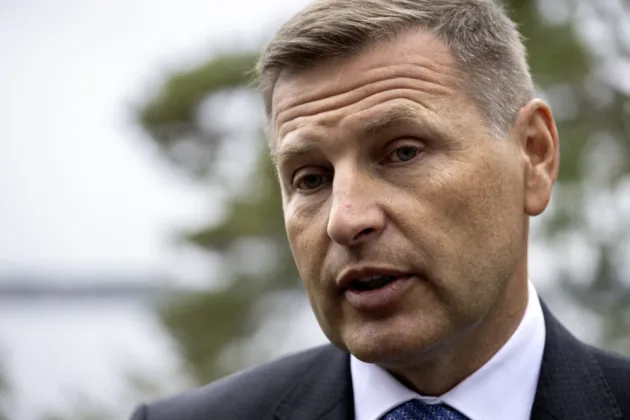
Defence minister Hanno Pevkur resigned on September 2 after the expensive but botched contracts became public. The money was meant to buy artillery shells for Ukraine and was drawn from the EU’s European Peace Facility.
Pevkur, a Reform Party politician in office since July 2022, said he was accepting political rather than personal responsibility. He is staying on in a caretaker capacity until parliament returns on September 14.
Director general Elmar Vaher told parliament on September 7 that he does not know how the first talks with the company were held, Estonia’s public broadcaster ERR News reported.
“I wasn’t working here at the time and neither was my team,” he said. “So what we can talk about now is how we operate today.”
Vaher, a former head of the Police and Border Guard Board, took over at RKIK in January. He has said responsibility for the deal lies with his predecessor Magnus-Valdemar Saar, who left the agency in July 2025.
RKIK says its usual procurement rules were not followed in 2024 on the Datasel projects.
There is no written record of how contact with the firm began, how RKIK first found it, or why it was judged fit to supply artillery shells.
There is also no summary of a background check. Standard checks would cover whether a bidder actually has the technology it offers, whether it can deliver it, and whether it has the money, investors or bank guarantees to do so.
Media reports have said Datasel used pictures of shells copied from other websites and cover art from a computer game.
RKIK says it is still searching 2024 files and speaking to former managers.
Vaher told the Riigikogu State Budget Control Select Committee that the European Commission would send an investigative team to Estonia for three days at the end of September to look at whether RKIK met its due diligence duties.
The money came from the EU’s European Peace Facility, including proceeds linked to frozen Russian assets, not from the Estonian state budget.
European Commission spokesman Christian Wigand said on September 3 that it was not yet clear whether Estonia would have to repay the money, adding that recovery procedures were in place to protect European taxpayers.
RKIK says it now has about 200 procurement projects and about 80 staff. Contracts are signed by the director general. “That means RKIK is responsible for its own actions,” Vaher said.
A lawyer advising the agency said court and arbitration cases are closed and that confidentiality clauses can carry penalties, so officials are limited in what they can say.
In 2024 RKIK signed four contracts with Datasel S.R.L., an Italian-registered firm acquired on March 6 that year by India’s Neco Defence Munitions, controlled by the cousins Anand and Avneesh Jayaswal. Neither company had a record of making or selling the shells Estonia ordered.
The first contract was signed in August 2024 with an advance of about €15 million. A second followed in October carrying more than €10 million and two further deals were struck at the end of the year, taking the total paid up front to roughly €70 million. The first rounds were due to reach Ukraine in November 2024.
RKIK paid large advances, later cancelled the contracts and took the dispute to court and arbitration after delays and what Estonia called incomplete or low-quality deliveries. The contracts were terminated in November 2025 and the main case is before the European Court of Arbitration in Strasbourg.
Datasel has filed a counterclaim. RKIK has not seen the papers behind that claim and has not disclosed its value. The agency has not ruled out that the counterclaim is a tactical move.
Datasel disputes Estonia’s account. Its representatives say the firm received €59 million and delivered goods worth €58 million that Estonian officials had inspected, and that it is still willing to complete the order.
RKIK first said publicly that only one contract had gone wrong. It now says seven have been terminated: five are before the courts or in arbitration, all of them linked to Datasel, while two remain under confidential negotiation.
Estonia’s National Audit Office set the crisis in motion with an August 28 report on defence spending which found that the agency could not produce the contracts auditors had repeatedly asked for. The Prosecutor’s Office has since opened a criminal investigation.
Estonia’s defence minister Hanno Pevkur has resigned after a failed attempt to buy artillery shells for Ukraine left about €70 million in advance payments stranded with an Indian-owned Italian firm that had never previously sold a shell. https://t.co/I0XG9oRa3O
— Brussels Signal (@brusselssignal) September 3, 2026