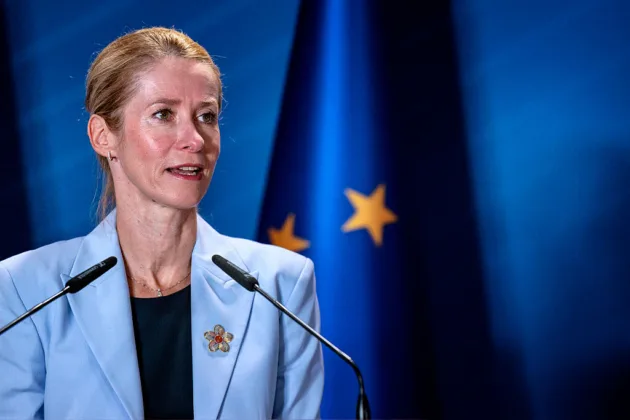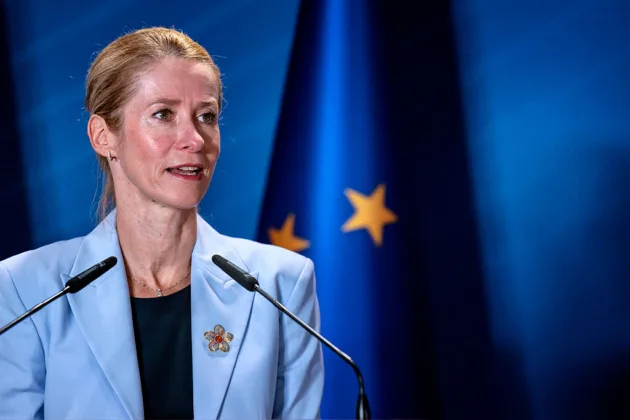

EU foreign policy chief Kaja Kallas has called for tougher action against Russia’s shadow fleet and its military industrial complex. She argued that Europe had to raise Moscow’s costs as the Kremlin took greater risks.
Speaking in New York on September 21 after a meeting of European Union foreign ministers at the UN General Assembly, Kallas said Europe faced a rapid increase in sabotage attacks and airspace violations. She described them as a Russian attempt to intimidate Europe into cutting its support for Ukraine.
The High Representative said the Russian economy was one of Moscow’s weakest points and that pressure on it had to grow to bring the war to an end. She called sanctions a central pillar of the EU response and has promised the most far-reaching listings since the full-scale invasion for this autumn.
Her remarks came hours after EU ambassadors failed to finalise the renewal of individual sanctions on about 3,000 Russia-linked people and entities. Kallas said she hoped the extension could be approved quickly.
The compromise on the table would have extended the listings for three years in exchange for removing Russian billionaires Alisher Usmanov and Mikhail Fridman, according to diplomats cited by Reuters. France and Slovakia had pushed to delist Usmanov, while Luxembourg sought the same for Fridman.
Latvia was the only member state still withholding approval late on September 21, diplomats said. The measures are due to lapse at midnight on September 22 unless all 27 governments agree.
Latvian foreign minister Baiba Braže said sanctions had to be strengthened, not weakened. The EU already gave member states the power to confiscate oil cargoes from detained shadow fleet tankers under its 21st package, adopted on July 23.
Kallas also turned to the Red Sea, where Yemen’s Houthi rebels seized the port city of Mocha on September 10, tightening their grip on the Bab el-Mandeb Strait. She said the EU naval mission there, Operation Aspides, needed more naval and air assets to cope with the higher threat level.
“The situation, I think, is even more grave right now,” she told reporters, according to Reuters. Diplomats said she had written to member states the previous week asking for more ships and aircraft.
In a second session joined by ministers from Australia, India, Japan and South Korea, Kallas said the UN was too often paralysed when it came to preventing or ending conflicts. She said the next UN secretary-general should defend the UN Charter but also push through reform.
Ministers discussed the growing link between security in Europe and in the Indo-Pacific. Kallas pointed to North Korean troops deployed to support Russia in the war in Ukraine and to China’s supply of dual-use goods to the Kremlin.