






Poland’s authorities have said that they are investigating two fires at plants in eastern and southeast Poland connected to the production of drones as potential arson attacks, with one of them treated as a terrorist act committed on behalf of a foreign intelligence service.
Speculation immediately emerged that the blazes could have been caused deliberately. Poland has been the primary target in Europe of sabotage activities carried out by operatives working on behalf of Russia.
Interior ministry spokeswoman Karolina Gałecka refused to confirm whether the authorities are treating the two fires as related, but said every line of inquiry would be examined.
The first of the fires broke out in the afternoon of August 30 at a warehouse belonging to JFG Composites in Lublin, eastern Poland, which produces composite parts for the aviation industry and is a subcontractor to Leonardo, the Italian group that owns the Polish helicopter maker PZL-Świdnik.
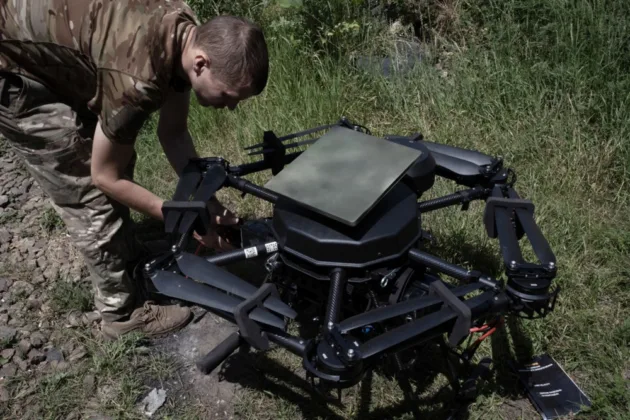
Polish media have reported that the facility was packed with materials used in the production of drones.
When firefighters arrived, the entire production and warehouse facility, covering approximately 2,000 square metres, was in flames and due to the extreme heat, the building collapsed inward. More than 40 firefighters worked at the site for about seven hours. No injuries were reported.
The losses incurred as a result of the fire have been put by prosecutors at about zł21 million (€5 million).
Prosecutors have been to the scene of the incident and have secured surveillance footage but so far no potential arsonists have been identified. The Lublin district prosecutor’s office said arson was one of three lines being examined, alongside a technical fault and spontaneous ignition, and that no evidence yet pointed to any of them.
The Lublin fire was followed after midnight on August 31 with a blaze at the WB Electronics plant in Skarżysko-Kamienna in Świętokrzyskie province, southeast Poland.
That fire at a facility which manufactures components for drones was quickly extinguished but still managed to cause damages estimated by prosecutors at zł15 million (€3.5 million) or more. There were no reported injuries as the plant was not operational at the time.
Przemysław Nowak, spokesperson for the National Prosecutor’s Office, said an investigation had been launched by its organised crime and corruption department in Kraków into participation in the activity of a foreign intelligence service against Poland and a “terrorist crime” consisting of “deliberately starting a fire” at the site.
He added that investigators believe the blaze was started by placing a charge containing flammable material at the facility.
According to Polish media reports surveillance cameras recorded a masked man climbing the perimeter fence shortly before the fire, and a backpack and a sweatshirt were later found near the plant. A manhunt is under way.
Interior minister Marcin Kierwiński said on September 1 that “everything indicates that we were dealing with an act of sabotage”, and urged private firms working for the armed forces to strengthen security.
The damaged plant is operated by the WB Group, one of Poland’s largest privately owned defence companies, and supplies drone parts to the Polish and Ukrainian militaries. It makes composite and control structures for unmanned aerial platforms, including parts for the FlyEye, Gladius, FT5 and StormRider systems.
WB Electronics was established in Poland in 1997 and has grown into one of Europe’s largest private defence firms producing unmanned aerial systems for the military. Its Warmate loitering munitions drones have been used by Ukraine in its defence against Russian attacks.
In December 2025, WB Electronics entered into a contract with South Korea’s Hanwha Aerospace that will see Poland manufacture over 10,000 CGR-080 precision-guided missiles for the K239 Chunmoo rocket artillery system.
In a statement following the fire the company said that “all procedures and systems worked properly, and the fire was quickly extinguished”.
The WB Group also said production could restart once investigators complete their work at the site and that it does not expect the incident to delay deliveries to Poland’s armed forces.
The incident comes with Poland on alert amid fears of potential Russian sabotage and hybrid attacks. A number of suspected arson attacks have been reported at defence premises across Europe in recent weeks.
On August 25, Slovak police said they had foiled a plan to set a drone manufacturing plant in the east of the country ablaze. Two Latvians and a Ukrainian were charged.
On August 15, Estonian defence company Milrem Robotics was targeted in an arson attack in Tallinn. There were also explosions at the EMCO ammunition plant in Bulgaria on August 10 and at the KNDS Ammo Italy site in Colleferro, near Rome, on August 13.
Polish prosecutors have previously linked Russia to sabotage attacks involving incendiary devices sent through European delivery networks.
In March, a report by the International Centre for Counter-Terrorism on Moscow’s growing campaign of sabotage in Europe alleged that Poland is the “primary focus of Russian activity”. It counted 151 incidents across Europe since 2022, of which 31 took place in Poland, more than in any other country.
In May 2025, Poland accused Russia of being behind the fire that in 2024 destroyed the Marywilska 44 shopping centre in Warsaw.
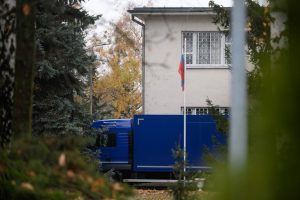
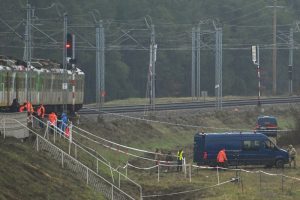
It is also seeking to detain two men believed to have sabotaged a rail line on the Warsaw-Lublin route in November 2025 on orders of Russian intelligence. Prime Minister Donald Tusk told parliament they were Ukrainians who had crossed into Belarus.
Moscow has regularly denied accusations of planning or carrying out such attacks, saying such reports are part of an anti-Russian propaganda campaign. It has also warned NATO member states that it reserved the right to retaliate against those which produced weapons used by Ukraine.
Polish government officials, led by Tusk, have on several occasions warned that the country feared some form of Russian attack on its soil in the near future.
The country, which neighbours Ukraine, has on two occasions suffered incursions of its airspace by Russian rockets and in September 2025 saw about 20 Russian decoy drones enter its airspace during a mass attack on Ukraine.
The Polish authorities fear that Russia may wish to test the eastern flank of NATO in order to ascertain the effectiveness of Article 5 of the NATO Treaty, which obliges members to come to each other’s defence but does not specify what that defence might entail.
Both the present centre-left government and its Law and Justice (PiS) predecessor have pursued a policy of rapid rearmament to deter Russia. Poland’s 2026 budget sets defence spending at 4.8 per cent of gross domestic product, among the highest in the alliance.
That has drawn praise from both the previous Democrat administration led by US President Joe Biden and the present Republican administration led by President Donald Trump. Trump said on May 22 that a further 5,000 US troops would be sent to Poland, which already hosts about 10,000, mostly on a rotational basis.