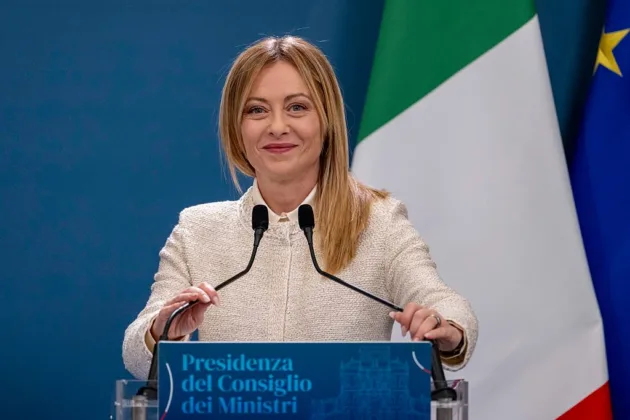










Italian Prime Minister Giorgia Meloni has asked the European Commission for further leeway in the bloc’s fiscal rules, on the day Istat, Italy’s national statistics institute, put Italian inflation at 4.2 per cent, up from 3.3 per cent in August.
The Prime Minister said she was writing to European Commission President Ursula von der Leyen so that the Economic and Financial Affairs Council (Ecofin) in Luxembourg on October 9, and the European Council on October 15-16, would consider “additional flexibility” for member states supporting households and firms against an energy-driven price rise.
Istat put the monthly rise at 0.7 per cent and core inflation, which strips out energy and fresh food, at 1.7 per cent, against 1.5 per cent in August. Regulated energy prices were 25.9 per cent higher than a year earlier.
Higher inflation, she said, had to be taken into account when the permitted deficit was calculated.
In the letter she put the share of Italian public spending directly exposed to inflation running above forecast at 20.4 per cent of GDP, pensions among it, and asked that at least part of the extra indirect tax revenue generated by higher prices be used for targeted help with energy costs.
Economy minister Giancarlo Giorgetti called the request obvious.
The net-expenditure path Rome is meant to follow is a nominal path, set when the Commission’s inflation assumption was much lower.
With budget lines indexed to prices, he said, that path was becoming hard to hold, “not for us, for everyone”.
The ask sits on top of a clause Italy has already applied to use: The national escape clause, first opened for defence and then extended to energy after the Iran war pushed up fuel prices, lets a member state deviate from its net-expenditure path.
The energy strand allows up to 0.3 per cent of GDP a year between 2026 and 2028, capped at 0.6 per cent over the period, and is meant for grids, storage, renewables, heat pumps and similar energy-security investment.
Rome wants the maximum of 0.6 per cent of GDP for energy security and 0.9 per cent for defence — below the 1.5 per cent the clause allows for military spending — 1.5 per cent in all, about €35 billion through 2028.
The energy slice is put at about €14 billion over two years, to cut bills for firms. The defence slice accounts for the rest, about €21 billion.
Meloni said that money was not the point of the new letter.
She wants the ordinary rules rewritten so that the inflation spike is built into the parameters, not treated as a one-off deviation.
Deputy minister Maurizio Leo called the coming budget law difficult because of inflation, the public accounts and the debt, and pointed to a spread approaching 100 basis points.
Brussels has not opened that door.
Commission spokeswoman Paula Pinho said a letter from Meloni and Czech Prime Minister Andrej Babiš on measures against high energy prices had been received and was being examined, as a normal contribution ahead of the European Council.
On the separate request for more fiscal room because of inflation, she said member states had already been given extra flexibility.
Budget spokesman Balazs Ujvari said the Commission had not yet received that letter, and that the escape clause had been widened from defence to energy precisely to give governments space for the energy crisis.
Italy is one of two countries to have filed to activate it, in mid-September.
The file is still under review. The money under the clause cannot be used for structural measures or for a cut in fuel excise.
Rome is trying to hold both lines at once. The Italian Government still plans to bring the deficit below the 3 per cent ceiling this year, from 3.1 per cent in 2025, in line with a 2.9 per cent goal set in April, and to leave the excessive-deficit procedure in 2027.
Istat’s confirmation on September 22 of last year’s 3.1 per cent ended hopes of an earlier exit.
Giorgetti has said he wants an “interpretation” of the rules that would let Italy leave the procedure and still use the escape clause in 2027 and 2028. The new multi-year forecasts, in the public finance planning document known as the DPFP, are due on October 2.