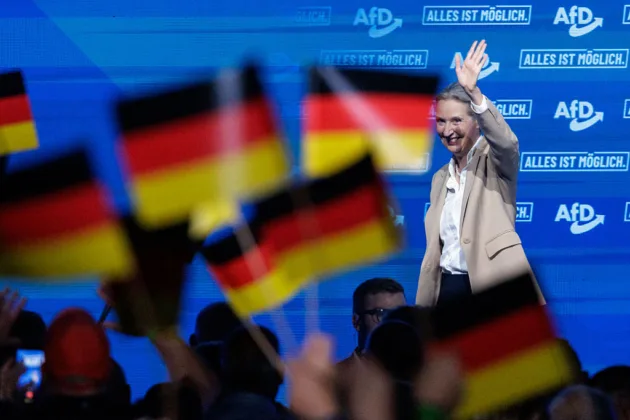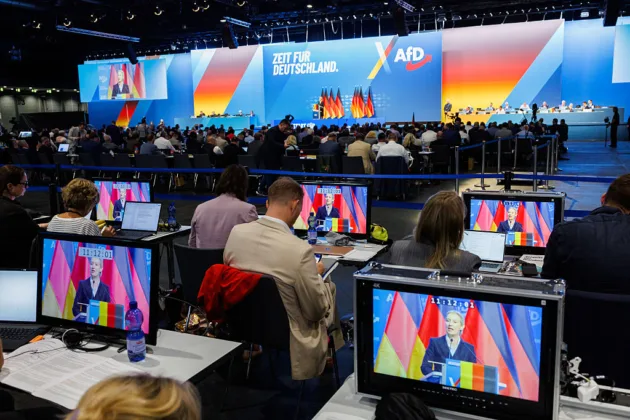












The victory of Alternative for Germany (AfD) in Saxony-Anhalt on September 6 was not merely another success for the right-wing opposition in eastern Germany. Its significance lies above all in a qualitative shift in the party’s support base. The result of 43.8 per cent is in itself historic for the party (the party received 20.8 per cent of the vote in the 2021 election) and it was achieved amid unprecedentedly high voter turnout. Nearly 78 per cent of eligible voters cast ballots, compared to 60 per cent five years earlier – a sign not of the mobilisation of the usual protest core, but of a deeper shift in electoral behaviour.
The AfD has managed to move beyond its circle of committed supporters. It has become attractive to a segment of voters who previously supported other parties and to those who previously distanced themselves from the political process altogether. In the past, backing the AfD was often a way of expressing dissatisfaction with the existing system without actually envisaging a transfer of power to the party. Now, a growing number of voters are signalling their readiness to consider it a fully legitimate participant in governance.
It is precisely this transition – from a party of protest to a party of power – that constitutes the principal challenge to the “mainstream” German political system.
The alternative to the AfD-led government would be an unstable coalition of disparate forces, which would itself struggle to secure a majority. On paper, the Christian Democratic Union (CDU), Social Democrats (SPD), Greens, Left and Sahra Wagenknecht Alliance (BSW) would together hold 44 of the 83 seats in the state parliament, the same number as the AfD and BSW combined. And yet, what is it that so frightens the German elites, the media and a portion of the public? Let us be honest: What is at stake is not a parliamentary election but a vote in a small, sparsely populated German state. Where, then, does the danger that the AfD is perceived to pose to the “mainstream” lie?
First, the political crisis. It would appear that the German elites have created the current problem themselves, devoting excessive attention to the firewall (Brandmauer), to the AfD, and indeed to every election. Judging by politicians’ statements and media coverage, one gets the impression that the very existence of the Federal Republic is on the line. Keeping the party out of power has become an article of faith, and the firewall has become something close to the country’s foremost measure of stability. The political mainstream has raised the stakes on its own – and now contemplates the result with horror. A potential entry of the AfD into government would deal a severe blow to the firewall. At the same time, it could trigger a political crisis. The state-level party organisations will (with considerable justification) blame the federal government for their electoral results, which means someone in Berlin will have to bear political responsibility.
Second, the Russian factor. One might assume that this is more of a propaganda device in the election campaign than a genuine fear – although it is characteristic of the German elites, in line with constructivist logic, first to advance a thesis and then to come to believe it themselves and become alarmed by it. After all, foreign policy issues are decided at the federal, not the state level. Yet despite this, representatives of various parties and the media did not hesitate to claim that an AfD victory in the east would entrench Russian influence. As Baden-Württemberg Minister-President Cem Özdemir of the Greens put it: “I want Saxony-Anhalt to remain Saxony-Anhalt, and Magdeburg not to become a suburb of Moscow.” This instrumentalisation of the Russian threat seems rather strained.
There are, though, those who attempt to rationalise the link between the AfD and the fear of Moscow, noting that should the party come to power, it would gain leverage over security policy. The party would gain representation in the Bundesrat and the Conference of Minister-Presidents, as well as access to classified information. Accordingly, the AfD is accused of being in a position to pass sensitive data to Russia, sway public opinion or even obstruct the movement of troops through Saxony-Anhalt – which seems entirely far-fetched, yet has repeatedly been discussed in major European media outlets.
It must be said that the attempt by opponents – at the state level, the federal level and beyond Germany’s borders – to portray the AfD on the eve of the election as a party of Nazis and Putin’s puppets proved entirely ineffective in this eastern state. Perhaps its heavy-handedness even provoked irritation and added a few percentage points to the AfD’s result. The drone episode at Leipzig/Halle Airport in August, which Berlin has blamed on Moscow, and the subsequent sharp escalation of tensions with Russia had no effect whatsoever on the voting outcome – or possibly had the opposite effect. It is telling that among the issues voters considered important, the preservation of peace in Europe featured prominently, second only to social security – hardly typical of state elections in Germany, which traditionally focus on domestic politics and socio-economic matters. Fifty-seven per cent of surveyed voters supported the AfD’s position against further arms deliveries to Ukraine, and when asked which political force was best equipped to help preserve peace in Europe, 29 per cent named the AfD – more than any other party.
Third, there are areas in which the AfD, once in power, would be able to make decisions. One of these is internal security – particularly policing. As part of a state government, the party would be able to influence personnel decisions within the police, raising concerns about the growth of right-wing sentiment within the force. Furthermore, in Germany, culture and education fall primarily under the jurisdiction of the states. Accordingly, the AfD could begin to deliver on its promise to overhaul school curricula and move away from the agenda that has dominated the educational process for many years.
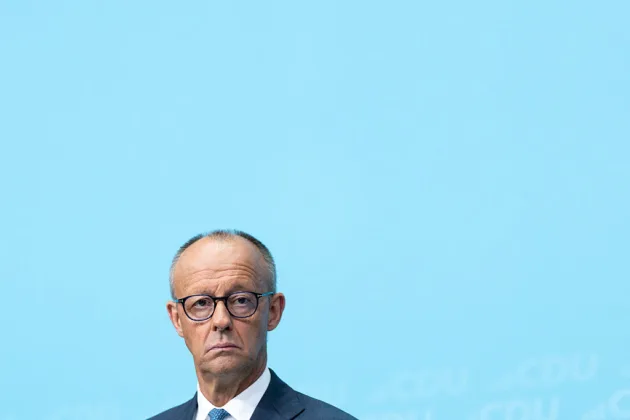
The CDU’s defeat in Saxony-Anhalt does not pose an immediate threat to Friedrich Merz’s position as Federal Chancellor. State elections do not alter the composition of the Bundestag, nor do they trigger a procedure to remove the government. Yet the CDU’s loss in Saxony-Anhalt represents a strategic problem for him.
The premise underlying Merz’s strategy within the CDU was the notion that the party could strengthen its position on the Right by winning back a portion of the voters who had drifted to the AfD. In Saxony-Anhalt, the opposite occurred: The AfD more than doubled its vote share, while the CDU lost a substantial share of its support, falling from 37.1 per cent in 2021 to 17.2 per cent, its worst result in the state.
Now a debate within the CDU is bound to intensify over why the previous strategy failed to deliver. Some will argue that the answer must be an even stricter policy of distancing itself from the AfD. Others will call into question the very efficacy of the policy of isolation if it does not diminish the party’s support but merely turns it into the system’s principal political antagonist. All of this will be accompanied by debates over whether Merz can remain an electoral asset for the bloc and lead it into the next federal election.
The forthcoming state elections in Mecklenburg-Western Pomerania and Berlin on September 20, 2026, will carry particular weight. If a single result can still be attributed to regional particularities, a series of such defeats will be read as a national trend. At the same time, Merz’s standing is determined not only by elections in eastern Germany but also by the federal government’s ability to demonstrate economic and social progress – a prospect, it must be said, in which an ever smaller share of the German population believes.
For the AfD itself, this is only the beginning. At the time of writing, it remains unclear whether it will be able to form a government at all. With 39 seats, short of the requisite 42, there is still room for coalitions formed against it. AfD lead candidate Ulrich Siegmund has ruled out a minority government, saying fresh elections could be the alternative. But if the party does obtain executive power, it will confront a problem with which it has thus far had little experience: Power not as an object of criticism, but as a system that must be made to function.
What if it suddenly turns out that the AfD is insufficiently prepared to govern effectively, even at the state level? It is entirely plausible that this is precisely what both the federal authorities and opponents are counting on.
One of the principal challenges will be the party’s relationship with the bureaucracy. In Germany, the state apparatus possesses a high degree of professional autonomy. A new government built around the AfD will inevitably have to work with civil servants, many of whom have no political affiliation with the party. This creates two potential problems: The possibility of resistance from within the apparatus and the risk of the gradual erosion of the party’s own political profile through integration into the existing system.
Herein lies the difference between the AfD and certain other right-wing parties in Europe. The ideologically similar Freedom Party of Austria (FPÖ), for example, has participated in government for decades and is already embedded in the state system. The German AfD, by contrast, has long existed in a state of conflict with the political mainstream – and it is precisely this that earns it considerable support among a German public weary of the “mainstream parties”.
That said, the party itself is aware of this, thinks about it and speaks of it constantly – and, most likely, has some idea of how to resolve the problem.