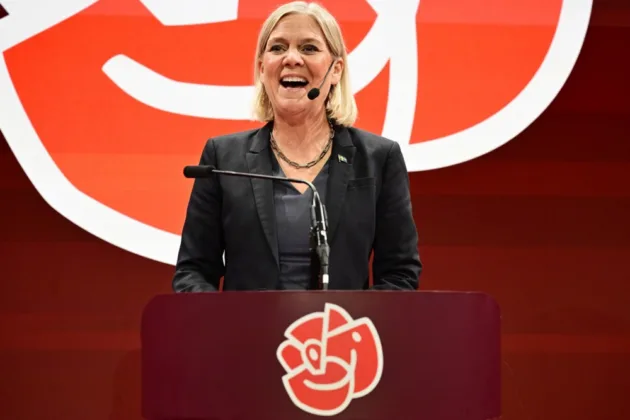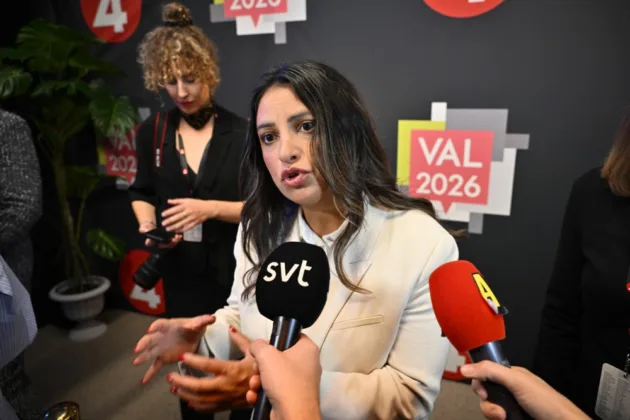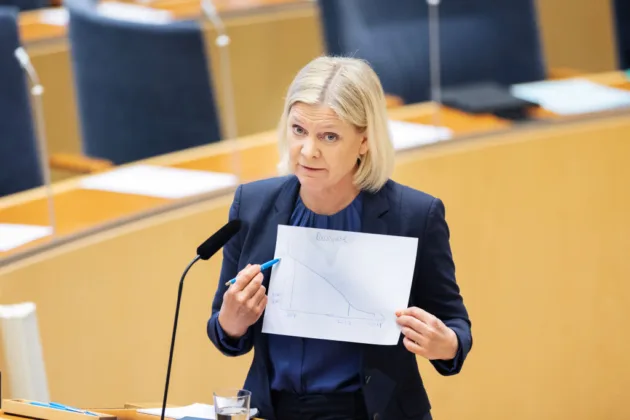





The Swedish election remains too close to call, although it appears likely that Social Democrat Magdalena Andersson’s unwieldy four-party red-green coalition will win a narrow majority. On the preliminary count her side holds 176 of the Riksdag’s 349 seats against 173 for the outgoing Tidö parties, with late postal and overseas ballots due to be counted on September 16. The broader Right can find reassuring trends in the results that should, over time, lead to more victories in the future.
Let’s first look at the results for the Right. The centre-right Liberals came back from the political graveyard in the final weeks of the campaign and made it back into the Riksdag (parliament). Winning 5.4 per cent of the vote may not seem like much, but the party had spent virtually the entire four years in power polling under the 4 per cent needed to win seats. It was polling about 2 per cent as recently as a month ago and just 1.3 per cent in June. Clearly many Swedes looked at the two blocs and, despite large polling leads for the Social Democrat-led coalition, decided to turn rightward.
Those polls themselves also have to be called into question. Only one pre-election final poll – Ipsos – showed the race as close as it truly was, putting the opposition parties 0.3 points ahead; SVT’s pollster Verian had the gap at 5.6 points. Even the exit polls taken on election day forecast a comfortable three-to-five-point win for the Left. The fact is that in most nations in most elections, polls overstate the Left and understate the Right.
This could matter in a place like Sweden where millions of people vote before election day. More than 3.6 million Swedes, about half of the total voters, cast ballots early, a record. Some might have voted for the centre-left because of the polls, thinking their victory was guaranteed. Faulty polls that always lean in one partisan direction plus early voting can be a fundamental problem in close races like this one.
The Left also has clear warning signs despite their narrow lead. The Social Democrats did finish first, as they have in every parliamentary election since the adoption of universal suffrage in 1921. Its 28.1 per cent of the vote was, though, the lowest the party has ever received since then, below the 28.3 per cent it took in 2018. Andersson would thus come to power in the weakest political position any Social Democratic prime minister has ever held.
Her potential problems are compounded by the low share of the vote which all parties of the Left obtained. The Greens and the ex-communist Left Party won 14.3 per cent combined, giving the Left a mere 42.4 per cent. Social Democrats alone won more than this in every election between 1936 and 1988. This is now the third straight election that the once dominant Left has received below 43 per cent of the vote combined.
That means the Left can come to power only if it attracts votes from the non-socialist Centre Party. For decades Centre was a reliable part of the anti-Left centre-right alliance, but its unwillingness to work with the populist Sweden Democrats has pushed it into uneasy alliance with the Left bloc. It’s entirely unclear if this set of unnatural bedfellows can agree on what a government looks like, much less agree on a common set of policies for the next four years.
This is especially difficult for Centre because the Left Party’s gains are why Andersson’s coalition is in position to win. The Left Party gained 1.5 per cent over the last election, to 8.2 per cent, and was especially strong in immigrant, largely Muslim neighbourhoods. Centre has previously said it will not go into government with the Left, but the Left came into the election saying it wanted to sit in government for the first time (it has historically supported Social Democratic-led governments from the outside). Somebody is going to have to blink if Andersson is to regain power.
Even that might not be enough to allow her to serve a full four-year term. Fighting between Centre and the Left Party over a proposed end to rent control for newly constructed apartments led to the toppling of her predecessor, Stefan Löfven, in 2021. One can easily imagine the Left pushing policies on migration or economics that would be anathema to the bourgeois voters who back Centre. That inherent contradiction within the opposition to the populist-conservative centre-right coalition will not go away.
Indeed, it will likely increase because of the Social Democrats’ reliance on older voters. SVT’s Valu exit poll showed the party won 36 per cent of voters 65 and older, but under 24 per cent among voters 30 or younger. The Left Party, on the other hand, received about 14 per cent among younger voters but only 4 per cent among senior citizens. Unless age tempers the views of the young Left, the radical Left will grow in strength within the non-conservative/populist coalition in 2030, making coalition with the Centre even more difficult.
The incumbent conservative-populist government may have lost the 2026 battle. But it is slowly winning the war for Sweden’s future.