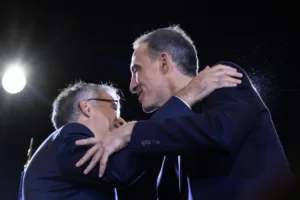

Turkish President Recep Tayyip Erdoğan has said Turkey plans to expand nuclear co-operation with Russia after the Akkuyu plant opens, speaking after talks with Vladimir Putin on the sidelines of the Shanghai Co-operation Organisation (SCO) summit in Bishkek.
“The Akkuyu nuclear power plant is of great importance in Russia-Turkey relations. We are now in the final stages,” Erdoğan said, according to state news agency Anadolu during the summit on September 1.
“With the opening of the Akkuyu nuclear power plant, we will take steps together to open some new power plants. We are in the midst of these preparations.” He described bilateral ties as “at a much more advanced level today than in any previous period”.
Putin called Turkey “one of our privileged partners” in foreign policy and the economy and said the first Akkuyu unit would come online this year, adding that Rosatom, the Russian state nuclear corporation building it, was on schedule.
The Russian delegation in Bishkek included foreign minister Sergei Lavrov and presidential aide Yuri Ushakov, according to the Kremlin. Erdoğan was accompanied by foreign minister Hakan Fidan and intelligence chief İbrahim Kalın.
Turkey is an SCO dialogue partner, not a full member. It is the only NATO member state to hold that status.
Speaking to journalists on his return flight, Erdoğan said Ankara would consider raising its relationship with the organisation to a higher level. Full membership would not mean “a breakaway from any other bloc or from the West”, he said, according to Reuters.
The Bishkek summit, on August 31 and September 1, was the 26th meeting of the SCO Council of Heads of State and marked the group’s 25th anniversary.
Akkuyu, on the Mediterranean coast in Mersin province, southern Turkey, is Turkey’s first commercial nuclear plant.
Under a 2010 intergovernmental agreement, Rosatom is building four VVER-1200 reactors with a combined capacity of 4,800 megawatts on a build-own-operate model, meaning the Russian state firm retains ownership and control. It is the first plant in the industry to be built that way, with first concrete poured in April 2018.
The project is valued at about $20 billion (€17.2 billion).
Once all four units run, officials say they should supply about 10 per cent of Turkey’s electricity.
Rosatom has said fuel loading and start-up of unit one are planned for autumn 2026 after delays linked to sanctions, supply chains and financing. Construction work on the unit was completed in June and the remaining three reactors are due to follow at intervals of about a year, the company said. Its director-general, Alexei Likhachev, has said Germany’s Siemens did not deliver equipment that had been built and paid for, and that about $2 billion of project money remained frozen abroad.
Russia provided $9 billion (€7.8 billion) in extra financing, energy minister Alparslan Bayraktar said on December 26, 2025. Most of it would be spent in 2026 and 2027, he said.
Turkey imports two out of every three units of energy it uses, Bayraktar said on April 11, 2026.
UN Comtrade figures put Turkish imports from Russia at $44.02 billion (€38 billion) in 2024, of which mineral fuels and oils accounted for $32.23 billion (€27.8 billion).
Ankara wants nuclear capacity of 20 gigawatts by 2050, with further large plants planned at Sinop on the Black Sea and in Thrace, plus small modular reactors. The country’s net-zero target is 2053.
Energy minister Alparslan Bayraktar said on March 18, 2026, that Turkey was still talking to Russia, China, South Korea and Canada and had not chosen a contractor for the next sites. He said the winning bid would pair the most competitive terms with the highest level of local content.
Parliament passed a law on July 24, 2026, fixing tax breaks for nuclear investors until the end of 2045, with the President able to extend them to 2050. Deputy energy minister Zafer Demircan told the planning and budget committee the measures covered future projects rather than Akkuyu.
No contracts for the extra plants were announced in Bishkek. Ushakov said before the meeting that the Black Sea and Ukraine were on the agenda, though neither was raised in the part of the talks open to reporters.
COMMENT: The US is beginning to realise that Turkey cannot be a reliable long-term partner, gradually detaching its energy, trade, and military interests from Ankara. Europe, in its turn, must now decide whether to do the same, writes @BogdanosK. https://t.co/NSh7MjRMt8
— Brussels Signal (@brusselssignal) February 27, 2026