








Martha Kleedörfer, deputy chair of Die Linke in Berlin and the party’s directly elected member for Wedding, has told private investors they are free to go.
In an Instagram video posted after a Bild report asked whether investors were leaving and whether the Left was “playing with fire,” she stood in front of a bookshelf and a bust of Karl Marx and said the housing companies had never had it so hard.
She then addressed what she called a misunderstanding in the paper, which had argued that talking of expropriation while courting private capital was a contradiction.
“We have no problem at all if private capital, the housing corporations and the investors finally go home and leave us Berliners, our flats, in peace.”
Her rhetoric is in line with the programme the party has already said it will carry out.
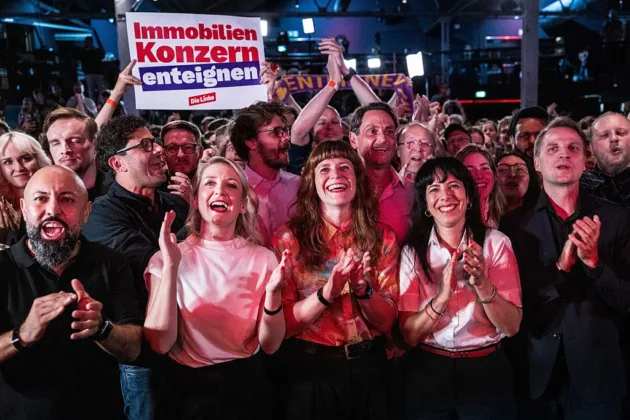
Die Linke won the Berlin election of September 20 with 25.7 per cent, a gain of 13.4 points on 2023 and its strongest result in the capital. Turnout reached 74.2 per cent and the party took 47 of the 158 seats in the Abgeordnetenhaus, the city parliament, 28 of them direct mandates.
Its lead candidate, Elif Eralp, told ARD that if the Left governs, there will be socialisation, adding that she had said as much and would stand by it.
The target is landlords who own more than 3,000 flats, which collectively have about 220,000 homes in their possession.
Die Linke wants to take those flats into municipal ownership on the strength of the 2021 referendum in which 59.1 per cent of voters backed the socialisation of Deutsche Wohnen and similar companies. That vote, on September 26, 2021, did not bind the senate and produced no bill. An expert commission appointed afterwards reported in 2023 that socialisation was constitutionally permissible under Article 15 of the Basic Law and that owners could be compensated below market value.
A draft put forward by the campaign Deutsche Wohnen & Co enteignen would compensate owners at 40 to 60 per cent of market value, paid in 100-year bonds rather than cash.
On Vonovia’s Berlin book, valued at about €22 billion with €11 billion of debt, the draft compensation is put at about €7 billion. The company holds some 138,000 flats in the city, about a quarter of its German portfolio, with a fair value of around €23 billion.
Vonovia shares fell 2.2 per cent on September 21, the day after the vote, to €17.31 in morning trading. Chief executive Luka Mucic has said expropriations would create no new flats.
Kleedörfer has already told the Vonovia chief, in a clip she replayed, that the Left would take his property, his car and his toys. On September 26 she called for the expropriation of the publisher Axel Springer.
Ulrike Hinrichs, managing director of the German private-equity association (BVK), told newspaper Bild that anyone who drives investors out will see the money elsewhere, and called the socialisation debate “pure poison” for Germany as a place to invest. Capital, she said, is shy and above all quick.
Michael Voigtländer of the Institute of the German Economy (IW) said the result would be capital flight from Berlin, not more affordable flats, because most of the money in the market is foreign. Institutional holders — pension funds, sovereign wealth funds and international asset managers — accounted for about 87 per cent of Vonovia’s shares in June 2026. Speaking to Wirtschaftswoche, he drew a parallel with the French nationalisations of the early 1980s, after which capital left the country.
Lars von Lackum, chief executive of LEG, which owns no Berlin stock, said investors in Melbourne, Hong Kong and New York now ask within 10 minutes whether Germany is on the road to socialism. He told the Deutsche Presse-Agentur on September 30 that property guaranteed individual freedom and that he trusted the federal government to see its law through.
Chancellor Friedrich Merz has said the federal government would legislate to stop states transferring corporate rental portfolios into public ownership, with effect across the country. Whether such a statute could bind a Berlin senate acting under Article 15, which allows land and the means of production to be transferred into common ownership against compensation, is disputed among constitutional lawyers.
German left-wing party Die Linke is calling for taxpayers to pay for permanent beard removal for trans women in the State of Baden-Württemberg. https://t.co/JMxIspzg3b
— Brussels Signal (@brusselssignal) August 22, 2025