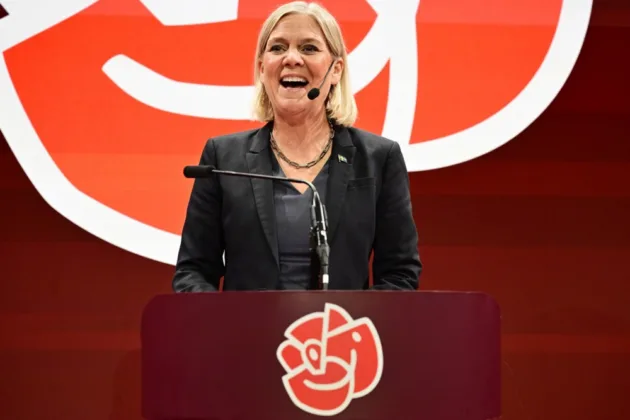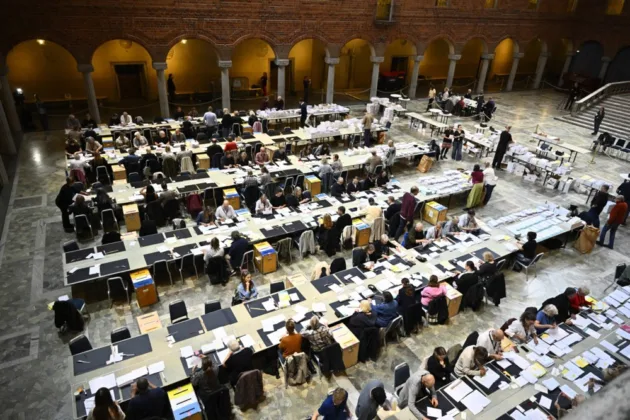





After days of counting in an exceptionally close contest, the left-wing bloc was officially declared the winner of the September 13 election, by 176 seats to 173, giving it the initiative in forming a new government. Around 50,000 votes, roughly the population of a small city, decided the fate of the Nordic nation. Of the 6,735,557 valid votes cast, on a turnout of 84.8 per cent, the margin amounted to just 0.76 per cent.
There is, of course, an uplifting lesson to be drawn: Every vote counts. Those who stay home, convinced that their vote makes no difference, have been proved wrong once again. In a democracy, the collective will can still shift the balance of power.
But a closer look at how those votes were cast should temper much of that optimism.
SVT’s exit poll, Valu, revealed a sharp divide by background. Voters who, or whose parents, grew up outside Europe overwhelmingly favoured the Left. The Social Democrats received 38 per cent of their votes, the Left Party 21 per cent, the Greens 7 per cent and the Centre Party 4 per cent. Together, these parties accounted for 70 per cent, against 27 per cent for the four parties of the outgoing right-wing bloc.
People with a non-European immigrant background already make up 13 per cent of Sweden’s eligible electorate, roughly one million voters, and their share is growing.
Simple counterfactual calculations circulated after the election suggested that, without this section of the electorate, the Right would have won something like 181 seats to 168. The precise result depends on the assumptions used, but the underlying political question is difficult to ignore: What happens when voting patterns increasingly follow lines of origin?
This electoral divide does not exist in isolation. It coincides with significant differences in employment, reliance on public assistance and recorded criminal offending, to name a few.
Self-sufficiency is substantially lower among people born outside Europe. Even after many years of residence, a large minority remain primarily dependent on public transfers. Some register-based breakdowns suggest that, after more than 20 years in Sweden, the share relying on such transfers can still be around four times that of the native-born population.
In 2024, foreign-born people accounted for about 58 per cent of adult recipients of ekonomiskt bistånd, Sweden’s last-resort social assistance, according to the National Board of Health and Welfare. Municipalities paid out SEK10.9 billion (about €1 billion) under the scheme that year. Foreign-born households have for years received more money through the programme than native-born households, despite being a minority of the population. Couples with children receiving assistance are overwhelmingly foreign-born.
The crime figures point to another substantial disparity. Foreign-born people are about 2.5 times as likely as those with two native-born parents to be registered as suspected offenders. Swedish-born people with two foreign-born parents often have higher rates still: Figures commonly cited from the Swedish National Council for Crime Prevention’s (Brå) 2021:9 report put the standardised relative risk at around 3.2 times for all offences and 2.8 times for violent crime.
A Lund University study examining rape convictions over two decades found that 63 per cent of convicted offenders had an immigrant background. Led by Ardavan Khoshnood and published in the Journal of Interpersonal Violence, it covered more than 4,000 convictions between 2000 and 2020. Those who arrived after the age of 15 had more than six times the risk of conviction compared with ethnic Swedes, and socioeconomic controls did not eliminate the disparity.
These figures do not, by themselves, explain individual voting decisions or establish that immigrant background determines political preferences. They do, though, raise questions about the long-term interaction between migration, public finances, social cohesion and electoral politics.
For productive native-born taxpayers, the potential consequences are tangible: Higher taxes or pressure on public services to fund transfers, policing, courts and prisons, alongside concerns about neighbourhood safety and school quality.
The danger is that parallel societies become more entrenched while the state struggles to maintain a common set of rules. Informal systems of authority, including clan justice and honour-based norms, already exist in some communities. If the formal state retreats, or is perceived to enforce the law selectively, these systems can gain ground.
And if the electoral coalitions benefiting from these developments also influence local government and enforcement, the risk of political patronage and selective accountability becomes harder to dismiss.
The possibility of voting oneself out of this situation may become increasingly remote for native-born Swedes.
Sweden is not unique in facing the political consequences of demographic change. Across multi-ethnic societies, voting patterns can become increasingly aligned with ethnic, religious or ancestral identities. As these loyalties harden, political competition risks shifting away from disagreements over policy and towards a struggle over which groups control the state, and how its resources are distributed.
That is a profound challenge to the assumptions underpinning liberal democracy.
For years, parts of the Swedish establishment have framed social inequalities through the language of structural racism, while questioning whether Swedish national identity should retain its traditional place in public life. This approach treats the majority culture as something to be dismantled rather than a shared inheritance that can be maintained alongside integration, while at the same time tribal cultures are being embraced.
Left-wing parties have targeted voters in Arabic and Somali, while concerns about rape statistics, gang shootings and parallel legal norms are sometimes dismissed as racist. When crime figures are concentrated in immigrant-dense districts, and raising that fact is treated as a moral failing, some native-born voters may conclude that their security and their children’s education are being subordinated to other political priorities.
The result is a particularly corrosive combination: A growing sense of being outvoted, alongside the feeling that expressing dissatisfaction is itself illegitimate.
Liberal democracy depends on more than counting ballots. It requires election losers to continue seeing one another as members of the same political community, a sufficient degree of fiscal reciprocity to sustain public consent, and a state capable of enforcing a common law.
Ethnic clientelism threatens all three.
When people feel that they cannot see themselves represented, the problem may extend beyond the number of seats their preferred party holds. Representation also concerns whether the state is perceived to treat their security, language, interests and contributions as legitimate priorities. When that confidence erodes, political legitimacy erodes with it.
What options remain for native-born Swedes if integration and political normalisation fail to deliver, as migration has become a defining feature of society rather than a marginal phenomenon?
One possibility is fiscal and human-capital flight: Voting with their feet. High-productivity citizens may relocate to countries where they believe their taxes, security and prospects are better protected. That may offer an individual escape, but it also deprives Sweden of taxpayers, skills and investment, potentially accelerating the very trends that prompted them to leave.
Another possibility is the emergence of a permanently segmented party system, à la libanaise, in which political representation and access to state resources become organised around communal identities. Iraq, Bosnia-Herzegovina and South Africa offer different examples.
In such a system, winning an election risks becoming synonymous with capturing the state for one’s own constituency. Trust in courts, police and official statistics can deteriorate as each side comes to suspect that public institutions are being used against it.
A further possibility is a surge in extra-parliamentary radicalisation among native-born citizens.
If legal politics is perceived as incapable of delivering fairness, tighter migration controls or fiscal reciprocity, some may begin to regard elections as little more than theatre. The consequences could include street violence, vigilantism or growing support for parties willing to abandon liberal constraints.
When a large section of the population feels simultaneously dispossessed and silenced, the resulting reaction is unlikely to remain confined to polite parliamentary debate. History offers ample examples of what can happen when political grievances become entrenched and institutional trust collapses.
The same crime statistics that fuel public anxiety can also provide recruits and narratives for those who claim that the state has failed and that they must take matters into their own hands.
Against that backdrop, policies such as denaturalisation, large-scale returns and sharp cuts to benefits may come to be regarded by some voters as the more moderate alternatives.
A high-trust, high-tax welfare democracy can accommodate immigration, including people who initially have limited skills or require public assistance. The harder question is whether it can sustain that model if a growing section of the population remains persistently less self-sufficient, becomes politically cohesive along lines of origin, and supports policies that others believe will perpetuate the financial and social pressures.
The danger is not simply that one bloc wins an election. It is that the political community itself becomes increasingly divided over who belongs to it, who owes what to whom, and whether the state serves everyone on equal terms.
So far, Europe has been fortunate that the response to profound and often contentious societal changes has remained so calm and well within democratic politics.
There is no guarantee that this restraint will last.