



German car manufacturer Audi has narrowly avoided tumbling into the red after its net profit collapsed by 87 per cent in the third quarter, dropping to €95 million from €718 million during the same period last year.
Over the first nine months of the year, Audi’s revenue dropped by more than €6 billion to roughly €42 billion, with post-tax earnings settling at €1.22 billion, down 41 per cent, following an earlier 17 per cent earnings slump in the first half.
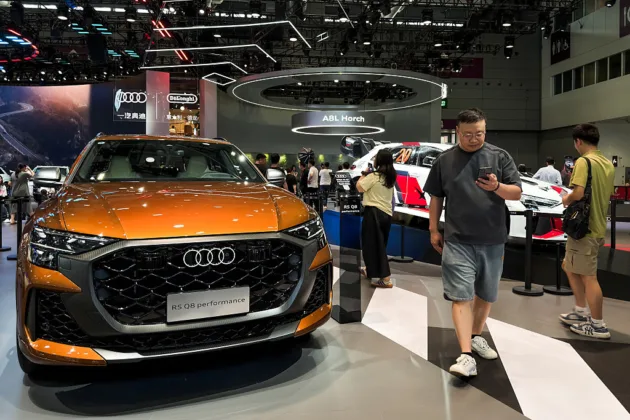
Global deliveries for the core Audi marque plummeted by nearly 20 per cent during the third quarter, to 314,905 vehicles, led primarily by a collapse in demand for conventional internal combustion engine (ICE) vehicles in China, long the brand’s largest market.
Deliveries in China, including Hong Kong, fell 24.5 per cent to 328,042 vehicles over the first nine months, according to company figures.
The drop has plunged the Volkswagen Group subsidiary deeper into financial distress, forcing management to cut its full-year guidance for the second time this year and intensify internal restructuring programmes.
The earnings contraction reflects a combination of headwinds across key global markets.
The brand has been hit hard by slumping sales in China, where domestic electric vehicle manufacturers continue to undercut European legacy brands, alongside mounting United States tariffs and aggressive price discounting across European dealerships.
The company also cited tensions in the Middle East, higher energy costs and Chinese exporters pushing into the European market.
The manufacturer has also borne the brunt of trade friction in North America, where deliveries dropped 17.3 per cent over the first nine months.
Because Audi currently builds no passenger vehicles on American soil, US import tariffs have inflicted an estimated €1.2 billion drag on corporate finances. Rivals BMW and Mercedes-Benz both build vehicles in the US.
In response, chief executive Gernot Döllner unveiled plans to construct a multibillion-euro production plant in the United States and double down on large combustion and hybrid SUV models such as the Q7 and Q9.
The proposed plant in Macon, Georgia, would represent an investment of $4.2 billion (€3.8 billion). It could build up to 200,000 Q7, Q8 and Q9 models a year from the early 2030s and employ up to 4,500 people, though the project still requires approval from the Volkswagen supervisory board.
That transatlantic strategy has, though, triggered a political and domestic backlash in Germany.
Döllner appeared alongside US President Donald Trump at a campaign-style event in Georgia ahead of the November 3 midterm elections to announce the prospective American factory, drawing immediate condemnation from German trade unions and works council leadership.
Audi’s own code of conduct bars public appearances with political candidates in the three months before an election. Döllner has defended his presence as being in the company’s interest, saying Audi had been asked to present its plans publicly alongside the US President.
Volkswagen general works council chairwoman Daniela Cavallo accused Döllner of allowing himself to be co-opted for partisan political campaigning, describing his appearance as “active campaign assistance”. IG Metall leader Christiane Benner labelled the public appearance “politically unacceptable”.
The controversy has intensified alarm among German workers as Audi reviews emergency cost-cutting programmes.
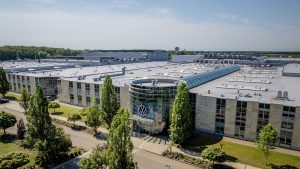
Under previous framework agreements, Audi had already scheduled the reduction of up to 7,500 domestic positions by 2029, but the quarterly collapse has placed historic German production sites — notably Neckarsulm in Baden-Württemberg, southwest Germany, which employs more than 15,000 staff — under intense viability reviews.
In September, Volkswagen gave the Neckarsulm plant one year to present a viable cost-cutting plan or face closure. On October 8, Audi invoked a “bad weather clause” agreed in 2019, which obliges management and the works council to negotiate savings when business conditions deteriorate significantly.
Left Party (Die Linke) leader Luigi Pantisano has demanded Döllner’s resignation over the Trump appearance.
At the operating level, the core Audi brand swung to a €174 million loss between July and September, on revenue of €11.6 billion, compared to a profit of €279 million 12 months earlier, leaving nine-month operating profit down over 40 per cent at €477 million.
Across the wider brand group, which includes Bentley, Lamborghini and Ducati, nine-month operating profit fell 26 per cent to €1.15 billion, an operating return on sales of 2.7 per cent.
Chief financial officer Jürgen Rittersberger sounded the alarm following the release of the figures, describing the situation as urgent and warning that the market environment deteriorated significantly during the late summer months.
Rittersberger stressed that the executive team has no room for manoeuvre. “The figures clearly show: The need for action at Audi is high and brooks no delay,” he said.
He added: “Our measures are working but, due to the enormous competitive pressure, we must intensify them.”
The slump at Audi forms part of a wider industrial shockwave spreading across its parent company, the Volkswagen Group, which posted a third-quarter loss of €5.82 billion.
The group has been bogged down by billions of euros in exceptional charges, sluggish consumer appetite for electric models and the steep costs associated with vehicle redesigns and factory retooling.
The earnings collapse has injected fresh urgency into fraught labour negotiations in Germany.
Under an existing framework agreement, Audi had already committed to phased headcount reductions, but management is now examining far sharper cost-cutting measures.
Trade unions have sounded the alarm over potential plant closures, with the future of the historic site at Neckarsulm coming under intense scrutiny as automotive bosses assess whether domestic manufacturing costs remain viable amid falling global margins.
The crisis has also ignited political pushback over Audi’s international supply chain strategy.
With sales down 17 per cent in North America this year, company leadership has explored developing production capacity in the United States to circumvent import tariffs.
The prospect of shifting capital investments abroad while slashing domestic manufacturing capacity has, though, drawn condemnation from German trade unions and left-wing politicians. Some have demanded Döllner’s resignation over what they describe as a capitulation of Germany’s industrial core.
In response to the figures, Audi has slashed its full-year outlook, lowering projected revenue to between €55 billion and €59 billion, from €58 billion to €63 billion, and reducing its operating return on sales forecast to a range of 3 to 5 per cent, down from 5 to 7 per cent.
The Q9, Audi’s new flagship SUV aimed mainly at the US and European markets, is due to go on sale in November. Rival Mercedes-Benz reported third-quarter net profit of €1.52 billion.
While executives maintain that newly launched sport utility models could offer some commercial respite before year-end, the quarterly balance sheet reinforces concerns over the competitiveness of Germany’s premium car sector, which is increasingly caught between high domestic production costs and overseas competition.