
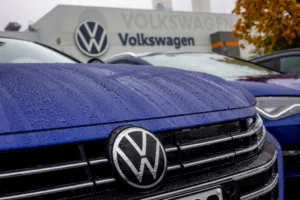



Volkswagen Group has reported a net loss after tax of €5.82 billion for the third quarter of 2026, compared with a loss of just over €1.07 billion in the same period a year earlier.
The operating loss widened to about €5.9 billion from €1.3 billion. Revenue fell 6.3 per cent to approximately €75.3 billion.
Analysts polled by Visible Alpha had expected an operating loss of about €2.6 billion, according to Reuters.
The result was driven primarily by special items of about €7.8 billion booked in the quarter.
The largest single charge was a €6.4 billion non-cash goodwill impairment on its stake in Porsche, reflecting lowered expectations for the sports-car subsidiary’s future performance.
Additional hits included roughly €1 billion in impairments related to China operations and costs linked to the planned sale of the Osnabrück plant, alongside broader restructuring expenses.
The Osnabrück site, in Lower Saxony, is to be sold to investor Aurelius and the regional State government, which intend to convert it to defence production, the German news agency dpa reported.
Weak conditions in China, intensifying global price and competitive pressure, and a higher share of lower-margin electric vehicles in the sales mix also weighed on results.
Vehicle deliveries declined 14.3 per cent to 1.885 million units. The drop was concentrated in China, where deliveries fell 38.5 per cent to under 406,000 vehicles.
Over the first nine months, group deliveries were down 9 per cent and the operating result was essentially flat at €71 million, versus €5.4 billion a year earlier. The group posted a net loss of €2.72 billion for the nine-month period.
Excluding special items of €8.7 billion year-to-date, the operating return on sales stood at 3.8 per cent.
Chief financial officer Arno Antlitz said the nine-month figures made clear that the company “cannot afford to lose any time” and must act “quickly and decisively”.
He noted that the 3.8 per cent return before special items was insufficient to fund future investment.
Antlitz said US tariffs were weighing on the group, the Chinese market was shrinking and competitive pressure in Europe was increasing “massively”. Electric cars, he added, still earned less than combustion-engine vehicles.
Electric vehicles nevertheless make up about 40 per cent of the group’s European order bank, which has grown 11 per cent since the end of 2025.
The group confirmed its already-reduced full-year guidance of sales revenue around €315 billion and an operating return on sales of up to 1 per cent. In 2025, revenue totalled €321.9 billion.
That guidance was cut on September 18, when Volkswagen warned of about €10 billion in special items for the year and lowered its margin target from a previous range of 4 to 5.5 per cent.
Management has outlined a comprehensive cost programme of around €31 billion, including a streamlined model range, lower overheads and factory efficiency measures.
Reuters reported that CEO Oliver Blume is pursuing plans involving up to 100,000 job cuts across the group, including Audi and Porsche, and the possible closure of as many as four German plants, facing strong union opposition. According to dpa, about 50,000 of those cuts were agreed in earlier deals running to the end of the decade.
Group headcount fell from about 628,900 at the end of 2025 to 614,500 on September 30. Talks with employee representatives at the core Volkswagen brand are due to begin in November.
The quarterly deficit exceeds the €1.67 billion net loss the group booked in the third quarter of 2015, at the height of the Dieselgate emissions scandal, which at the time was its first quarterly loss in 15 years.
Volkswagen is not the only German carmaker in trouble. Mercedes-Benz Group published its third-quarter figures on October 28 and recorded a drop of 4.5 per cent in its group revenue to €30.7 billion.
Reported group earnings before interest and tax (EBIT) rose to €1.77 billion from €0.75 billion, largely because of smaller adjustments than in the prior-year quarter. Adjusted group EBIT, though, fell 15 per cent to €1.78 billion.
It cited a more challenging China market and higher fourth-quarter costs for raw materials and product-cycle measures. Group EBIT is now expected at the prior-year level rather than significantly above it. Industrial free cash flow in the quarter was €172 million, down from €1.37 billion a year earlier.
Volkswagen plans to freeze salaries worldwide until 2030 as part of a restructuring drive to cut rising costs, according to internal documents reported by Süddeutsche Zeitung. https://t.co/2QV3X6CZ68
— Brussels Signal (@brusselssignal) October 19, 2026