

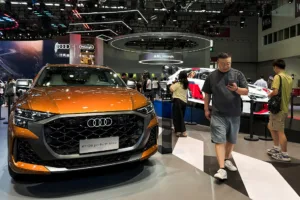





Audi’s core-brand deliveries have fallen 19.7 per cent in the third quarter to 314,905 vehicles, accelerating a decline that had been roughly 8 per cent in the previous quarter.
The Volkswagen Group as a whole reported a 14.3 per cent drop in global deliveries to 1,885,300 vehicles, its steepest quarterly fall in more than four years.
Audi’s nine-month total stands at 1.04 million vehicles, down 11.4 per cent year-on-year.
Germany and the rest of Europe showed a slight increase over that period, but the damage elsewhere was severe: China deliveries fell nearly a quarter, and the United States by roughly a sixth.
Audi, unlike BMW, has no US manufacturing footprint and is therefore fully exposed to American tariffs. BMW builds in Spartanburg, South Carolina, and Mercedes-Benz in Tuscaloosa, Alabama. The Volkswagen Group assembles cars at Chattanooga, Tennessee, but no Audi model is made there.
Washington capped duties on EU-built cars at 15 per cent under the trade framework agreed in July 2025. On May 1, 2026, US President Donald Trump said the rate would rise to 25 per cent, with an exemption for European marques producing in American plants.
Model changeovers on the volume A1 and Q2 lines added further pressure.
For perspective, the same third quarter in 2023 saw Audi deliver close to 480,000 core-brand cars.
According to its half-year report, the Audi Group’s revenue fell from €32.6 billion to €29.2 billion, while operating profit held at €1.1 billion and the margin edged up to 3.8 per cent.
At group level the picture is consistent and worse in China.
Volkswagen Group deliveries there plunged 38.5 per cent in the third quarter and are down 30.2 per cent year-to-date.
North America declined 5.8 per cent, Western Europe 2.8 per cent and South America 2.4 per cent, while Central and Eastern Europe managed a modest 1.4 per cent rise.
Nine-month group deliveries totalled 6.01 million, down 9 per cent.
The Volkswagen passenger-car brand and Audi each posted declines near 20 per cent in the quarter. Porsche fell 15 per cent. Škoda held roughly steady. The commercial-vehicle unit Traton rose more than 10 per cent.
Battery-electric deliveries for the group fell 4.7 per cent globally in the quarter, to 240,200.
Europe recorded a near-20 per cent increase, but this was more than offset by sharp drops elsewhere, including an almost total collapse in the United States, where group battery-electric sales fell 86.4 per cent to 5,100 cars after Washington ended federal purchase subsidies.
Group executives described the Chinese market weakness as “an industry-wide challenge”. Martin Sander, who sits on the group’s extended executive committee for sales, said deliveries outside China had held broadly stable over the nine months and that one in five cars the group delivered in Europe was all-electric.
The numbers continue a multi-year erosion.
German premium and volume brands have lost ground in China to domestic competitors that combine lower prices, rapid product cycles and aggressive software offerings.
US tariffs compound the problem for those without local production.
At home, high energy costs, labour expenses and the regulatory timetable for CO2 fleet targets and the eventual phase-out of new combustion engines continue to weigh on margins and investment decisions.
The European Commission softened that timetable on December 16, 2025, proposing that new cars cut CO2 by 90 per cent rather than 100 per cent from 2035, with the remainder covered by credits for e-fuels, biofuels or low-carbon European steel. The package has still to clear the European Parliament and the Council of the European Union.
On July 27, 2026 Audi had already cut its full-year guidance amid the China downturn and tariff pressure, to revenue of €58 billion to €63 billion and an operating margin of 5 to 7 per cent, against the €63 billion to €68 billion and 6 to 8 per cent forecast in April.
The latest figures arrive against a backdrop of factory closures, capacity utilisation problems and repeated warnings from the industry that the combination of Chinese competition, energy prices and Brussels rule-making is eroding the industrial base that once underpinned German and wider European prosperity.