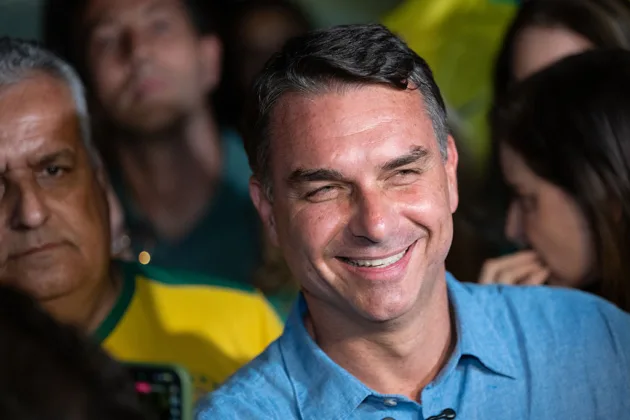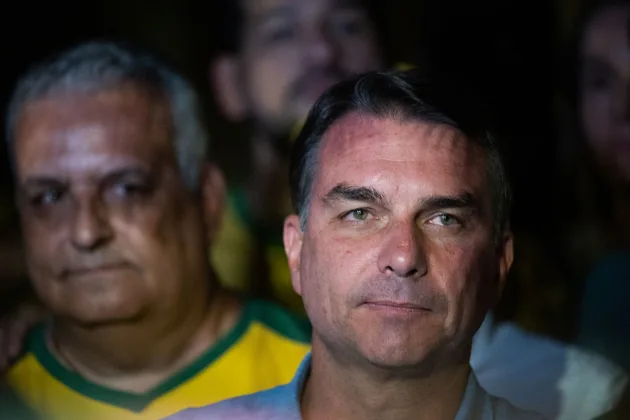

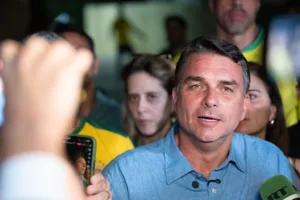


With the disorders in France, the revolving-door governments in Great Britain and the disintegration of the mandate of the Federal Republic government in Germany, there may not be a great deal of attention paid in Europe at the moment to developments in Latin America. But the first-round victory in the Brazilian presidential elections of Flávio Bolsonaro over the three-term president and seven-time candidate Luiz Inácio Lula da Silva is another decisive turn to the responsible Right in Latin America and an important strategic victory for US President Donald Trump. Bolsonaro took 47.03 per cent of the valid vote to Lula’s 45.16 per cent, short of the majority that would have spared Brazil a run-off on October 25.
In his flamboyant manner, Trump had raised tariffs on Brazil to 50 per cent in 2025 because of his objections to the manner in which courts that he judged to be manipulated by Lula had sent former president Jair Bolsonaro, father of the current leading candidate, to prison for 27 years and three months after convicting him of an attempted coup d’état. (Lula himself languished for over 18 months in prison, a victim of the elder Bolsonaro, and most recent Brazilian presidents have faced or been threatened with criminal proceedings. It is in a sense, a sign of reform in Latin America that constant charges of skulduggery and felony at least have some chance of being followed up, even if in a highly politicised atmosphere, for the courts are no more trustworthy than the politicians. Former leaders of France and of Israel, not to mention Thailand, the Philippines and Spain have been charged and occasionally confined. The whole world watched in astonishment the attempted incarceration and illegal financial assault upon President Trump while he toiled back towards office between terms.)
Lula da Silva is a formidable presence in the politics of this immense country of 214 million people, a metal worker who left school at eight and was late learning to read and write, having run seven times for president over almost 40 years. He undoubtedly delivered well for the working class and poor people of Brazil and unlike many of his predecessors, confined himself substantially to reasonable standards of legality despite the legitimate questions about financial integrity which led to his spending more than 18 months in prison. While Lula has been relatively responsible in foreign policy matters and has avoided the more egregious forms of gringo-bashing that have been a speciality of Latin American politicians for 200 years, the likely victory of his opponent is nonetheless a tremendous triumph for the United States.
Under Lula, China has become the principal trading partner of Brazil and has used that country as a giant conduit for the flow of Chinese influence in Latin America. Trump has made it extremely clear that he will not tolerate what he considers to be excessive tinkering in the American hemisphere by foreign powers and particularly not by the one more or less serious rival in the world to American influence and interests, China. He had Chinese interests removed from both ends of the Panama Canal and a series of conservative but not reactionary political victories in Argentina, Paraguay, Honduras, El Salvador, Peru, Chile, Colombia, Ecuador and Bolivia have constituted a tidal wave of support for a Pan-American and pro-American hemispheric policy. The addition of giant Brazil to this company has strategic importance for the whole world, as the seventh most populous country in the world and the tenth in GDP.
It will certainly be challenging, assuming Bolsonaro is elected president of Brazil in the run-off on October 25, to uncouple Brazil economically from China and re-fasten it to the American orbit. But it should certainly be possible for the United States to be thoroughly competitive with China for the goodwill and prosperity of Brazil, and the orientation of Brazil is an important factor in the international correlation of forces between the two superpowers, unequal in America’s favour though that contest is. Following the end of the Cold War, successive American administrations were little interested in the political devolution of affairs in Latin America. As long as extra-hemispheric forces ambiguous or hostile towards the United States were not installing themselves in Latin America, the United States was glacially unconcerned when left-wing governments took power in Latin American countries.
With the establishment of BRICS (Brazil, Russia, India, China, South Africa) as an attempted rival to the G7, and a movement, however improbable, to displace the primacy of the United States dollar, the Trump administration has responded and invoked the Monroe Doctrine, asserting that it would not tolerate hostile forces entering the hemisphere. This stated determination has been accompanied by creative initiatives to assist in the increasing prosperity of Latin American states, a determined military counterattack on drug cartels, most of them ultimately supplied from China, and a concentrated effort to assist populist conservative and free-enterprise political movements across Latin America. The gathering wave of these forces, if Bolsonaro’s victory is confirmed in Brazil, will have swept the entire hemisphere except, to a limited extent, Mexico.
In 1980, Argentina and Brazil and Chile and a number of other Latin American countries were under military rule. The continent has made great political progress in that time, poverty has been sharply reduced and illiteracy almost eliminated. The juntas have gone and the old Peronist formula of blaming everything on the United States has given way to popular electoral forces consciously or coincidentally emulating the United States. Not since Franklin D Roosevelt’s Good Neighbour policy of 90 years ago, has America exercised such positive leadership in its hemisphere, as the final detritus of the ghastly Castro experiment in Cuba flounders dismally to its end.