





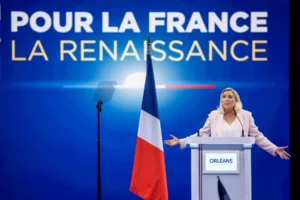




In a bid to broaden her electoral appeal ahead of the 2027 French presidential race, National Rally (RN) leader Marine Le Pen has publicly abandoned several of her most long-standing socially conservative platforms.
During an interview released on November 15, she confirmed a shift to the political Left on social issues by dropping her opposition to same-sex marriage and disavowing her previous proposal to ban dual citizenship.
The remarks came during an appearance on Brevet présidentiel, a new online programme from the parliamentary channel LCP aimed at younger audiences, where she was interviewed by a 15-year-old secondary school pupil from Bordeaux who runs a political Instagram account.
The casual setting provided the backdrop for some of the most significant ideological back-pedalling of her political career, marking a deliberate effort to shed her party’s image and court a voter base who may have previously been alienated by the National Rally’s traditional conservatism.
One of the most notable shifts was Le Pen’s total reversal on dual nationality, which had been a signature policy during her 2012 and 2017 presidential campaigns.
Her 2017 programme proposed banning dual nationality with non-European countries, a measure she dropped from her 2022 platform, according to LCP.
She said that her previous stance was “a mistake”, acknowledging that she had wrongly implied people with dual nationality should automatically be viewed with suspicion regarding their loyalty to France.
She noted that many individuals hold two citizenships simply due to their birth and their parents’ origins, arguing that this administrative reality does not inherently compromise their national devotion.
In a parallel move to align with more liberal social policies, Le Pen confirmed she no longer seeks to repeal the 2013 Taubira law that legalised same-sex marriage in France.
She had pledged to abolish the law in 2013, though during her 2022 campaign she wrote that same-sex marriage “is and will remain” an established right if she were elected.
Following the broadcast, she took to the social media platform X to cement the policy change in writing, stating unequivocally that she had changed her mind on the issue. “I have changed my mind on same-sex marriage,” she wrote.
She explained that her previous fierce opposition was anchored in the fear that legalising same-sex marriage would inevitably open the door to surrogacy, which remains illegal in the country and which she still opposes.
Because this fear never materialised, she stated there was no shame in evolving in politics.
J’ai longtemps proposé l’interdiction de la double nationalité. Je pense que j’ai commis une erreur.
J’ai laissé penser à ceux qui ont la double nationalité que je nourrissais à leur égard une forme de suspicion. Il n’y a aucune raison d’avoir la moindre suspicion. pic.twitter.com/HKiVFsqzcV
— Marine Le Pen (@MLP_officiel) November 15, 2026
This pivot on marriage equality sits alongside her increasingly progressive positioning on abortion, further distancing her from the traditional Catholic right.
Le Pen voted in March 2024 for the parliamentary move to enshrine the right to abortion in the French constitution, a significant departure from the National Rally’s historical roots and the anti-abortion rhetoric once championed by her late father, party founder Jean-Marie Le Pen.
RN deputies split on that vote, with 46 in favour, 11 against and 20 abstaining, according to LCP.
While critics and political opponents across the spectrum view these manoeuvres as a highly cynical, calculated attempt to sanitise her image for the upcoming election cycle, the shift aligns with a broader trend among European populist leaders.
By discarding traditional, religiously conservative social policies, figures like Le Pen are attempting to build larger, secular nationalist coalitions that appeal to working-class voters regardless of their social liberalism.
This domestic repositioning coincides with a calculated recalibration of her foreign policy, most notably regarding the war in Ukraine.
During a closed-door meeting with Vadym Omelchenko, Ukraine’s ambassador to France, on November 16, Le Pen confirmed that the severe state of France’s public finances would force her to halt direct financial aid to Kyiv if elected in 2027.
In a statement after the meeting, she said France would no longer be able “to help Ukraine financially in the coming months”. She has previously said she would maintain payments for six months after taking office.
In a nuanced shift designed to assuage international concerns and distance herself from past accusations of Russian sympathies, though, she explicitly promised to maintain French material, humanitarian and diplomatic support for Ukraine.
Le Pen was careful to ensure that her pivot to the Left on social and administrative issues did not entirely alienate her core, anti-immigration voter base.
Throughout the interview, she maintained a firm stance on the National Rally’s bedrock principle of national priority.
Addressing the country’s severe housing crisis, she reiterated that French citizens must always receive priority access to social and student housing, regardless of any newly adopted social moderation.
To balance her progressive concessions, she proposed implementing new eligibility requirements for foreign nationals residing in France.
Under her vision, foreign nationals would only qualify for housing benefits after completing a minimum of five years of full-time-equivalent work in France.
Le Pen’s social pivot has drawn sharp condemnation from her former European allies, most notably Germany’s Alternative for Germany (AfD).
The RN broke with the AfD in May 2024 after comments by the German party’s then lead candidate, Maximilian Krah, and the two now sit in rival groups in the European Parliament: Patriots for Europe and Europe of Sovereign Nations.
AfD MEP Tomasz Froelich publicly criticised the National Rally leader.
He explicitly warned the broader European Right against following her example, arguing that right-wing politicians implementing left-wing policies are worse than the political left doing so.