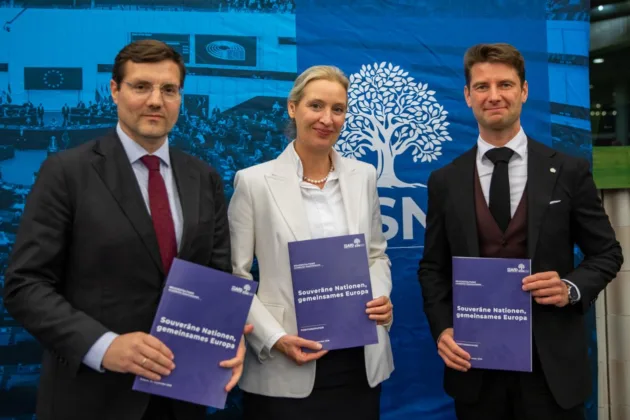











The Europe of Sovereign Nations (ESN) has moved a step closer to losing its access to EU funding and potentially its registration as a European political party as Brussels moves ahead with a procedure examining whether the party has breached the bloc’s fundamental values.
Six people appointed by the EU institutions are due to examine whether ESN, the European political family whose largest national member is Germany’s Alternative for Germany (AfD), complies with EU principles including democracy, the rule of law and respect for human rights.
Their assessment could ultimately pave the way for the withdrawal of ESN’s registration as a European political party, putting its access to European Parliament funding at risk.
Speaking exclusively to Brussels Signal, ESN vice-president Alexander Sell fears that the procedure could become “a political judgement” rather than an independent assessment of the party’s case.
The procedure began when the Authority for European Political Parties and European Political Foundations (APPF), the EU body responsible for registering and monitoring European political parties and foundations, alerted the European Parliament, the Council and the Commission to concerns about ESN’s compliance with the bloc’s fundamental values. Its director, Pascal Schonard, set out those concerns in a letter sent on May 22.
Following that notification, the European Parliament voted on July 7 by 414 votes to 224, with 18 abstentions, to formally request a verification of the party’s compliance.
The case passed to the Committee of Independent Eminent Persons, a standing six-member body whose members serve five-year terms and are appointed two each by the Council, the Parliament and the Commission. It will examine the case and issue an independent opinion to the APPF on whether ESN has committed a manifest and serious breach of the EU values required for registration.
The opinion must be delivered within two months, after which the APPF will decide whether ESN should remain on the EU register. Under the rules, deregistration is possible only if the APPF finds such a breach.
It is the first verification of its kind since a revised regulation on European political parties took effect in October 2025.
ESN was established in 2024 as a European political party bringing together national right-wing parties from across the EU, with Germany’s AfD as its largest member. It was founded on August 14 that year and entered the EU register, from its Berlin seat, on September 30, 2024.
It is closely linked to the Europe of Sovereign Nations parliamentary group, which was formed on July 10, 2024, after the 2024 European elections and currently has 27 MEPs, making it the smallest group in the European Parliament. The group includes representatives from Germany, Bulgaria, Poland, Slovakia, France, Hungary, Czechia, Lithuania and Italy, the AfD’s 15 MEPs forming the largest single contingent.
As a registered European political party, ESN is eligible to apply for European Parliament funding. Under EU rules, 10 per cent of the annual funding is distributed equally among eligible parties, while 90 per cent is allocated according to their number of elected MEPs. From 2026, EU funding can cover up to 95 per cent of eligible expenditure, up from 90 per cent.
The European Parliament’s 2026 budget provides €46 million for European political parties, unchanged from 2025, when 12 parties were registered. ESN became eligible from the 2026 financial year, while its affiliated Sovereignty Foundation has a maximum 2026 grant of €1.1 million.
Deregistration would end ESN’s European-level funding and remove its legal personality, but would not automatically remove its MEPs from Parliament or dissolve the separate ESN parliamentary group, which is legally distinct from the party.
The concerns surrounding ESN are based on material collected by the APPF, including statements and social-media posts by figures linked to ESN member parties, running to some 300 pages. Reports have cited allegations of racist, anti-Semitic, anti-Roma and anti-LGBT rhetoric, as well as statements concerning Russia and democratic institutions.
These are concerns being examined as part of the procedure, not findings that ESN has already breached EU law.
The six experts serving on the Committee of Independent Eminent Persons are German European-law professor Pia Lange, of the University of Bremen, Lithuanian Linas Kontrimas, former European Commissioner Martine Reicherts, former Commission Secretary-General Alexander Italianer, law professor Luca Vanoni and political scientist Anna Pacześniak. The two Council nominees are Lange and Kontrimas; the European Commission appointed Reicherts and Italianer, while the European Parliament selected Vanoni and Pacześniak.
Speaking exclusively to Brussels Signal, Sell questioned whether the six experts could remain fully neutral, pointing in particular to the fact that some of the nominees are politically affiliated or former European Commission officials or have worked closely with EU institutions. Sell fears that these backgrounds could influence the committee’s approach.
Pacześniak, a professor at the University of Wrocław, has sat since 2018 on the scientific council of the Foundation for European Progressive Studies, the think tank of the Party of European Socialists.
“The six experts who are judging us should be independent. But there are doubts about whether they really are, given the institutional and political backgrounds of some of them,” Sell said. “We fear that they may not be truly neutral.” He stressed, though, that ESN has so far seen no concrete indication that the committee has acted with bias.
On the substance of the case, Sell said “ESN does not reject European values which are in fact often violated by EU institutions”. He argued that democracy requires respecting election results, pointing to Romania, where the Constitutional Court annulled the 2024 presidential election and ordered a rerun.
For Sell, the rule of law also means that states must be able to enforce their own laws, reflecting his emphasis on national sovereignty. He added that minority rights should include the rights of parliamentary minorities, citing what he considers the treatment of the AfD in the German Bundestag.
Germany’s Constitutional Court has, for example, examined AfD complaints concerning equal treatment and participation rights in Parliament, including disputes over committee chairs.
ESN has already submitted its response to the EU institutions, Sell said, adding that the party expects its arguments to be fully considered. ESN co-chairman René Aust, an AfD MEP, called the July vote a disgrace.
If the APPF decides to deregister ESN for a manifest and serious breach of EU values, the decision is communicated to the European Parliament and the Council. They have three months to object. If no objection is raised, the deregistration decision is published in the EU’s Official Journal and takes effect three months after publication.
For now, ESN remains a registered European political party. The next steps are the six-member committee’s assessment and the following APPF final decision.