




Punitive bans and fragmented national rules on electronic cigarettes are fuelling a surge in organised criminality across the European Union, leaving law enforcement unable to keep pace, according to industry representatives and enforcement officials speaking in Brussels on Wednesday.
These warnings coincide with the release of a new study by market intelligence firm Euromonitor International, presented at an event hosted by British American Tobacco (BAT) in Brussels.
The research shows that illicit consumption of e-cigarettes expanded nearly two and a half times faster than the legal European market between 2023 and 2025, surging by 33.6 per cent from 2.6 million litres to 3.5 million litres, equivalent to roughly 1.8 billion single-use e-cigarettes.
Black market sales are estimated to represent between 35.8 and 36 per cent of the total EU e-cigarette market, while counterfeit and smuggled conventional products cost member states an, according to the European Court of Auditors, estimated €13 billion annually in uncollected excise revenues.
The Euromonitor study, covering 24 member states, revealed sharp divergences depending on national regulatory choices.
Where national authorities have introduced sweeping prohibitions, the black market has boomed.
In Belgium, which enacted bans on disposable e-cigarettes and online sales, the illegal volume rose by more than 20 per cent per year, reaching an estimated 84 per cent of total national consumption.
In the Netherlands, following an outright ban on all flavours other than tobacco, legal sales dropped by 10 per cent annually while 87 per cent of local consumers now use illicit devices.
By contrast, member states opting for targeted, risk-proportionate frameworks, such as the Czech Republic (3.3 per cent illicit share) and Sweden (14.4 per cent), have largely retained trade within taxed, age-verified channels.
Addressing the findings, Fabio de Petris, BAT’s Vice President for EU External Affairs, cautioned that ideological restrictions are backfiring: “Today’s report shows that vape bans don’t work — they hand the market to criminals, where there are no age checks, product safeguards, or taxes paid. The EU needs to implement smarter, targeted regulation that keeps control where it belongs — with governments, not criminals.”
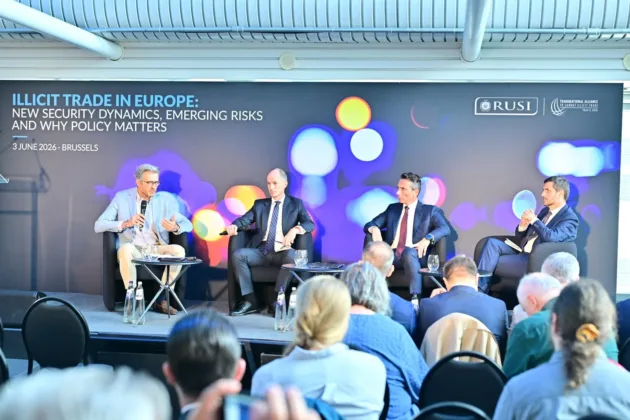
During an expert panel with frontline law enforcement figures, it was stressed that criminal groups are rapidly industrialising contraband supply chains.
Major Luigi Nacca, commander of the Italian Guardia di Finanza’s Central Service for Combating Organised Crime, warned that illicit operations offer “low risk and high reward”, pointing to uncovered criminal factories engineered to replicate authentic manufacturing sites.
Felix Schirner, of Germany’s BDZ Customs and Fiscal Union, noted that Germany has shifted from merely being a transit hub to a domestic production centre, lamenting that customs services lack the technical resources to match increasingly professional criminal outfits.
Kristýna Richter, representing the Czech Republic’s Nefejkuj anti-counterfeit project, highlighted that current track-and-trace regimes fail to identify illicit networks because they monitor only legitimate operators, leaving black-market supply lines untouched.
Speaking on the sidelines of the briefing with Brussels Signal, Fred Monteiro, BAT’s Regional Director for the Americas and Europe, criticised the European Commission for sidelining industry dialogue ahead of the forthcoming revision of the Tobacco Products Directive (TPD) and the Tobacco Excise Directive.
“Dialogue is part of life,” Monteiro said. “If one particular regulator is avoiding dialogue or basically stepping out of the opportunity to have a conversation with the private sector, that’s unfortunate and that is a disservice to the population.”
Monteiro rejected suggestions that the tobacco industry had manufactured its own black market problem: “Any black market for any sector is an anomaly that should be ideally eliminated. We did not create the e-cigarette market… The problem is that this market has been unfortunately disturbed by a number of smaller operators, mostly coming from places like China, Paraguay, Russia, Belarus, and some places in the Middle East. They come to market with products of horrible quality, pay no tax, and are not compliant with EU standards.”
Monteiro warned that EU policymakers face an acute fork in the road: “Law enforcement cannot handle this alone. If the EU goes down a pathway of trying to ban and restrict and increase taxes and basically try to suffocate these categories, it is going to backfire. They are going to hand over Europe to criminals”.
“European regulators have a choice now in their hands between a dark future with organised gangs or a bright future with law abiding companies, and I hope they make the right choice.”