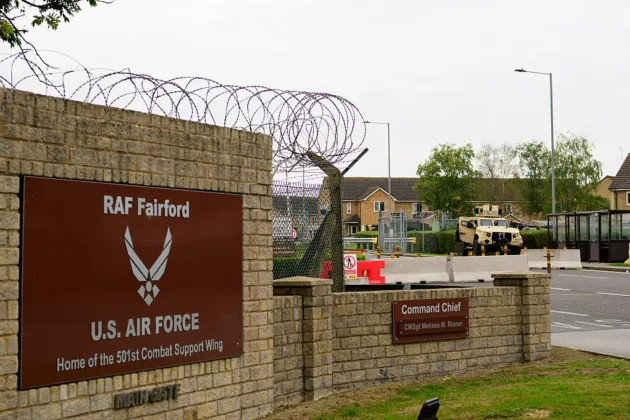







The British Government has insisted that RAF Fairford remains secure after the United States withdrew its entire bomber force from the Gloucestershire base, a week after a series of arrests near the perimeter.
Asked on October 5 whether the base was safe, the Prime Minister’s official spokesman replied: “Yes.” He declined to discuss what he described as foreign nations’ military operations.
The spokesman pointed to earlier remarks by Defence Secretary Wes Streeting, who said Britain had “tried and tested approaches to defend our bases”. A defence minister said separately that the Ministry of Defence remained comfortable with security at the site.
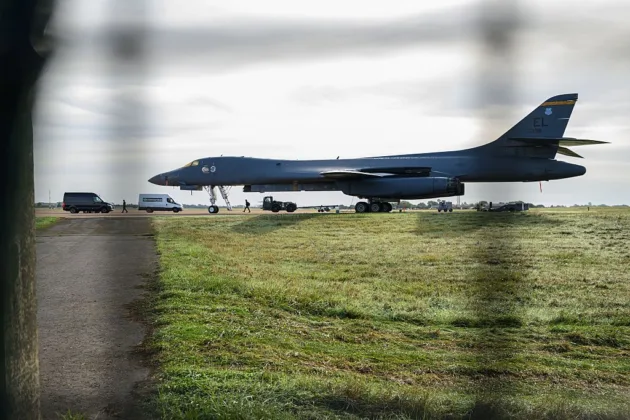
The 12 B-1B Lancers stationed at Fairford flew home on October 4, the Pentagon confirmed, in a withdrawal that emptied Britain’s only mainland base cleared for the Iran campaign. Six B-52s had already crossed the Atlantic in late September.
Washington’s explanations have not matched. US Secretary of State Marco Rubio said the American defence department constantly reallocated resources and that rotations were routine, adding: “I wouldn’t directly tie that to the move that was made.”
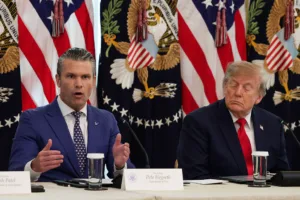
US President Donald Trump told reporters that threats had prompted the decision and that those behind them would be linked to Iran. US Vice President JD Vance said the aircraft had been pulled out of an abundance of caution.
ITV News reported that American commanders had been concerned about the possibility of a drone attack on the base. Counter-terrorism officers found no explosive device in the three vans stopped near Fairford on September 27, though a quantity of petrol was recovered.
Five British men in their twenties were arrested that day and a sixth, a British-Iranian dual national, on October 1. All six have been released on bail and none has been charged.
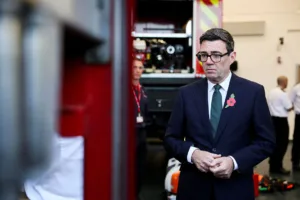
Prime Minister Andy Burnham said on September 30 that there were “strong indications that Iran played a part” in the incident. Tehran rejected the accusation and summoned the British ambassador over the claim.
The episode has hardened European assessments of Iranian activity on the continent, after months in which Brussels and national capitals weighed the risk of strikes on American and British targets in Europe. Iran’s Revolutionary Guards warned in July that any base used against Iranian territory would be a legitimate target.
For European governments the sequence carries an uncomfortable lesson: Washington can move its aircraft beyond the reach of a threat, while the host country keeps the base, the risk and the investigation.