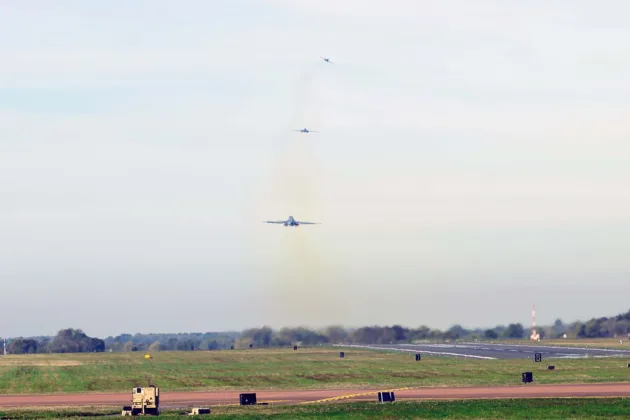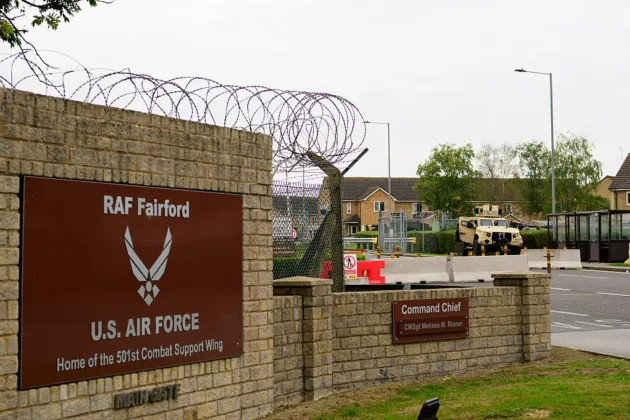


The United States has pulled all its B-1 bombers out of RAF Fairford, the Gloucestershire airbase used to strike Iran and now at the centre of a British counter-terrorism investigation.
A Pentagon official confirmed the move on October 4, saying the bombers deployed to Fairford had returned to their home stations in the United States. It added that operational security had prevented Washington from confirming the movement in real time.
US European Command said the aircraft were going home but declined to discuss threat information. British media reported that about a dozen B-1B Lancers had left, with at least three reaching South Dakota by October 4, and six B-52s had already crossed the Atlantic in late September.
The withdrawal follows a security alert early on September 27. A farmer in the village of Whelford, roughly a mile from the perimeter, called police after seeing three vans blocking a road and masked men running away.
Police declared a major incident and evacuated homes nearby. Five British men in their mid-twenties were arrested on suspicion of offences under the Explosives Act and released on police bail the following day, although counter-terrorism law allowed officers to hold them for 14 days.
Investigators later said no explosive device had been recovered from the vehicles, though a quantity of petrol was found. A sixth suspect, a British-Iranian dual national aged 27, was arrested in London on October 1 and none of those detained has been charged.
Burnham told the BBC on September 30 that there were “strong indications that Iran played a part” in the incident. It was the first time a British official had publicly linked Tehran to the case.
Iran’s embassy in London rejected and condemned the suggestion, and Foreign Minister Abbas Araghchi accused Burnham of levelling a false charge. Counter-terrorism police have said only that they are examining possible foreign state involvement.
Washington’s irritation has been aimed less at Tehran than at the bail decision. US President Donald Trump told reporters “I wouldn’t have done that”, while Secretary of State Marco Rubio said on September 28 that a foreign actor was behind the plot.
Fairford is the only base on the British mainland cleared for the Iran campaign. Then prime minister Keir Starmer granted permission in March for specific defensive operations, reversing a refusal that had angered Trump.
The Islamic Revolutionary Guard Corps named the base in July, warning that any British facility used against Iranian territory would be a legitimate target. The conflict has also kept the Strait of Hormuz at the top of the European agenda, with oil prices rising as Trump dismissed the prospect of a deal with Tehran and eurozone inflation reaching a near three-year high in August.