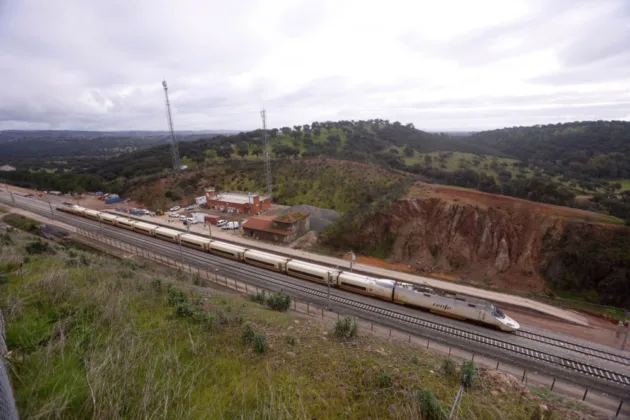
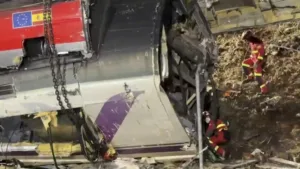





The deadly high-speed train collision at Urda, Toledo province, central Spain, has thrust Spain’s management of European recovery funds into the spotlight, as the European Commission confirms it is scrutinising whether Madrid has genuinely delivered on key rail modernisation pledges before releasing further cash.
The crash on October 28 killed 69 people and injured more than 200, according to provisional figures from Spain’s rail accident investigators.
The collision between a State-owned Renfe AVE and an Iryo convoy on the Madrid–Seville line occurred along a corridor where a multi-million-euro rollout of the state-of-the-art European Rail Traffic Management System (ERTMS Level 2) was supposed to replace the legacy German LZB system installed ahead of the 1992 Seville Expo.
Instead, at the moment of the crash, commercial traffic remained reliant on the ageing LZB apparatus. According to the investigators’ preliminary findings, that system had failed at 8.31am, some 22 minutes before the collision.
It was the second deadly crash on the line this year, after 46 people died near Adamuz, Córdoba province, on January 18.
The tragedy immediately ignited political controversy in Madrid following reports that the Spanish Government had informed Brussels of progress on the modernisation corridor while passenger services on the ground remained dependent on legacy equipment.
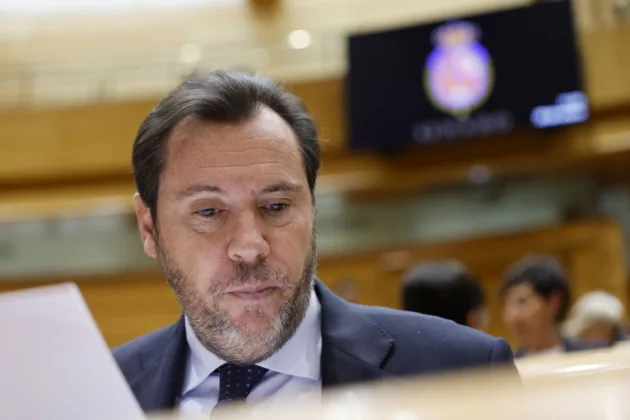
Spanish transport minister Óscar Puente rejected those claims today. “The European Union is not deceived, it is provided with certificates of completion of works,” he said.
Puente said the physical installation of ERTMS had been completed in June 2026 but that the system still needed testing and authorisation and would not be operational until early 2027. He has ruled out resigning, while the opposition People’s Party (PP) has demanded his departure ahead of his appearance in parliament on November 3.
In an official response to questions by Brussels Signal regarding the funding and verification of the corridor, the European Commission disclosed the exact mechanism under which EU recovery cash has been attached to Spain’s rail upgrades. It revealed that the funds earmarked for the actual completion of these works have not yet cleared Brussels’ assessment.
According to the Commission, rail safety and modernisation on the Madrid–Seville corridor are funded under Component 6 (“Sustainable Mobility”) of Spain’s Recovery and Resilience Plan, divided between policy reforms and capital infrastructure investments.
The EU executive drew a strict distinction between the administrative tendering of rail projects and their physical delivery.
Under Target 85, Spain qualified for and received European cash under its fourth payment request by proving it had legally awarded contracts or agreements for rail modernisation actions.
The Commission confirmed it gave a positive assessment to Target 85, meaning European funds were disbursed at the procurement stage, long before any new signalling entered commercial service.
That procurement phase dates back to October 2021, when rail infrastructure manager Adif Alta Velocidad awarded a €93.8 million contract to Thales España to install ERTMS Level 2 along the Madrid–Seville line. Thales said at the time that the contract was financed with EU funds.
The tender explicitly established an execution timeline of 52 months, setting an original delivery window that expired in February 2026.
To unlock financing for the execution phase under Milestone 87, Spain must certify that contracts covering 1,400 kilometres across core Trans-European Transport Network (TEN-T) corridors have actually been performed.
Reporting across Spanish media revealed, though, that Adif pushed through successive contract modifications and extensions as deadlines slipped, leaving commercial passenger services running on the legacy 1992-era system long after the planned rollout. Spanish newspaper El Mundo has reported that Adif agreed to keep the LZB in service in exchange for savings of €37 million.
The disclosure that the original 52-month schedule had already elapsed prior to the crash has intensified questions in Madrid over how projects funded under early recovery milestones were tracked once construction began to lag.
The Commission confirmed this milestone has not yet been approved, stating that it is currently assessing the satisfactory fulfilment of Milestone 87 as part of Spain’s seventh payment request. Madrid submitted that request, the last under the plan and worth €25.9 billion, on September 30.
The timing leaves the Spanish Government facing heightened regulatory scrutiny.
With the seventh payment request under review in Brussels, auditors and Commission task-force officials must determine whether Spain’s certification of completed rail contracts reflects true operational safety or mere administrative milestones.
The Commission’s disclosure also brings to light the flexible design of Spain’s Recovery Plan, which may allow authorities to sidestep delays on the Madrid–Seville line while still claiming recovery billions.
Under the agreed terms of the investment package, Spain was granted a broad choice of actions to reach its targets, ranging from track bed renewals and track electrification to fixed and mobile telecommunications or signalling.
Furthermore, the Commission noted that Spain could choose in which corridors, out of TEN-T corridors, the actions could be implemented.
Because Milestone 87 only requires Spain to show 1,400 cumulative kilometres of completed contracts across any qualifying TEN-T corridor, the government could theoretically meet its European target and receive its full disbursement without Madrid–Seville’s ERTMS Level 2 ever carrying a commercial passenger train, provided other rail projects make up the required distance.
The Commission’s formal reply did not address whether EU auditors define a rail signalling contract as performed when tracks are handed over on paper, or only when national and European railway safety bodies, such as the State Railway Safety Agency (AESF) and the European Union Agency for Railways (ERA), grant technical authorisation for revenue service.
The Commission did not comment on whether it plans an ex-post inquiry into whether premature documentation was submitted prior to the Urda accident, confining its comments to noting that its assessment of Spain’s seventh payment request remains ongoing.