


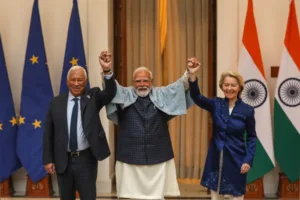



India has been reshaping its trade relations with Europe amid mounting international turmoil.
As Switzerland, Norway, Iceland and Liechtenstein mark the first anniversary of their free trade agreement with New Delhi, the European Union has completed negotiations on its own deal and is moving towards ratification.
Both developments reflect Europe’s growing interest in accessing the Indian market and in expanding its international economic relationships as the global order is reshaped. The agreement with the European Free Trade Association (EFTA), which entered into force on October 1, 2025, though, still faces practical difficulties in turning commitments on paper into reality, particularly in translating greater trade openness into investment and industrial activity.
The central ambition is substantial: $100 billion (€89.8 billion) in additional investment in India over 15 years and the creation of one million direct jobs.
On October 7, during the second India-EFTA Prosperity Summit in New Delhi, both sides announced new business projects and reviewed progress under the agreement. Swiss President Guy Parmelin said that 53 companies from his country had investment plans across 20 economic sectors.
Norway, meanwhile, highlighted the presence of around 160 Norwegian companies operating in India. The governments also identified opportunities in advanced manufacturing, medical technologies, maritime transport and energy.
These announcements, though, do not yet provide a complete picture of the results. The official documentation marking the agreement’s first anniversary does not include a consolidated figure for new investment actually disbursed or jobs directly attributable to the deal. Indian government data cited by Business Standard put the increase in Swiss investment in the country at $202 million (€181 million) between September 2025 and March 2026.
Meanwhile, the European Union, which is not part of EFTA, is pursuing its own strategy.
On January 27, 2026, the European Commission and Indian Prime Minister Narendra Modi’s government concluded negotiations on a much broader trade agreement. On September 11, Brussels submitted the text to the Council of the European Union to move towards its signature and approval. The agreement still needs to complete the EU’s institutional procedures, including the consent of the European Parliament, and India’s ratification process before entering into force.
The economic figures explain the interest.
According to Eurostat data published by the Council of the EU, merchandise trade between India and the EU-27 reached €118 billion in 2025. Europe imported €69.5 billion worth of Indian goods and exported €48.9 billion, resulting in a trade deficit of €20.6 billion. That made the EU India’s second-largest trading partner in goods, behind the United States and ahead of China.
In addition, the stock of European direct investment in India stood at €132.8 billion in 2024, with more than 6,000 European companies established in the country directly providing around three million jobs.
The agreement negotiated with Brussels provides for tariff reductions or eliminations covering 96.6 per cent of European goods exports to India, according to the Commission. It estimates that it could save European exporters around €4 billion annually in customs duties once fully implemented. Amid the ongoing tariff battle between Washington and Beijing, this is welcome news.
But realpolitik is stubborn and the two negotiations have followed different timelines. Talks between India and the EU resumed in 2022, before the EFTA agreement was signed. There is insufficient evidence to present Brussels’ rapprochement with New Delhi as a direct response to the deal reached by the four European countries.
The trade figures between India and EFTA reveal a deeply unbalanced relationship. During the 2025-26 financial year, which ran from April 2025 to March 2026, trade reached approximately $26.7 billion (€24 billion), with Indian exports amounting to $1.8 billion (€1.6 billion) compared with imports of nearly $24.9 billion (€22.4 billion).
Gold imported from Switzerland accounts for a substantial share of this difference, meaning the deficit cannot automatically be attributed to the new agreement.
Tariff liberalisation does not eliminate regulatory obstacles either.
On July 21, during India’s eighth trade policy review at the World Trade Organization, the EU itself raised concerns over unpredictable customs procedures, complex sanitary requirements, intellectual property issues and increasing restrictions on public procurement.
Brussels also questioned certification requirements linked to certain Indian national standards, warning of “an ever-expanding number of Quality Control Orders” that risked insulating the Indian market from the world economy.
These difficulties also affect the implementation of the EFTA agreement. Although it grants preferential treatment to 99.6 per cent of the value of Indian exports to its members, smaller companies must still meet technical, documentation and quality requirements to benefit from it. The obstacle is technical and should not pose a problem in the longer term.
The investment chapter is the agreement’s most distinctive feature.
EFTA countries are required to promote an increase of $50 billion (€44.9 billion) in direct investment over the first ten years, followed by another $50 billion over the subsequent five years.
Chapter 7 of the agreement, though, establishes obligations to promote investment, not a guarantee that private companies will actually commit those amounts. India could review certain trade concessions if the targets are ultimately not met and the consultation mechanisms provided for under the agreement have been exhausted. The first formal review of progress is due within five years of entry into force and any suspension of concessions would have to be proportionate and temporary.
The agreement has allowed the four EFTA countries to move ahead of the EU in implementing preferential trade arrangements with India. Brussels has a much larger economic relationship with New Delhi, although its new agreement has yet to enter into force.
Despite the challenges, the direction of travel is encouraging. European companies are showing growing interest in India, new investment opportunities are emerging and both sides have strong incentives to deepen their economic cooperation.
The coming years will determine how quickly these opportunities translate into tangible results. But with the EFTA agreement already in operation and a broader EU-India deal moving closer to implementation, India and Europe are laying the foundations for a more ambitious economic partnership, one that could strengthen industrial cooperation, encourage technological exchange and create new opportunities for businesses on both sides.