






A key witness cited by Mediapart in its investigation of Rassemblement National (RN) president Jordan Bardella has said the outlet manipulated him, distorted some of his remarks and invented others.
Laurent G., a former official of the Front National de la Jeunesse (FNJ) in Seine-Saint-Denis, north of Paris, spoke on October 5 to Éric Morillot on Les Incorrectibles, on condition of anonymity.
Clips were first shown on CNews. Asked at the end of the interview whether he had been manipulated, he replied: “Yes, I was manipulated by Mediapart, which distorted my remarks.”
He said he had decided to speak for three reasons: To state publicly that his words had been distorted and to explain why; to rebut rumours that he was trying to destabilise the Rassemblement National’s campaign, which he called “totally false”; and to say that he bore no ill will towards Bardella or Marine Le Pen and supported both in the campaign now under way.
Laurent G. said he met Bardella at the end of 2013, when he himself no longer held any responsibility in the Front National (FN), although he still attended events at the Seine-Saint-Denis federation, including the party’s youth forum.
Bardella, he said, was at the start of his militant career; his own was over.
They crossed paths “perhaps four or five times”. The relationship was “courteous” and militant, not personal.
“We were not close, even if I have esteem for him, and we are not friends.”
He said they never spoke by telephone, that he did not think he had ever had Bardella’s number, and that Bardella never replied to his emails.
The sharpest dispute concerns Eustace Mullins’ book The Secrets of the Federal Reserve.
Mediapart reported that Laurent G. had described the book as Bardella’s “bedside book”.
He told Morillot: “I never said to Mediapart that Mr Jordan Bardella had [that book] as a bedside book. I never said it.”
Pressed, he called the phrase not a distortion but “invented remarks”.
What he said he had told the journalist was that Bardella had made a good impression — well turned-out, energetic, with “great intellectual curiosity” and already solid knowledge — and that, over pizza after a youth-forum evening, there had been a brief discussion of the book, a publishing success in patriotic circles two or three years earlier.
Bardella, he said, merely knew the contents. He had mentioned it to illustrate curiosity, not devotion.
He also rejected a passage in which Mediapart quoted him as recalling that Bardella “took an interest in the theories about the possible survival of Adolf Hitler after the Second World War”.
He said he had not said that.
The exchange, again at the pizza dinner, concerned a single item Bardella had seen online, presented as drawn from declassified FBI documents and raising the possibility that Hitler had fled to South America.
Laurent G. said he had replied that he did not really believe it, and that it was “a reaction of intellectual curiosity to one plausible piece of information”, not an interest in such theories in general.
“Mr Bardella never told me that he admired Adolf Hitler, at any moment, and it is not something I sensed either.”
He accused Mediapart of trying to suggest a neo-Nazi fascination.
A third point concerns an email of February 8, 2014, which he sent to Bardella and another activist with a digital copy of Dialogues désaccordés, the book of interviews between the controversial intellectual Alain Soral and Éric Naulleau, writing that he no longer remembered which of the two had asked for it.
He confirmed he was the sender. The context, he said, was a Wednesday youth forum: A talk, then pizza, and a conversation about a book that had just appeared. He had access to a large stock of texts in PDF and other formats.
He added that he did not believe he had spoken to Mediapart about this email at all.
He said the other recipient, Maxence B., replied in substance “it’s me, thank you”, and that Bardella did not reply. That, he said, showed the request had not come from Bardella.
Mediapart, he went on, published the first message, which already left the question open, but “concealed” the reply.
“There is dishonesty on their part… with the aim, of course, of splashing and smearing Mr Bardella by making him out to be an admirer of Soral.”
Asked whether the outlet had the reply and had deliberately left it out, he said: “Very certainly.”
The emails Mediapart presents as radical reading advice were, he said, nothing of the sort.
He described them as material he made available, to Bardella and to others, “so that people would have access to the information, supposing it interested them”.
There was, he said, no acknowledgement and no proof of interest, either from Bardella or from members of his present circle whom Mediapart “tries to implicate”.
On the interview itself, he said he had two missed calls and rang back about ten days before the October 5 broadcast, on a Friday.
The journalist who answered gave his name as Alexandre Berteau, who signed the investigation with his colleague Antton Rouget.
Laurent G. said his first reflex was that Mediapart “doesn’t much like the FN”, but that he was not cautious enough.
The object of the call was not stated.
He thought the questions concerned the old Seine-Saint-Denis federation; only later did the conversation turn to Bardella.
Laurent G. said he had not suspected, at the time, an intention aimed at the RN president.
He is now “intimately convinced that the intention was malicious from the start”, and called the publication “malice in its pure state”.
He linked the timing to the day after the senatorial elections, which he said obscured RN gains, and to October, when the party is due to elect its president at congress.
That vote was held on September 27. The RN and its UDR allies took enough seats to form a group in the Senate for the first time, and the party congress is set for Orléans on October 24-25, with Bardella the only declared candidate for the presidency.
Mediapart had made him a central witness, he argued, “quite simply because their file is empty”.
Asked whether he had ever witnessed anti-Semitic remarks by Bardella, he said that on the occasions he had been with him he had never heard any, “nor even had any reported, at any moment”.
He referred to the account given by Kelly Betesh, Bardella’s girlfriend at the time and a Jewish woman, and to what he called Bardella’s repeated public condemnations of anti-Semitism. “My mind is made up: Mr Bardella is not at all anti-Semitic.”
The testimony does not by itself address the private messages Mediapart attributes to Bardella. The site’s report of September 28 quoted lines including “All the banks are owned by Jews” and “The Jew must dominate other peoples, crush them and rob them”, dated to 2013, when Bardella was 17.
On October 1 Mediapart published what it called proof: Screenshots, a Meta download of a Messenger thread requested on August 16, and a bailiff’s certificate of September 29.
Bardella has called the texts “crude forgeries”, filed a defamation complaint, and said he would also complain of forgery and use of forged documents. He has cast the publication as an attempt to damage his party before the 2027 presidential election, and Marine Le Pen has dismissed the allegations as fabrications.
The New York Times was shown some of the material but said it could not independently confirm the messages. As of October 6, Mediapart had not issued a specific reply to Laurent G.’s interview.
Fabrice Arfi, co-head of the outlet’s investigations desk, told France Info on September 28 that Mediapart was sure of what it had published and had the means to demonstrate it, adding that it was ready to make documents public and to cooperate with the courts.
Bardella’s ex-girlfriend Betesh wrote on X on the evening of September 29 that she had been with Bardella for two years “precisely during the period in question” and had “never heard him make a single anti-Semitic remark”.
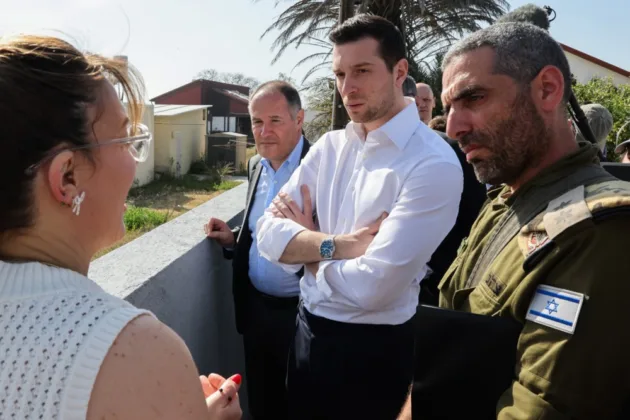
The same day Amichai Chikli, Israel’s minister for diaspora affairs and combating anti-Semitism, defended Bardella on X as “one of the clearest voices in Europe against Hamas”, citing his March 2025 visit to the Nova festival site and a speech against anti-Semitism in Jerusalem. No court has yet ruled on authorship.