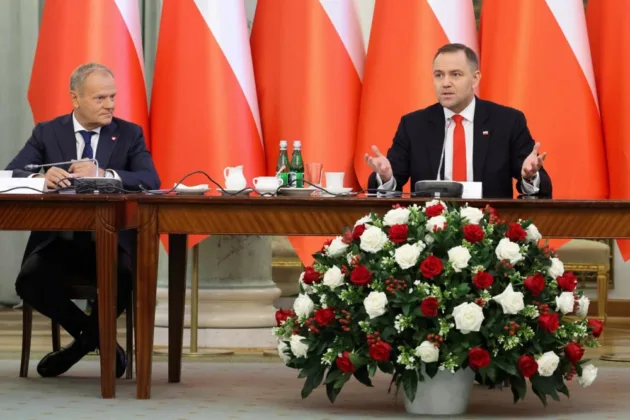







Poland’s President Karol Nawrocki has signed legislation backed by the centre-left government led by Prime Minister Donald Tusk to impose a windfall tax on fuel companies in order to lower fuel prices.
Nawrocki did so despite the fact that he had blocked an earlier version of that legislation on the grounds that it was unconstitutional because it was retroactive and despite pressure from the Confederation party, part of the right-wing opposition that supports him, to stand firm and refuse to sign the bill.
The law applies a tax to any extraordinary profits earned from the sale of liquid fuels between March 1 and December 31. Companies pay on revenue above a reference margin set at their average 2025 sales margin plus 20 per cent.
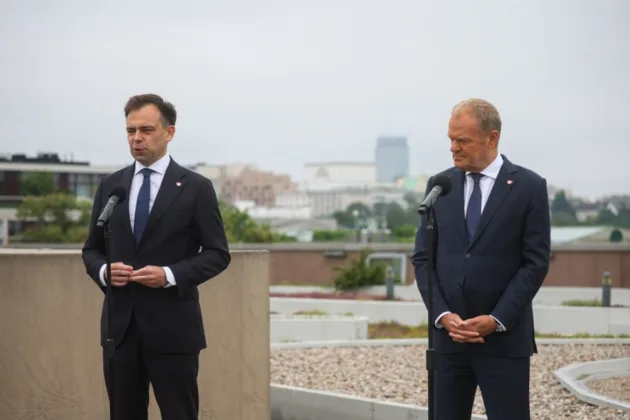
When originally announcing the plans for the windfall tax the finance ministry under Andrzej Domański said the levy was justified by this year’s “exceptional economic and geopolitical conditions that have led to above-average financial results in a specific segment of the fuel sector, not resulting from improved operational efficiency, but from a supply shock”.
Nawrocki’s chancellery had until the end of September argued that fuel companies would pass the costs of the tax on to consumers, therefore actually increasing prices.
The head of state announced his decision in a televised address to the nation on October 1 in which the President said he was allowing the legislation through in order to hold the government’s feet to the fire over PM Tusk’s promise he would use the proceeds from the tax to lower fuel prices at the pump.
Nawrocki declared that he was seeking to call the government’s bluff over fuel prices. He claimed that they were actually hoping the windfall tax would fail so that the treasury could continue obtaining normal tax revenue from high fuel prices, as well as dividends from state oil giant Orlen.
By signing the bill, the President said he was “ending the process of holding Poles hostage” and now expected the government to “immediately” reintroduce measures to bring down prices at petrol stations, as well as the cost of fuel for farmers.
But he made clear that he was not withdrawing his doubts over the constitutionality of the measure and that he would be submitting it to the Constitutional Court, the composition of which is not recognised by the government, which refuses to publish that court’s rulings, which means that even if the court rules against the law it will continue to be in force.
“As autumn begins, a question is emerging in Polish homes. Will we manage? Will we be able to pay all the bills? Will we be able to afford to fill up the car?” Nawrocki said in his address.
“The state cannot answer these questions with another political row, because that will never make fuel cheaper and it will not make a single bill lower,” he added.
Nawrocki said that every penny raised through the levy should go towards cutting prices and demanded that reductions at filling stations take effect immediately and criticised the Tusk government for having been slow to reduce fuel costs during the current crisis.
“Price cuts at gas stations should happen immediately,” Nawrocki said, adding that they should bring prices down to the level of around 5.19 złoty (€1.19) promised by Prime Minister Donald Tusk during the parliamentary election campaign in 2023.
Nawrocki also urged parliament to take up his own fuel-price proposal, which would allow fuel-company margins to be temporarily capped and exempt fuel sales from retail sales tax. He also called for increased fuel reimbursements for farmers.
The Tusk-supporting majority and the Speaker of the Sejm are likely to shelve that proposal, though, as they have with most other pieces of legislation proposed by the present head of state.
Poland, like the rest of Europe, is grappling with soaring fuel costs amid turmoil on the global energy markets after the present conflict in the Middle East, now in its seventh month, caused major disruption to oil supplies.
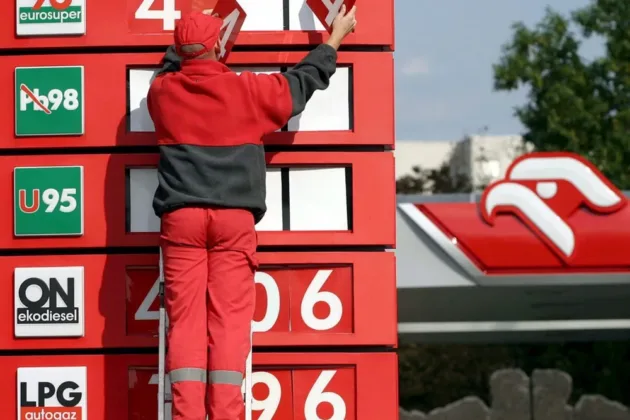
The latest nationwide survey by Polish fuel-market analysis service e-petrol, published on September 30, put the average price of 95-octane petrol at 8.19 złoty (€1.87) per litre and diesel at 9.14 złoty (€2.09), both all-time highs.
The surge in prices followed the expiry on August 31 of the latest government measures aimed at cushioning motorists from rising fuel prices which included a temporary cut in VAT on fuel from 23 per cent to 8 per cent.
The government-backed legislation, passed by parliament in September, imposes a 60 per cent tax on profits fuel companies make above a threshold based on their normal margins, with the government expecting to raise about 4 billion złoty (€914 million) to help finance lower prices. Orlen has put its own liability for March to August alone at 2 billion złoty (€457 million).
The President blocked an earlier version of the bill in July by sending it to the Constitutional Court for preventive review instead of signing it, arguing that taxing earnings generated before the legislation took effect would amount to retrospective taxation. Without his signature the law could not be activated.
That government tax proposal in the spring was intended to offset some of the more than 5 billion złoty (€1.19 billion) the government spent on keeping prices lower for consumers amid the crisis in the Middle East by cutting VAT and excise duty and introducing a maximum daily price. Those measures were initially in place from March to June.
The dispute was part of a wider stand-off between Tusk’s coalition and Nawrocki, who took office on August 6, 2025 with the backing of the right-wing opposition Law and Justice (PiS) party.
Nawrocki has repeatedly blocked government legislation and has already vetoed more bills than his right-wing predecessor Andrzej Duda did during his 10 years as president. Duda used the veto 19 times between 2015 and 2025, a total Nawrocki passed within five months of his inauguration.
Nawrocki has seen his approval rating fall in recent surveys which, commentators believe, may explain his change of mind over the fuel levy. A Pollster poll for Super Express taken on September 21-22 put positive assessments of the President at 44 per cent against 39 per cent negative, a three-point drop on August.
The fact that this time round Nawrocki backed down to the government is viewed as a triumph by Tusk and his allies claiming that they had forced him into a humiliating climbdown for fear of being blamed for fuel price rises. They insisted that it showed that “pressure works”.
Tusk’s administration moved speedily on October 3 to lower VAT and excise duty on fuel and reintroduced a cap on price levels. Under the programme, branded Ceny Paliwa Niżej (Fuel Prices Lower), maximum prices were set at 6.73 złoty (€1.54) a litre for 95-octane petrol and 7.88 złoty (€1.80) for diesel, with the finance ministry estimating the package would take about 1.20 złoty (27 cents) off a litre of petrol and 1.30 złoty (30 cents) off diesel. The VAT and excise reductions are due to run until the end of December.
The reaction to the President’s move was mixed on the opposition benches.
PiS leader Jarosław Kaczyński wrote on social media platform X that Tusk “no longer has an alibi” for refusing to lower fuel prices.
The libertarian-nationalist Confederation party criticised the President, though, with Confederation leader Sławomir Mentzen claiming that the windfall tax was unconstitutional and accusing Nawrocki of giving in to “Tusk’s propaganda”.
Stanisław Tyszka MEP, who sits with the Europe of Sovereign Nations (ESN) grouping in the European Parliament, said that Nawrocki had broken his election pledge given to Confederation before the run-off second round of the presidential election in June 2025 that saw him supported by all parties of the Right.
The dispute over the financing of fuel price reductions comes at a time when Polish public finances are under increasing pressure with the country running one of the highest deficits in the EU and being placed under the EU’s excessive deficit procedure. The finance ministry expects the general government deficit to reach 6.8 per cent of GDP this year.
The country’s public debt passed the EU’s limit of 60 per cent of GDP for the first time this year, reaching 64.5 per cent at the end of the second quarter, and on September 18 Moody’s, one of the three global rating agencies, lowered Poland’s rating from A2 to A3 because of the deteriorating fiscal situation and the lack of willingness or ability of the authorities to take the necessary action. The outlook was set at stable and the cut left all three main agencies rating Poland at the same level.
Poland will hold a parliamentary election in the autumn of 2027 in which the Tusk government will face a challenge from the four parties of the political Right who support President Nawrocki. Until those elections are over there is little chance of any attempts to reduce public spending, especially at a time when the government is arguing that it needs to spend more on defence because of potential Russian aggression on NATO’s eastern flank.
Sources close to President Nawrocki are signalling that the head of state is behind the scenes engaging in talks with regard to the four parties of the Right fielding a joint slate for the second chamber, the Senate, which is elected in 100 single-member constituencies on a first-past-the-post basis. The Senate is merely a revising chamber, though, and it is the nominally lower chamber, the Sejm, which has the final say over the appointment of the government and also legislation, before it goes to the President for signature and which can overturn any presidential veto if it can reach a three-fifths supermajority.
Nawrocki would also like to see more cooperation between the parties of the Right ahead of the parliamentary elections but since the lower chamber is elected by proportional representation each of the four parties — PiS, Confederation and the radical nationalists from the Polish Crown party led by Grzegorz Braun MEP plus former PiS Prime Minister Mateusz Morawiecki’s breakaway Development + movement — only the danger of failing to clear the 5 per cent threshold is likely to persuade any of them to field joint slates with another.
In this respect Donald Tusk and his Civic Coalition are better placed because that party dominates the centre-left with polls showing that the other three parties that make up that ruling coalition — the Left Party, the centre-right Polish People’s Party and the centrist Poland 2050 party, which has disintegrated into two factions — are struggling to reach the electoral threshold and are therefore considering Tusk’s offer of them being on one single slate.
Nawrocki stood in the presidential election as a staunch opponent of the Tusk government and has continued that political direction while in office. This is why the parliamentary election in 2027 will be crucial for him, since he has made no secret of the fact that he wants to see constitutional reform that would give the head of state more powers.
Only a majority for the Right would enable him to continue moving in that direction. Another Tusk majority would put him even more on the defensive than he ended up being in the stand-off over the price of fuel, a skirmish which the Prime Minister seems to have won as it was the head of state who backed down.